


In contrast to the heated debate on the arms-procurement package, the government, which regards the bird flu epidemic as a threat to national security, has not hesitated to allocate NT$30 billion to purchase vaccines and other preventive measures. This budget was approved without causing any controversy. No one seems to have questioned this action. This is because certain interest groups have used the statements made by the World Health Organization (WHO) and foreign experts to convince the public.
Modern evidence-based medicine carries out medical procedures based on empirical studies and evidence. The experts' personal statements are among the least convincing evidence. This is especially true since 1980, when pharmaceutical companies began to spend large amounts of money to buy off university professors and experts in different medical fields to produce false results from clinical studies and to publicly disseminate distorted information to promote products. Thus, it is important for the public to be able to discern whether the various reports are reliable.
First, we should question the story about the 1918-1919 influenza pandemic, also called the Spanish influenza pandemic (H1N1), which is believed to have resulted in the death of 20 million to 50 million people around the world. The pandemic period also saw World War I, which brought the turmoil and chaos of war, plague, population reduction and other causes of mortality.
Therefore, the casualties in this particular period should not be blamed solely on the Spanish flu. Besides, the lack of medical technology, the inconvenience of transportation, the limitated access to information, the lack of household registration systems, and other constraints make one ask: How could global figures be obtained? We would like to know how the mortality figures were arrived at, how information was gathered and what statistical methods were used.
Then, we want to question the accuracy of the predictions that more than 5 million people would be infected and at least 10 thousand people would die if a potential bird flu epidemic strikes Taiwan next March. The US Food and Drug Administration approved the use of Tamiflu (oseltamivir phosphate) to treat patients diagnosed with flu but without any other complications. In other words, Tamiflu has not been shown to prevent life-threatening conditions such as pneumonia. This is to say that Tamiflu cannot save the lives of people facing complications from pneumonia resulting from avian flu.
The WHO hasn't released any documents saying that Tamiflu is an effective treatment for avian flu, nor has it urged countries to purchase a sufficient amount of Tamiflu and store it for later use.
On Aug. 26, a journalist reported that Swiss drug maker Roche would donate 30 million capsules of the antiviral Tamiflu (oseltamivir) to the WHO. The donation is to help establish a first line of defense against the feared global bird flu pandemic. On Aug. 24, the WHO issued a news release, stressing that it would use this antiviral stockpile to respond quickly to an emerging global influenza pandemic, but didn't refer specifically to avian flu.
On Aug. 8, the US Center for Disease Control and Prevention (CDC) announced that drug makers including Aventis Pasteur and Chiron will each produce between 8,000 and 10,000 doses of the "experimental" vaccine for human tests. In Taiwan, what we have learned from the news report is that Aventis Pasteur has successfully developed a vaccine against avian influenza, and that the US government is beginning to purchase it in quantity.
The first documented infection of humans with an avian influenza virus occurred in Hong Kong in 1997. In 2003, drug makers including Pfizer, Johnson, AstraZeneca and Merck Sharp & Dohme invested US$7.1 billion, US$4.6 billion, US$3.4 billion and US$3.1 billion respectively in their research and development. However, they have yet to produce an avian influenza vaccine. Nor is any one of them able to develop a vaccine against AIDS after 20 years of research. And even though vaccines for regular influenza are now available, tens of thousands of people in the US die every year from pneumonia resulting from influenza.
The pharmaceutical organizations of each nation have yet to find the clinical tests of Tamiflu acceptable and prove that Tamiflu can effectively treat avian flu, for as yet it has not even reduced the incidence of complications nor the mortality rate. If human infection from avian flu becomes prevalent, early diagnosis and sufficient respirators that can support the patients suffering from pneumonia will help the patients recover and reduce the mortality rate.
In view of this, to cope with such a disease, the British government has sent pamphlets to doctors with information on how to differentiate between different cases of avian influenza and control the outbreak of such a disease.
In the US, the CDC has adopted a number of preventative measures, including training lab technicians in the use of molecular technologies to identify the H5 virus and working with local epidemiologists to formulate a response to major epidemics. It has also initiated cooperation with the Department of Defense and Veterans Affairs to organize the stockpiling of vaccines.
The US is also cooperating with the WHO and the Ministry of Health in Vietnam to research the H5N1 flu strain that has appeared there, and is helping to conduct tests and train personnel for the testing of the virus. It has also earmarked US$5.5 million for the monitoring of flu in Asia.
The US is helping to raise the standard of local staff in the investigation and testing of the H5 virus, and also the development and supply of test drugs. It is also working together with the WHO and local health centers to develop vaccinese against bird flu and other types of flu.
Zanamivir, manufactured by GlaxoSmithKline, is a medication similar to Roche's Tamiflu, but it was not widely promoted so it was neglected in favor of Tamiflu, which the government bought in great volume despite evidence it was ineffective against avian flu. This was done in violation of the Government Procurement Act and the Pharmaceutical Act, and goes against medical principles.
Take note that Taiwan's resources are limited, and the budget for avian flu should be used to raise the diagnostic standard of Taiwan's doctors and to improve the treatment for pneumonia, rather than spending on developing new vaccines that have no guarantee of success. And instead of purchasing Tamiflu, the money would be better spent on developing new kinds of respirators.
Marcus Reidenberg, a professor of pharmacology at Cornell University, has written that in the past, when science and clinical pharmacology were not well developed, doctors would often use, with the best possible intentions, treatments that were harmful to patients or for which the dangers greatly exceeded efficacy. This was because the means were not available to test the safety and effectiveness of the treatment, and they can be forgiven because they acted with the highest motives.
Means for the testing of pharmaceuticals is now available, and if such mistakes are made again, doctors should no longer benefit from the public's forgiveness, however high their motives may be.
Hsieh Yen-yao is the vice president of the Koo Foundation's Sun Yat-sen Cancer Foundation.
Translated by Lin Ya-ti, Daniel Cheng and Ian Bartholomew
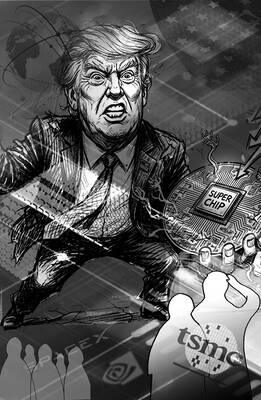
The White House’s decision to take a 9.9 percent stake in Intel Corp is looking like very shrewd business indeed. Since the government bought in at US$20.47 a share last August, the US chipmaker’s surging stock price has delivered the US a US$43 billion return. One of the reasons the investment has so far proved so sound is that the White House has made sure of it. According to The Wall Street Journal, Howard personally pushed deals on Intel’s behalf with some of the most lucrative clients imaginable. They include Nvidia Corp, the company at the heart of the AI
The Ministry of the Interior, working with the navy and coast guard, is organizing Taiwan’s first joint exercise simulating escort tankers carrying liquefied natural gas (LNG) and oil through a Chinese blockade. The drills simulate fuel transport along three maritime corridors leading toward Japan, the Philippines and the US. Deputy Minister of the Interior Sawyer Mars (馬士元) said that a blockade of the Taiwan Strait would amount to “almost a 100 percent blockade of the regional energy supply.” Minister of National Defense Wellington Koo said planning to counter a blockade is standard practice in Taipei. While the exercise is limited in
A single photograph can cut through a lot of noise, but it can also be used to misrepresent the truth. At the very least, it can concentrate the mind on something that requires further investigation. On Monday last week, Ma Ying-jeou Foundation CEO Tai Hsia-ling (戴遐齡) and former National Security Council secretary-general King Pu-tsung (金溥聰) held a news conference in which they showed a photograph of former foundation CEO Hsiao Hsu-tsen (蕭旭岑), now Chinese Nationalist Party (KMT) deputy chairman. In the image Hsiao is seated next to Xiamen Taiwan Businessmen Association chairman Han Ying-huan (韓螢煥). The two men were holding
I first met Professor Ray Jiing (井迎瑞) as a film and documentary student at Shih Hsin University’s (SHU) Department of Radio Television and Film in 1988. The following year, he went on to become the director of the Chinese Taipei Film Archive — forerunner of the Taiwan Film and Audiovisual Institute (TFAI). Over his eight-year tenure, Jiing rescued and restored over 200 classic Taiwanese films. In 1997, he established the Graduate Institute of Studies in Documentary and Film Archiving at Tainan National University of the Arts (TNNUA), and I joined the program in his third cohort of students. Beyond a


 RSS
RSS