


While much of the media in Taiwan is already focusing on likely candidates for president three years hence, the two main parties have yet to establish their platforms for the forthcoming campaign.
The two countries most important to Taiwan, China and the US, may want to involve themselves in the next presidential election -- both in terms of developing platforms and the choice of candidates -- much earlier than they have done in the past. They should write their plans in pencil, not ink. The complexities and uncertainties found in Taiwan today are likely to continue right up to election day.
Voters complain that the government has not provided reforms in the everyday issues that most concern them. The opposition meanwhile, by virtue of their control of the legislature, are deliberately blocking bills for political purposes. Faced with this, the electorate is tired and disappointed in politics. With national identity likely to be the major issue in the 2008 election, that attitude could bring disaster to the democracy they take for granted.
At this point, the two political parties face opposite problems. The Chinese Nationalist Party (KMT) has a more certain candidate, but an incomplete platform. The Democratic Progressive Party (DPP) is less sure of who it will nominate, but has a platform that will likely need only a few changes. Additionally, both parties face two other elections before the presidential poll -- local elections this year and legislative elections in 2007. The issues in these polls will focus more on domestic concerns and the candidates themselves, unlike the presidential campaign, which will focus more on national concerns, security and cross-strait matters.
The DPP is now in its sixth year in government, and despite it's minority in the legislature, it has had some successes. The participation of different ethnicities in the body politic has clearly improved. So has government transparency. And there is far more recognition of national identity, both at home and abroad.
There have been some improvements in transforming the bureaucracy into national, not party, institutions and reducing corruption in business and government generally. There has been an effort to establish ceilings on the wealth of political parties and to improve the government's public relations.
At the same time, however, the DPP has had little success in two important areas -- with grassroots voters in local elections and attaining a majority in the legislative elections.
In this, the KMT has been successful, retaining the "ward boss" system that has often given it a majority in local elections -- and the "localized" legislators in the party, despite their more liberal ideology. The party doubtless also believes it has been successful in retaining support for its ideological position, but it has done so by forming its own relationship with China, and using its majority in the legislature to block governance almost completely.
The present belief is that Taipei Mayor Ma Ying-jeou (馬英九) is almost certain to be the KMT's candidate for the presidential election in 2008. It is still unclear, however, to what degree he will be able to establish his own policies and objectives. In the last presidential election, the party's policies became flexible, and moved very close to those of the DPP. But statements made by the party's leaders during their visits to China this year indicate that its objective is to reinstate the "one China" policy of the past. Ma apparently accepts this, putting it in the phrase "no independence."
Measures to strengthen economic and cultural relations with China in a way that would assure an eventual unification are already part of KMT policy. This will probably tilt the upcoming presidential election to being another debate on Taiwan's identity.
Taiwan's political parties are already setting their sights on the 2007 legislative elections and the 2008 presidential poll. If observers in Washington and Beijing are looking, they will see an electorate that is tired of political wrangling, including many who are willing to risk economic dependence on China. But mostly, they will see voters who are not interested, and therefore not informed, about the politics that could fundamentally change their lifestyles and their children's futures.
In play between the two major political parties are many of the normal issues debated between parties in any democracy: social welfare, construction projects, limits on political funding, pensions, personnel and budgets. The continuous jostling for advantage on these issues is normal.
Unfortunately, Taiwan has one priority issue that overshadows all the others -- the lack of consensus on national identity.
There are three years before the next president is chosen. That is a long time in politics. Perhaps, during the debates that will go on leading up to the local and legislative elections, the government, the media, universities and schools, and even the politicians, can speak to the voters about the choices for Taiwan's statehood.
That is an enormous task, but a critical necessity. Voters see "status quo" as the answer -- thinking that staying neutral can last as long as they like. My last article tried to explain why this is illusory. The result would not be a choice, but eventual unification. Ambiguity dominates the language between Taiwan, the US and China. In addition, election campaigns tend to be dominated by unreliable rhetoric. With the lack of interest among so many voters, addressing this problem should be today's top priority.
Nat Bellocchi is a former chairman of the American Institute in Taiwan and is now a special adviser to the Liberty Times Group. The views expressed in this article are his own.
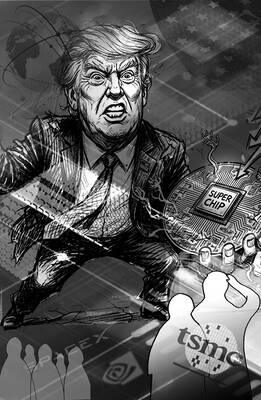
The White House’s decision to take a 9.9 percent stake in Intel Corp is looking like very shrewd business indeed. Since the government bought in at US$20.47 a share last August, the US chipmaker’s surging stock price has delivered the US a US$43 billion return. One of the reasons the investment has so far proved so sound is that the White House has made sure of it. According to The Wall Street Journal, Howard personally pushed deals on Intel’s behalf with some of the most lucrative clients imaginable. They include Nvidia Corp, the company at the heart of the AI
A single photograph can cut through a lot of noise, but it can also be used to misrepresent the truth. At the very least, it can concentrate the mind on something that requires further investigation. On Monday last week, Ma Ying-jeou Foundation CEO Tai Hsia-ling (戴遐齡) and former National Security Council secretary-general King Pu-tsung (金溥聰) held a news conference in which they showed a photograph of former foundation CEO Hsiao Hsu-tsen (蕭旭岑), now Chinese Nationalist Party (KMT) deputy chairman. In the image Hsiao is seated next to Xiamen Taiwan Businessmen Association chairman Han Ying-huan (韓螢煥). The two men were holding
I first met Professor Ray Jiing (井迎瑞) as a film and documentary student at Shih Hsin University’s (SHU) Department of Radio Television and Film in 1988. The following year, he went on to become the director of the Chinese Taipei Film Archive — forerunner of the Taiwan Film and Audiovisual Institute (TFAI). Over his eight-year tenure, Jiing rescued and restored over 200 classic Taiwanese films. In 1997, he established the Graduate Institute of Studies in Documentary and Film Archiving at Tainan National University of the Arts (TNNUA), and I joined the program in his third cohort of students. Beyond a
A recent report concerning a student who is suing his teacher posed the question in its headline: Does failing a student in two subjects constitute bullying? The college student in Chiayi County apparently sought NT$2 million (US$63,603) in state compensation, but a court dismissed the case. The first reaction of many might have been to ask: What has happened to students nowadays? Some say that teachers have lost their authority, while others say students are overindulged. Some even start reminiscing over the days when “whatever the teacher says goes.” However, the real issue might be overlooked if emotional reactions like that are the


 RSS
RSS