


Recently, a discouraging statistic showed that last year, South Korea's per capita GDP totaled US$14,098, while Taiwan's GDP per capita was only valued at US$13,529. Clearly, on the economic front, Taiwan is trailing behind East Asia's other "tigers": South Korea, Hong Kong and Singapore.
In the 1970s and 1980s, Taiwan fared much better than South Korea economically. In 1992, Taiwan's GDP per capita reached US$10,274, whereas South Korea was lagging behind at US$7,193. That is, in terms of GDP per capita, Taiwan outperformed South Korea in that particular year by US$3,081, or 30 percent. After 1992, South Korea started catching up with Taiwan and overtook us last year, after 12 years of hard work.
In this day and age, Taiwanese entrepreneurs are fond of the term "resource integration." They have even cautioned the government that Taiwan's resources should integrate with those of China in order to maintain the nation's competitive edge in the international market.
Academics and research groups have utilized all sorts of economic models to analyze how Taiwan can make use of China's resources and create a win-win situation for both sides, trumpeting the benefits people may acquire if they are daring enough to pour their capital into China. As a result, over the last 10 years, Taiwanese have been enthusiastic about investing in China.
If all these theories had proved correct, Taiwan should have fared far better than South Korea and other Asian countries economically, for the capital that Taiwan has poured into China is far greater than what Japan, the US and the rest of the world have offered to China. In fact, it has been 10 times greater than the amount invested by South Korea.
One has to wonder why reality is so different from the economic models and why China has come out on top while Taiwan's economy -- which actively makes use of China's resources -- is declining. Conversely, South Korea, which did not conduct a resource integration with China, has become a successful exporter and an international player.
Apparently, over the the past 10 years, Taiwan's advantage as an exporter has been on the wane. As Taiwanese industries have been too reliant on China's resources (cheap labor and land), the upgrading of Taiwan's industries has been delayed.
Fortunately, in 1996, former president Lee Teng-hui (
The excessive amount of investment poured into China (as we have pointed out above, no other country in the world has invested as much capital there as Taiwan, with the figure sitting at over US$200 billion, compared to less than US$20 billion from South Korea) has depleted domestic capital, reduced demand for labor, pushed up unemployment, and reduced domestic consumption.
It is obvious, given the circumstances, that economic growth rates would suffer and peoples' incomes would stagnate. These are the main factors behind the fact that annual GDP per capita has only increased, on average, by US$271 every year from 1992, when it stood at US$10,274, to US$13,529 twelve years later. One also notes that the average annual increase for South Korea was US$525, more than twice that of Taiwan.
In the last few days the Taiwanese company Rechi Precision (
The problem is that the amount of their investment in China has already exceeded the permitted limit of 40 percent of a company's net value, and so they were forced to use this rather circuitous method.
Certainly, many will sympathize with Rechi, given its predicament. At the same time, their comments here demonstrate where Taiwan's current problems lie: 80 percent of their customers have plants in China. Perhaps management at Rechi is unaware, or maybe they haven't thought fit to investigate the matter, but the fact that 80 percent of their customers already have plants in China is a direct result of the "active opening, boldly march west" policy the government had to follow because of China's use of private enterprise incentives to put pressure on it.
Because of this policy, there are sizable communities of Taiwanese businesspeople dotted around in places such as Shanghai or Dongguan. No wonder people think that the future will be bleak if their operations remain in Taiwan.
This is all well and good, but how does it account for the case of South Korea? I have already said that Korean investment in China equals less than a tenth of that from Taiwan. For this reason, Korean companies don't have a situation where 80 percent of their customers have plants in China. Korean enterprises have been very careful to keep their core operations in their own country, concentrating themselves in Korea. They have put their energies into innovation, using what Korea has to offer, which has increased domestic demand, enabled the income of domestic labor and average GDP to rise, helped Korean business to thrive and increased people's incomes. It is a win-win situation.
A few days ago President Chen Shui-bian (
On April 5 the Presidential Office and DPP had a meeting ending in a seven-point consensus that included the need for "effective management." Words are nothing unless translated into action, however, and we later found out that the government was considering relaxing the limit on how much a company can invest in China in terms of a percentage of its net value.
This might well satisfy Taiwanese firms' demands in the short term, but it would also mean that more companies would feel that remaining in Taiwan would constitute putting themselves on the road to extinction. If the government always gives in to the demands of the business community, then the issue of how we compete with South Korea will be of little consequence. What we're most concerned about is that Taiwan itself will be forced onto the road to extinction.
Huang Tien-lin is a national policy adviser to the President.
TRANSLATED BY DANIEL CHENG AND PAUL COOPER
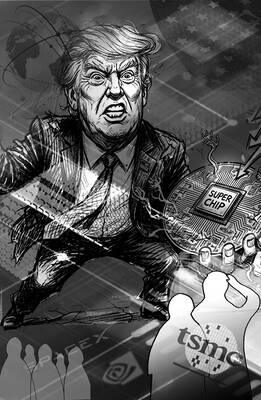
The White House’s decision to take a 9.9 percent stake in Intel Corp is looking like very shrewd business indeed. Since the government bought in at US$20.47 a share last August, the US chipmaker’s surging stock price has delivered the US a US$43 billion return. One of the reasons the investment has so far proved so sound is that the White House has made sure of it. According to The Wall Street Journal, Howard personally pushed deals on Intel’s behalf with some of the most lucrative clients imaginable. They include Nvidia Corp, the company at the heart of the AI
A single photograph can cut through a lot of noise, but it can also be used to misrepresent the truth. At the very least, it can concentrate the mind on something that requires further investigation. On Monday last week, Ma Ying-jeou Foundation CEO Tai Hsia-ling (戴遐齡) and former National Security Council secretary-general King Pu-tsung (金溥聰) held a news conference in which they showed a photograph of former foundation CEO Hsiao Hsu-tsen (蕭旭岑), now Chinese Nationalist Party (KMT) deputy chairman. In the image Hsiao is seated next to Xiamen Taiwan Businessmen Association chairman Han Ying-huan (韓螢煥). The two men were holding
I first met Professor Ray Jiing (井迎瑞) as a film and documentary student at Shih Hsin University’s (SHU) Department of Radio Television and Film in 1988. The following year, he went on to become the director of the Chinese Taipei Film Archive — forerunner of the Taiwan Film and Audiovisual Institute (TFAI). Over his eight-year tenure, Jiing rescued and restored over 200 classic Taiwanese films. In 1997, he established the Graduate Institute of Studies in Documentary and Film Archiving at Tainan National University of the Arts (TNNUA), and I joined the program in his third cohort of students. Beyond a
President William Lai Ching-te’s (賴清德) May 20 second-anniversary address was not just a routine policy review; it was damage control. US President Donald Trump’s remarks — that he did not want to see anyone move toward independence and that the delivery of a major Taiwan arms package could depend on the progress of US-China relations — unsettled Taiwan’s public and created an opening for opposition parties to question whether Taiwan was being treated as a bargaining chip in Washington’s dealings with Beijing. Lai’s speech was designed to close that opening. The address covered the expected ground: sovereignty, cross-strait relations, defense spending,


 RSS
RSS