


During World War II, Allied soldiers occupied Iran, using the country as a way station to transport supplies from the Persian Gulf to the Soviet Union. This was Iran's first exposure to Americans.
"They arrived in our country with a certain innocence," said the respected Iranian historian Kaveh Bayat, "and without any colonial pretenses."
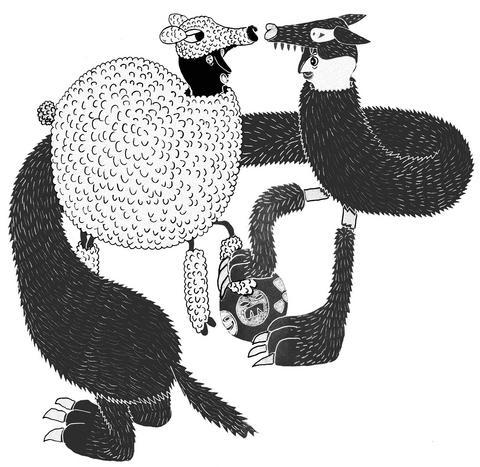
ILLUSTRATION MOUNTAIN PEOPLE
The Americans' supply train would regularly pass through my father's ancestral village, Arak, then a scenic oasis of green gardens and fruit orchards.
"Whenever we heard the train coming," my father once told me, "all the young boys in the village would run as fast as we could through the apple orchard to greet the passing Americans. They would smile and wave and throw us whatever gifts they happened to have -- playing cards, chewing gum, lifesaver candies ... For us they were like heroes from another world."
So much has changed since then. Iran's 1979 revolution did away with the pro-US, undemocratic regime of the Shah, bringing in its place the anti-US, undemocratic regime of the clerics. Relations between the US and Iran have been officially non-existent since a group of radical students stormed the US embassy in Tehran -- 25 years ago this week -- taking 66 Americans hostage for 444 days. Sixty years ago, Arak was a humble village known to US troops for its grapes; today Pentagon officials hone in on it as an industrial city that is integral to Iran's worrisome nuclear program.
And yet few countries have a more paradoxical relationship than the US and Iran. While the Iranian regime continues to be belligerently anti-US, the Iranian people are overtly pro-US. While the governments in Tehran and Washington appear to be strategic archrivals, in the words of former Secretary of State Henry Kissinger, "there are few nations in the world with which the United States has less reason to quarrel or more compatible interests than Iran."
Indeed, Iran has likely benefited more than any other country from US-led regime changes in Afghanistan and Iraq, as both the Taliban and former Iraqi president Saddam Hussein were the country's sworn enemies.
But neither side seized the opportunity to build on this common ground, and today US-Iran relations are as antagonistic as they have been in years. For the US, Iran's nuclear ambitions, opposition to Israel, and support for extremist groups have become increasingly intolerable in the context of the war on terror.
Iran's long-standing opposition to relations with the US is a bit more complex. To be sure, many of Iran's ruling elites came of age politically during the anti-imperialist and anti-colonialist agitations of the 1960s and 1970s, and still cling to that worldview. Although their revolutionary zeal may have waned over the years, they still tend to share the outlook of the late Ayatollah Khomeini, who likened the relationship between Iran and the US to that "between a sheep and a wolf."
Ideological rigidity alone, however, does not explain Iran's often-gratuitous anti-Americanism. For Iran's political and military elite, any increased liberalization that would likely result from an opening of ties with the US represents a threat to their interests. From their perspective, Iran is now a closed party -- their party -- and the less who join in, the merrier. With the US bogged down in Iraq and oil prices hitting record highs, regime hardliners see little reason to compromise these days.
On the other hand, some influential Iranians -- led by former president Hashemi Rafsanjani -- recognize that relations with the US are inevitable, given Iran's need to re-integrate into the international community and face its economic deficiencies. Moreover, the Iranian people are overwhelmingly in favor of rapprochement.
As author Afshin Molavi wrote in his incisive travelogue Persian Pilgrimages, Iranian youth today are not revolutionary idealists, like those of three decades ago. Instead, they have concrete demands, like jobs and political and social freedom. They are desperate to enter the global community and rid themselves of a damaged international reputation.
Today's Iranian intellectuals have undergone a similar maturation process, dismissing the "utopianist" and "nativist" political ideals of their predecessors. Referring to Jalal Al-e Ahmad's 1962 book Gharbzadegi ("West-toxication"), which became one of the manifestos of the 1979 revolution, one secular intellectual in Tehran remarked to me that, "Nobody reads Al-e Ahmad anymore. On the contrary, we long for interaction with the West. If it can bring us more economic opportunities, as well as social and political freedoms, let us be `West-toxified.'"
Still, despite popular demand in Iran, and common strategic interests, it could be years before the US and Iran sit down and make amends. After 25 years of living without each other, reconciliation will not come immediately. When it does, there is good reason to believe that Iranians will greet their long lost friends with the same friendliness and exuberance that they did sixty years ago in Arak.
Karim Sadjadpour is an analyst with the International Crisis Group.
Copyright: Project Syndicate

Because much of what former US president Donald Trump says is unhinged and histrionic, it is tempting to dismiss all of it as bunk. Yet the potential future president has a populist knack for sounding alarums that resonate with the zeitgeist — for example, with growing anxiety about World War III and nuclear Armageddon. “We’re a failing nation,” Trump ranted during his US presidential debate against US Vice President Kamala Harris in one particularly meandering answer (the one that also recycled urban myths about immigrants eating cats). “And what, what’s going on here, you’re going to end up in World War
Earlier this month in Newsweek, President William Lai (賴清德) challenged the People’s Republic of China (PRC) to retake the territories lost to Russia in the 19th century rather than invade Taiwan. He stated: “If it is for the sake of territorial integrity, why doesn’t [the PRC] take back the lands occupied by Russia that were signed over in the treaty of Aigun?” This was a brilliant political move to finally state openly what many Chinese in both China and Taiwan have long been thinking about the lost territories in the Russian far east: The Russian far east should be “theirs.” Granted, Lai issued
On Tuesday, President William Lai (賴清德) met with a delegation from the Hoover Institution, a think tank based at Stanford University in California, to discuss strengthening US-Taiwan relations and enhancing peace and stability in the region. The delegation was led by James Ellis Jr, co-chair of the institution’s Taiwan in the Indo-Pacific Region project and former commander of the US Strategic Command. It also included former Australian minister for foreign affairs Marise Payne, influential US academics and other former policymakers. Think tank diplomacy is an important component of Taiwan’s efforts to maintain high-level dialogue with other nations with which it does

On Sept. 2, Elbridge Colby, former deputy assistant secretary of defense for strategy and force development, wrote an article for the Wall Street Journal called “The US and Taiwan Must Change Course” that defends his position that the US and Taiwan are not doing enough to deter the People’s Republic of China (PRC) from taking Taiwan. Colby is correct, of course: the US and Taiwan need to do a lot more or the PRC will invade Taiwan like Russia did against Ukraine. The US and Taiwan have failed to prepare properly to deter war. The blame must fall on politicians and policymakers


 RSS
RSS