


The days ahead for Hong Kong's unpopular Chief Executive Tung Chee-hwa
Apart from nursing a fragile economy, Tung has to answer pressing local demands for more democracy while trying not to alarm communist leaders in Beijing worried that these aspirations pose a challenge to its authority in the territory.
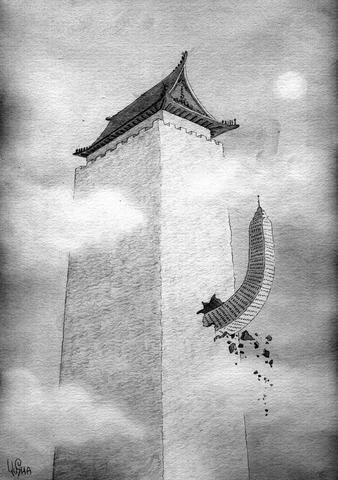
ILLUSTRATION: YU SHA
Underlining Chinese fears about quick democratization, China's parliament last Tuesday re-interpreted clauses in Hong Kong's constitution giving Beijing full control over how and when the city may choose its leader and lawmakers.
But this interpretation says that while China has the power to decide if electoral reforms are needed, it is up to Tung to propose and lobby Chinese leaders for any change -- putting the Beijing-backed former shipping tycoon in an unenviable position.
"Hong Kong people will now put even more pressure on Tung," said Ivan Choy, a politics professor at City University.
"If he ignores calls for reforms and fails to submit a reform proposal, his government will face a huge challenge."
While the 66-year-old Tung can in theory initiate reforms, his hands are tied and he is at the mercy of Beijing, which is greatly unnerved by growing calls in the past year in Hong Kong for universal suffrage from as soon as 2007.
Beijing fears such ambitions could escalate into demands for independence, embolden Taiwan on a breakaway course and spawn similar grassroots movements on the mainland.
"If Tung wants to submit a reform proposal, he is likely to consult Beijing first. If he doesn't submit a proposal, then it's most likely because Beijing asked him not to," Choy said.
Any failure by Tung to make such a proposal is sure to invite more criticism against him.
a DIFFICULT TASK
Apart from being able to veto any proposed reform, China now has the authority to decide if changes are even needed.
The change comes after China amended its Constitution last month to guarantee human rights as it seeks to adapt a revolutionary communist ideology to its increasingly capitalist system.
Hong Kong was meant to embody that dichotomy: a world-class financial center that can flourish under the nurturing hand of the communist motherland.
But last year's "people power" demonstrations showed that a relatively wealthy citizenry with a per capita income of almost US$25,000 is yearning for the right to choose its leaders as well as the right to make money.
While democracy champions see China's re-interpretation as dousing hopes for universal suffrage in the near future, they have vowed to continue fighting as Beijing has not explicitly ruled out the possibility of electoral reforms from 2007.
This presents a crucial test for Tung, whose administration plunged into crisis after 500,000 people took to the streets last July in Hong Kong's biggest protest in over a decade over Beijing's demand for an anti-subversion law.
Tung was forced to shelve the planned law.
Now the reticent billionaire has a golden opportunity to shed his stolid image and try to woo popular support, said Yip Kwok-wah, head of a pro-government think tank.
"If Mr Tung wants to make a contribution to Hong Kong and have his name go down nicely in history, I would advise him to aggressively and actively work on constitutional development, so as to get the support of Beijing on the one hand and of Hong Kong people on the other," Yip said.
SOPHISTICATED GAME
The daily South China Morning Post called on Tung's government to play a more sophisticated game.
"There is little to be gained by making blanket demands for universal suffrage. A more sophisticated and flexible approach is required," the newspaper said in an editorial. "There is a need to work hard on negotiating with the central government. This means being prepared to persuade, to reassure and perhaps to compromise."
The row has already attracted a great deal of international attention.
Expressions of concern from the US, Hong Kong's second largest trading partner, have earned sharp rebukes from Beijing and even Hong Kong's government.
Politics lecturer Sonny Lo warned that Tung risked more social unrest if he failed to bridge the growing rift between Hong Kong's aspirations and Beijing's fears.
"If the gap between the government and opposition grows, it's a recipe for chaos, political unrest and tension," Lo said.
Rather than muffle calls for democracy, analysts said the re-interpretation, seen by citizens as intervention by Beijing, may even boost support for the opposition pro-democracy camp and help it win a majority in legislative elections in September.
That would further alarm Beijing and pose a tremendous challenge to Tung, as the opposition would then be in a position to veto important policies.

Because much of what former US president Donald Trump says is unhinged and histrionic, it is tempting to dismiss all of it as bunk. Yet the potential future president has a populist knack for sounding alarums that resonate with the zeitgeist — for example, with growing anxiety about World War III and nuclear Armageddon. “We’re a failing nation,” Trump ranted during his US presidential debate against US Vice President Kamala Harris in one particularly meandering answer (the one that also recycled urban myths about immigrants eating cats). “And what, what’s going on here, you’re going to end up in World War
Earlier this month in Newsweek, President William Lai (賴清德) challenged the People’s Republic of China (PRC) to retake the territories lost to Russia in the 19th century rather than invade Taiwan. He stated: “If it is for the sake of territorial integrity, why doesn’t [the PRC] take back the lands occupied by Russia that were signed over in the treaty of Aigun?” This was a brilliant political move to finally state openly what many Chinese in both China and Taiwan have long been thinking about the lost territories in the Russian far east: The Russian far east should be “theirs.” Granted, Lai issued
On Tuesday, President William Lai (賴清德) met with a delegation from the Hoover Institution, a think tank based at Stanford University in California, to discuss strengthening US-Taiwan relations and enhancing peace and stability in the region. The delegation was led by James Ellis Jr, co-chair of the institution’s Taiwan in the Indo-Pacific Region project and former commander of the US Strategic Command. It also included former Australian minister for foreign affairs Marise Payne, influential US academics and other former policymakers. Think tank diplomacy is an important component of Taiwan’s efforts to maintain high-level dialogue with other nations with which it does

On Sept. 2, Elbridge Colby, former deputy assistant secretary of defense for strategy and force development, wrote an article for the Wall Street Journal called “The US and Taiwan Must Change Course” that defends his position that the US and Taiwan are not doing enough to deter the People’s Republic of China (PRC) from taking Taiwan. Colby is correct, of course: the US and Taiwan need to do a lot more or the PRC will invade Taiwan like Russia did against Ukraine. The US and Taiwan have failed to prepare properly to deter war. The blame must fall on politicians and policymakers


 RSS
RSS