


America's presidential election campaign is heating up, and with it the debate about American power. A year ago, after the blitz victory in the four-week Iraq War, many people thought the issue? was settled. But the subsequent difficulties in Iraq -- and in America's foreign relations more generally -- have placed that topic at the heart of the election campaign.?
It is hard to recall, but a little over a decade ago, conventional wisdom -- both inside and outside the US -- held that America was in decline. In 1992, the winner of the New Hampshire primary election argued that "the Cold War is over -- and Japan won." When I published Bound to Lead in 1990, I predicted the continuing rise of American power. But today I regard it as equally important to challenge the new conventional wisdom that America is invincible, and that the "new unilateralism" should guide US foreign policy.
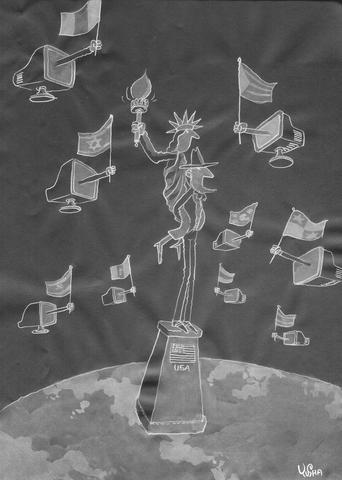
ILLUSTRATION: YU SHA
After the collapse of the Soviet Union, some analysts described the resulting world as unipolar and saw few constraints on American power. This is misleading. Power in a global information age is distributed among countries in a pattern that resembles a complex three-dimensional chess game.
On the top chessboard, military power is largely unipolar. The US is the only country with large state-of-the-art air, naval, and ground forces capable of global deployment -- thus, the quick victory in Iraq last year. But on the middle chessboard, economic power is multi-polar, with the US, Europe, Japan, and China representing two-thirds of world production. On this economic board, other countries often balance American power.
The bottom chessboard is the realm of transnational relations that cross borders beyond government control. At the benign end of the spectrum, this realm includes actors as diverse as bankers electronically transferring huge sums; at the other end are terrorists transferring weapons or hackers disrupting Internet operations.
On this bottom board, power is widely dispersed, and it makes no sense to speak of unipolarity, multipolarity, or hegemony. Those who recommend a unilateral American foreign policy based on such traditional descriptions of American power are relying on a woefully inadequate analysis.
Many of the real challenges to American power are coming not on the upper military board, on which the unilateralists concentrate, but on the lower transnational board. Ironically, the temptation to go it alone may ultimately weaken the US in this domain.
Why is this true? Today's information revolution and the type of globalization that accompanies it are transforming and shrinking the world. At the beginning of the 21st century, these two forces increased American power, particularly the ability to influence others through attractive, or what I call "soft" power. But with time, technological gains will spread to other countries and peoples, diminishing America's relative pre-eminence.
For example, today America's 5 percent of the global population represents more than half of all Internet users. But in a decade or two, Chinese may become the language of the largest number of Internet users. It will not dethrone English as a lingua franca, but at some point, the Asian market will loom larger than the American market.
Even more important, the information revolution is creating virtual communities and networks that cut across national borders, and transnational corporations and non-governmental actors -- terrorists included -- will play larger roles. Many organizations will have soft power of their own as they attract citizens into coalitions that cut across national boundaries.
The terrorist attacks on New York, Washington and now Madrid are terrible symptoms of the deep changes already occurring. Technology has been diffusing power away from governments, and empowering individuals and groups to play roles in world politics -- including wreaking massive destruction -- that were once reserved to governments. Privatization has been the leitmotif in economic policy in recent years, but in politics the privatization of war is terrorism.
Moreover, as globalization shrinks distance, events in faraway places -- like Afghanistan -- have a greater impact on everyone's lives. The world has moved from the Cold War to the Global Information Age, but the dominant foreign policy paradigms have not kept pace.
Today's growing global networks of interdependence are putting new items on national and international agendas; Americans simply cannot solve many of these by themselves. International financial stability is vital to prosperity, but the US needs the cooperation of others to ensure it.
In a world where borders are becoming more porous than ever to everything from drugs to infectious diseases to terrorism, Americans will be forced to work with other countries beyond their borders.
Because of its leading edge in the information revolution, and its vast investment in traditional power resources, the US will remain the world's single most powerful country well into this new century. While potential coalitions to check American power may be created, it is unlikely that they will become firm alliances unless the US handles its hard coercive power in an overbearing unilateral manner that undermines its "soft" or attractive power.
Joseph Nye, dean of the Kennedy School of Government at Harvard and a former US assistant secretary of defense, is author of the forthcoming book Soft Power: The Means to Success in World Politics. Copyright: Project Syndicate
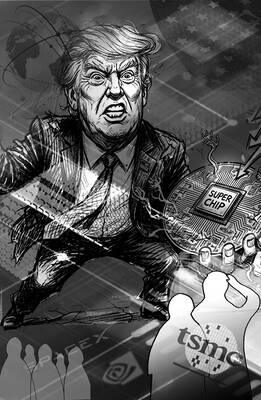
The White House’s decision to take a 9.9 percent stake in Intel Corp is looking like very shrewd business indeed. Since the government bought in at US$20.47 a share last August, the US chipmaker’s surging stock price has delivered the US a US$43 billion return. One of the reasons the investment has so far proved so sound is that the White House has made sure of it. According to The Wall Street Journal, Howard personally pushed deals on Intel’s behalf with some of the most lucrative clients imaginable. They include Nvidia Corp, the company at the heart of the AI
A single photograph can cut through a lot of noise, but it can also be used to misrepresent the truth. At the very least, it can concentrate the mind on something that requires further investigation. On Monday last week, Ma Ying-jeou Foundation CEO Tai Hsia-ling (戴遐齡) and former National Security Council secretary-general King Pu-tsung (金溥聰) held a news conference in which they showed a photograph of former foundation CEO Hsiao Hsu-tsen (蕭旭岑), now Chinese Nationalist Party (KMT) deputy chairman. In the image Hsiao is seated next to Xiamen Taiwan Businessmen Association chairman Han Ying-huan (韓螢煥). The two men were holding
I first met Professor Ray Jiing (井迎瑞) as a film and documentary student at Shih Hsin University’s (SHU) Department of Radio Television and Film in 1988. The following year, he went on to become the director of the Chinese Taipei Film Archive — forerunner of the Taiwan Film and Audiovisual Institute (TFAI). Over his eight-year tenure, Jiing rescued and restored over 200 classic Taiwanese films. In 1997, he established the Graduate Institute of Studies in Documentary and Film Archiving at Tainan National University of the Arts (TNNUA), and I joined the program in his third cohort of students. Beyond a
President William Lai Ching-te’s (賴清德) May 20 second-anniversary address was not just a routine policy review; it was damage control. US President Donald Trump’s remarks — that he did not want to see anyone move toward independence and that the delivery of a major Taiwan arms package could depend on the progress of US-China relations — unsettled Taiwan’s public and created an opening for opposition parties to question whether Taiwan was being treated as a bargaining chip in Washington’s dealings with Beijing. Lai’s speech was designed to close that opening. The address covered the expected ground: sovereignty, cross-strait relations, defense spending,


 RSS
RSS