


When Japanese soldiers arrive in Iraq later this month, they won't be making war. They will be making history.
The dispatch, expected to become Japan's biggest and riskiest overseas military mission since World War II, marks a milestone in a shift away from a purely defensive posture toward a larger international role for the nation's military.
Japanese troops in Iraq will operate in what experts agree is a conflict zone, where the risk of casualties is high and the blue helmets of a UN peacekeeping force are nowhere to be seen.
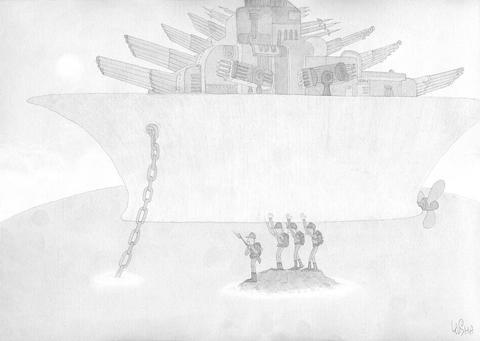
YUSHA
"Is Japan's security policy undergoing a major transformation? I think the answer is `yes,'" said Richard Samuels, a Massachusetts Institute of Technology professor.
"Putting `boots on the ground' in Iraq is fundamentally different from anything they have done in the past half century."
If successful, the Iraqi operation could become a model for future missions and accelerate a drive by neo-conservatives in Japan to revise its pacifist Constitution.
No member of Japan's military has fired a shot in combat or been killed in an overseas mission since World War II, and substantial casualties in Iraq could spark a public backlash that would rock Prime Minister Junichiro Koizumi's government and hamper the forging of a new security policy.
"There might be a setback because of severe casualties," said Akio Watanabe, president of the Research Institute for Peace and Security, a think tank. "Public opinion is still very fluid in that sense."
A small advance army team is expected to leave later this week for southern Iraq, where they will act as scouts for a Japanese force that could number some 1,000 personnel on a mission to provide humanitarian aid and help rebuild the country.
A law enabling the dispatch limits its activities to "non-combat" zones, a concept hard to apply in Iraq, where at least 261 US and allied military personnel have been killed in attacks since May, when US President George W. Bush declared major combat over.
Japan's constitution renounces the right to wage war, bans the maintenance of a military except for defensive purposes, and has been interpreted as prohibiting the exercise of the right of collective self-defense, or aiding allies when they are attacked.
Untested in combat
The Self-Defense Forces (SDF), as the military is known, celebrate their 50th birthday this year, and though untested in combat are comparable in terms of spending and manpower to those of Britain.
For most of those 50 years, the forces were kept at home and efforts to expand their reach and role constrained by the Constitution as well as by reluctance to fan fears among Asian neighbors of resurgent Japanese militarism.
But stung by criticism of a "checkbook diplomacy" which gave cash but no troops for the 1991 Gulf War, Japan has stretched the limits of the Constitution over the past dozen years.
A 1992 law allowed Japanese forces to take part in UN-led peacekeeping operations, though with severe restrictions.
In 2001, Japan deployed its navy to the Indian Ocean to provide logistical support for the US-led war in Afghanistan, the first post-World War II dispatch to a war situation.
Experts agree, though, that the level of risk and absence of a clear UN mandate make the Iraq operation qualitatively different.
HUGGING AMERICA
Behind Koizumi's decision to take such a risky step is both a long-felt desire to normalize Japan's gun-shy, postwar defense policies and more recent worries about North Korea's nuclear and missile programs and China as an emerging regional power.
The US, Tokyo's main security ally, has also been pressuring Japan to take a bigger global role.
"If they didn't fear the possibility of abandonment by the United States on North Korea, they wouldn't feel the need to hug the United States more vigorously," Samuels said.
Koizumi backed the US-led war on Iraq despite opposition from the majority of Japanese voters and is moving ahead on the troop dispatch to Iraq in the face of polls showing that most of the public want to wait at least until the country is safer.
While many voters appear to be abandoning the pacifism that defined Japan's postwar security debate, a sense of forced obedience to Washington has fostered some resentment.
"The feeling is mixed. We love America, but we don't like our people always having to obey US pressure," said defense policy expert Satoshi Morimoto.
Few, however, would suggest that Japan try to go it alone on defense in the foreseeable future.
Despite the policy shift, few expect Japan to soon become a "Britain of Asia," fighting alongside US forces overseas.
"The Japanese government cannot be so bold," Watanabe said.
"I think they will stick to providing logistical support rather than actual fighting. My conclusion as to whether Japan has crossed the Rubicon [taken an irrevocable step] is `yes,' but very cautiously."
The cancelation this week of President William Lai’s (賴清德) state visit to Eswatini, after the Seychelles, Madagascar and Mauritius revoked overflight permits under Chinese pressure, is one more measure of Taiwan’s shrinking executive diplomatic space. Another channel that deserves attention keeps growing while the first contracts. For several years now, Taipei has been one of Europe’s busiest legislative destinations. Where presidents and foreign ministers cannot land, parliamentarians do — and they do it in rising numbers. The Italian parliament opened the year with its largest bipartisan delegation to Taiwan to date: six Italian deputies and one senator, drawn from six
Recently, Taipei’s streets have been plagued by the bizarre sight of rats running rampant and the city government’s countermeasures have devolved into an anti-intellectual farce. The Taipei Parks and Street Lights Office has attempted to eradicate rats by filling their burrows with polyurethane foam, seeming to believe that rats could not simply dig another path out. Meanwhile, as the nation’s capital slowly deteriorates into a rat hive, the Taipei Department of Environmental Protection has proudly pointed to the increase in the number of poisoned rats reported in February and March as a sign of success. When confronted with public concerns over young
Taiwan and India are important partners, yet this reality is increasingly being overshadowed in current debates. At a time when Taiwan-India relations are at a crossroads, with clear potential for deeper engagement and cooperation, the labor agreement signed in February 2024 has become a source of friction. The proposal to bring in 1,000 migrant workers from India is already facing significant resistance, with a petition calling for its “indefinite suspension” garnering more than 40,000 signatures. What should have been a straightforward and practical step forward has instead become controversial. The agreement had the potential to serve as a milestone in
China has long given assurances that it would not interfere in free access to the global commons. As one Ministry of Defense spokesperson put it in 2024, “the Chinese side always respects the freedom of navigation and overflight entitled to countries under international law.” Although these reassurances have always been disingenuous, China’s recent actions display a blatant disregard for these principles. Countries that care about civilian air safety should take note. In April, President Lai Ching-te (賴清德) canceled a planned trip to Eswatini for the 40th anniversary of King Mswati III’s coronation and the 58th anniversary of bilateral diplomatic


 RSS
RSS