


As maladies go, it does not, at first glance, appear the most difficult to bear. Even the name -- luxury fever -- carries a certain aspirational panache. But the desire of Britons to ape celebrity lifestyles while earning altogether more modest incomes is leading, according to research, to a perverse delusion: the belief they are poor when they have never had it so good.
Despite relatively high incomes, the majority of Britons consider themselves little better off than the struggling poor. In a study by an academic at the University of Cambridge, England, more than 60 percent of people said they could not afford to buy everything they really need.
The middle classes are among the worst affected by this new affliction. Just under half of people who earn more than £35,000 (US$47,600) believe they do not have enough money for essentials, while 40 percent of those in the £50,000-plus salary bracket feel similarly deprived.
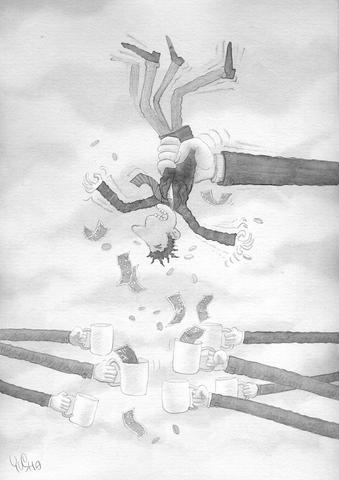
ILLUSTRATION: YU SHA
The delusion comes despite the fact that Britons today have incomes nearly three times higher, in real terms, than in 1950. It gives the UK a proportion of "suffering rich" even higher than the US. Clive Hamilton, who carried out the research, said the sense of deprivation was akin to "luxury fever."
Open a magazine or newspaper supplement, flick on a television lifestyle program and the temptation is there: luxury brands, fancy houses and famous people. While the lifestyles of the rich were previously seen to be beyond most people, Hamilton believes rising incomes have led many families to aspire to celebrity standards, making them feel deprived if they have to settle for the £200 fridge rather than the £2,000 one.
"The real concerns of yesterday's poor have become the imagined concerns of today's rich," he said.
The evidence, he said, comes in the booming sales of luxury items and the spiralling levels of personal debt. While the average size of household in the UK has fallen from 2.9 in the early 1970s to 2.3 today, the size of the houses they live in has grown. The number of households that can boast two or more rooms per occupant has risen from 37 percent in 1971 to 57 percent in 2001. Even the rooms are bigger.
Hamilton said luxury goods manufacturers were also proffering temptation into worlds previously thought outside the budget of middle-class households. Sunglasses by Gucci and Chanel are bought by people who cannot afford their clothes. And it is now possible to buy a Mercedes for £13,000 and a new Jaguar for less than £20,000.
Savings rates have halved since 1993 as the middle classes become increasingly reluctant to delay gratification. All this, said Hamilton, is leading to a skewed view of British life.
"This emphasis on the tribulations of the middle classes not only validates the preoccupation of wealthy people with their own financial circumstances, but crowds out sympathy for those who are genuinely struggling," he said. "It is hard to avoid the conclusion that the political system actively foments dissatisfaction amongst the middle classes, a process that has spawned a culture of middle-class complaint."
Britons' love of luxury and general inability to foot the bill is, according to Hamilton, having profound effects, particularly on our bank balances.
"Contrary to popular belief, the accumulation of consumer debt is not the result of poorer households being forced to borrow to cover living expenses but of wealthier households splashing out on luxuries," he said.
Increasing consumption has another price, too. Although they may have glossier and more expensive things they have less time to spend with them -- and our families. Full-time workers in the UK put in an average of 43.5 hours a week, compared with the European average of 40.1. Around a quarter of men work more than 48 hours a week, substantially more than just a decade ago.
"The culture of long hours is taking a toll on relationships," said Hamilton. "While most people recognize that children suffer from parents' excessive work, many parents seem unable to scale down their level of desire to spend more time at home.
And once they have the newest, most sophisticated item comes a further problem: where to put it. British households, said Hamilton, are struggling to accommodate the things they are buying.
The number of companies offering storage space is growing at a rate of 35 percent a year.
Money does not buy happiness, but it does at least buy space to put all the things accumulated along the way.

Because much of what former US president Donald Trump says is unhinged and histrionic, it is tempting to dismiss all of it as bunk. Yet the potential future president has a populist knack for sounding alarums that resonate with the zeitgeist — for example, with growing anxiety about World War III and nuclear Armageddon. “We’re a failing nation,” Trump ranted during his US presidential debate against US Vice President Kamala Harris in one particularly meandering answer (the one that also recycled urban myths about immigrants eating cats). “And what, what’s going on here, you’re going to end up in World War
Earlier this month in Newsweek, President William Lai (賴清德) challenged the People’s Republic of China (PRC) to retake the territories lost to Russia in the 19th century rather than invade Taiwan. He stated: “If it is for the sake of territorial integrity, why doesn’t [the PRC] take back the lands occupied by Russia that were signed over in the treaty of Aigun?” This was a brilliant political move to finally state openly what many Chinese in both China and Taiwan have long been thinking about the lost territories in the Russian far east: The Russian far east should be “theirs.” Granted, Lai issued
On Tuesday, President William Lai (賴清德) met with a delegation from the Hoover Institution, a think tank based at Stanford University in California, to discuss strengthening US-Taiwan relations and enhancing peace and stability in the region. The delegation was led by James Ellis Jr, co-chair of the institution’s Taiwan in the Indo-Pacific Region project and former commander of the US Strategic Command. It also included former Australian minister for foreign affairs Marise Payne, influential US academics and other former policymakers. Think tank diplomacy is an important component of Taiwan’s efforts to maintain high-level dialogue with other nations with which it does

On Sept. 2, Elbridge Colby, former deputy assistant secretary of defense for strategy and force development, wrote an article for the Wall Street Journal called “The US and Taiwan Must Change Course” that defends his position that the US and Taiwan are not doing enough to deter the People’s Republic of China (PRC) from taking Taiwan. Colby is correct, of course: the US and Taiwan need to do a lot more or the PRC will invade Taiwan like Russia did against Ukraine. The US and Taiwan have failed to prepare properly to deter war. The blame must fall on politicians and policymakers


 RSS
RSS