


Last week the world changed. The "No" votes in the French and Dutch referendums on the EU Constitutional Treaty plunged the EU into the most profound crisis since its foundation. They created a political dynamic that will challenge the opening up of western Europe, both internally and to the outside world, that has been the hallmark of economic, foreign and diplomatic policy since 1945.
If mishandled, the crisis may even lead to closure, protection, recession and the disintegration of the euro -- and the balkanization of Europe into mutually suspicious and hostile camps. The end of an era of easy movement from country to country embodied by cheap flights, a single currency and growing interpenetration of each other's economies is now in prospect. Historians may come to say that Europeans never knew they had it so good, but then they threw it away.
The EU, one of the institutional pillars of the postwar world, is visibly corroding before the disaffection of its citizens. In both France and Holland, there was a widespread if false belief -- shared in other member states, including Britain -- that an EU empowered by its new constitution would drive through policies that would destroy national approaches that were held dear.
ILLUSTRATION: MOUNTAIN PEOPLE
In France, plagued by at least 10 percent unemployment for more than 20 years, the easily inflammable fear was that "social France," enjoying a generous welfare state, a deep commitment to public services and benign conditions of employment, would be replaced by a minimalist, hard-hearted "Anglo-Saxon" approach to welfare in the name of economic efficiency. This was the reason depressed industrial France voted against the treaty by majorities of more than 80 percent, while Paris, like the rich suburbs of the Hague and Amsterdam, voted "Yes."
Nor was that all. Both countries have suffered backlashes against immigration, with the success of the anti-Islam party led by Pim Fortuyn in Holland, who was murdered for his views, and Jean-Marie Le Pen's far right National Front in France.
Already there are fears that migrant workers from the new member states in Eastern Europe are taking jobs from native French and Dutch with an alleged tidal wave of Polish plumbers in France a case in point. The prospect of an even larger influx of hard-to-integrate Muslim Turks once Turkey joined the EU was another powerful source of disaffection. Add ordinary people's sense of loss of control in an era of globalization and distance from democracy, especially towards institutions as complex and remote as the EU's, and the cocktail of apprehension was complete.
At a stroke the EU has been transmuted from an organization of supranational ambitions to something as weak and -- unless some momentum and coherence can be recovered -- as vacuous as the interwar League of Nations.Already the currency markets are beginning to worry whether the EU's greatest achievement, the euro, is sustainable without a political framework to support it. The Italian welfare minister suggested last week that Italy hold a referendum to leave the euro and bring back the lire.The entire EU edifice, and all the benefits it has brought in terms of trade, stability and peace, is at risk.
The problem is simple.Europe can neither go forward nor stay the same, because the status quo has been rendered illegitimate. French President Jacques Chirac, may insist that he wants the ratification process to continue, supported vainly by German Chancellor Gerhard Schroder,but his stance is plainly self-interested and ignores basic political rules. If every other member state says "Yes," then he may be provided with an excuse to run the French referendum campaign for a second time, asking the French to change their mind or risk exiting the EU.
But the British, Czech and Danish referendums are now virtually unwinnable, as opinion polls in each country signal -- and none of their leaders will be minded to commit political suicide to solve Chirac's problem. In any case, few French voters believe Europe can be constructed without them, and they are right.
In short, the ratification process is stone dead, as is the constitutional treaty. If, in the immediate dazed aftermath of the two votes, senior European Commission officials in Brussels were arguing ratification should continue, by Friday morning there was a readiness to accept the need for time out to reflect on what to do.
Blair would be let off the hook of the British referendum.
But the EU treaty, streamlining the cumbersome procedures for a union of 25 states, was vitally needed.Few beyond the initiates understand the relationship between the European Council (the EU's political directorate with a different member state occupying the presidency every six months), the European Commission (the EU's secretariat), and the European parliament.
The treaty tried to give Europe a more human face with a permanent president, a more coherent European Commission and a more empowered European Parliament, together with a more rational and fairer system of voting. It was not a breakthrough but it was an improvement. Now that it is dashed we are left with the current dysfunctional ragbag, with the No votes signalling opposition to any improvement. The danger is obvious.
Locked between a rock of an unratifiable treaty and a hard place of dysfunctional institutions, the EU can only become more discredited in a vicious cycle of decline, ever more obvious impotence and growing illegitimacy.
Only last week, the row over the 48-hour working week -- with Britain successfully resisting attempts to create a continent-wide level playing field -- revealed the drift into institutional and political deadlock. In a different climate, the European Commission might have banged heads together to achieve compromise; today it is a bystander in the row, with no authority to insist that all states rally to a commonly agreed set of values and principles.
Even before the "No" votes, the commission was unable to stop France, Germany and Italy blatantly disregarding single currency rules over the size of their budget deficits,and it is becoming steadily weaker in arbitrating disputes over state aid and competition. National self-interest rules as governments try in vain to meet their electorates' demands for protection, security and non-interference. In this climate not only is building Europe hard; its achievements risk disintegrating.
That 11 countries chose to concede national referendums to ratify the treaty -- in Holland it was the first referendum on any issue since the war -- is another symptom of the gathering malaise. National governments did not feel politically strong enough in the current climate to ratify an intergovernmental treaty as they had in the past through their parliaments; they had to concede to the Eurosceptic, populist mood and offer a referendum -- the instrument of the democratically weak and authoritarian regime alike throughout the ages. Last week we saw the anti-democratic consequences.
What has to be interpreted as the "democratic" voice of the people is in truth the result of the anti-democratic extreme right and left coming together on this issue as they would on no other -- thus weakening the parties of the normal democratic discourse who are characterized as the unlistening "elite" while posing them with an impossible political dilemma.
Already the Dutch prime minister has refused an invitation from Schroder for the original six founding members to meet to discuss whether this hard core can find a way forward; after the referendum he dare do nothing that smacks of offending the people's "democratic judgment." It is the paralysis that undermined European democracies in the interwar years; some very familiar and ugly ghosts are once again stalking our continent.
The stasis enveloping the EU has been steadily building ever since the collapse of communism in Eastern Europe in 1989.German reunification became inevitable and the fear was that Germany would emerge as the dominant state in Europe with a new political base in the East. It had to be tied into western Europe more completely to compensate -- the settled view of both the then French president Francois Mitterrand and then German chancellor Helmut Kohl.
France would agree to German re-unification and Eastern European states joining up; but the Germans had first to agree to closer economic and political union, in particular to a single currency. The Maastricht treaties were hatched, the single currency was born and the European Community was renamed the EU with the aim of constructing a political constitution to govern a more closely integrated Europe.
Such a Europe would be able to combine a commitment to social concerns with more competition, trade and freer markets.
All might have been well had the European economy responded with more growth; but while the Nordic countries, Spain and many of the smaller and new member states have grown fast with good levels of employment growth, the big three -- France, Germany and Italy -- have suffered a continuing crisis.
All have been unable to find a way of boosting personal spending via easy credit and mortgages collateralized against property. They have failed to embrace the dynamism of the new industries such as communications and computing, and to develop vibrant service sectors, which have been the hallmark of today's more successful economies. These common problems have been made worse in Germany by the burden of reunification, and in France and Italy by the capacity of interest groups, especially in the public sector, to obstruct change.
Continuing economic weakness has created a profound cultural pessimism in all three countries. Instead of building a consensus for economic reform, national politicians have tried to reassure their disaffected electorates that all will be well if they stick to the European way and resist "Anglo-Saxon" capitalism and the Brussels Commission, which they describe as its handmaiden. Thus Schroder has depicted Brussels as anti-German and Chirac has tried to build a domestic constituency by resisting what he says are anti-French policies emanating from Brussels. They have turned on their own European creation to solve their largely homemade problems.
Britain has not helped. Opting out of initiatives like the single currency and social Europe, the Blair government has chosen to attribute Britain's economic and social success to its resistance to Europe's bargains, values and preoccupations. Thus when Brussels proposes reforms, there is even more evidence for them to be characterized in mainland Europe as part of a pro-Anglo-Saxon, anti-European conspiracy.
Among the founding six member states,Brussels and European integration have come to be seen as the enemy of real Europe and the friend of Islamic immigration, high unemployment, reduced social protection, economic restructuring and "vulture, locust capitalism."
In Britain, paradoxically, Brussels is seen as the architect of grand social schemes, inflexible labor markets, regulation, economic weakness and reduction of political sovereignty.
Neither is true. And unless British, French and German politicians start to be honest, the EU will implode into fractious and competing nationalisms that have always lain under the surface of European rhetoric. Britain is a European country whose electorate has voted in three general elections for social Britain -- first cousin of social Europe -- and which New Labour is building while not acknowledging what it is doing.
Blairism is a quintessential European-style bargain, marrying a commitment to social justice with open markets and competition, but it is not understood in those terms either at home or in Europe. He needs to say so, and draw the sting from his European critics.
The unanimous demand for Britain to give up its budget rebate and to be offered nothing in return at the European Summit in a few days time -- a politically impossible condition for Blair -- is in part because of fury with the British position. He needs to buy time, and the precondition for that is to change the way Britain is seen.
Equally, France and Germany should be honest about the necessity to reframe their own domestic bargains and stop blaming Brussels for the need for change, while Italy -- in the deepest economic crisis of all -- should follow their lead. The European Commission can help by being more forensic about what works in Europe and what does not, and by more proactively challenging the consensus view that everything European is an economic basket-case when the truth is more complex.
Europeans have to think straight, to talk honestly and recognize their commonality. If they continue to resort to creating false enemies and false choices, there is no doubt that the European project will fail and with it the prosperity and peace we take for granted.
The gloomy outlook
-- 2005-2006 European Summit ends in disarray. No agreement on EU budget, ratification process or what to do.
-- Italian Prime Minister Silvio
Berlusconi declares he will hold referendum on leaving euro next spring. Italians vote to quit
currency.
-- Euro in free-fall as France and Germany prepare contingency plans for return of franc and mark. European Central Bank (ECB) forced to raise interest rates.
-- 2006-2007 German and French economy move into deep recession as ECB puts up interest rates to save euro. Extremist left and right parties make big advances.
-- Summer 2007 Incoming left-wing French government under president Laurent Fabius suspends euro membership, raises tariffs and leaves WTO.
-- Spring 2008 German chancellor Angela Merkel declares EU dead. Germany will no longer recognize European law, but instead will work for a European common market with floating European exchange rates.
-- 2009 British unemployment tops 2 million. House prices crash. The far-right British National Party predicted to win 50 or more seats in 2010 general election.
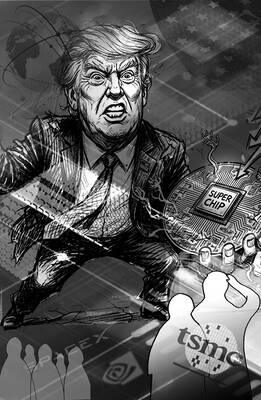
The White House’s decision to take a 9.9 percent stake in Intel Corp is looking like very shrewd business indeed. Since the government bought in at US$20.47 a share last August, the US chipmaker’s surging stock price has delivered the US a US$43 billion return. One of the reasons the investment has so far proved so sound is that the White House has made sure of it. According to The Wall Street Journal, Howard personally pushed deals on Intel’s behalf with some of the most lucrative clients imaginable. They include Nvidia Corp, the company at the heart of the AI
The Ministry of the Interior, working with the navy and coast guard, is organizing Taiwan’s first joint exercise simulating escort tankers carrying liquefied natural gas (LNG) and oil through a Chinese blockade. The drills simulate fuel transport along three maritime corridors leading toward Japan, the Philippines and the US. Deputy Minister of the Interior Sawyer Mars (馬士元) said that a blockade of the Taiwan Strait would amount to “almost a 100 percent blockade of the regional energy supply.” Minister of National Defense Wellington Koo said planning to counter a blockade is standard practice in Taipei. While the exercise is limited in
A single photograph can cut through a lot of noise, but it can also be used to misrepresent the truth. At the very least, it can concentrate the mind on something that requires further investigation. On Monday last week, Ma Ying-jeou Foundation CEO Tai Hsia-ling (戴遐齡) and former National Security Council secretary-general King Pu-tsung (金溥聰) held a news conference in which they showed a photograph of former foundation CEO Hsiao Hsu-tsen (蕭旭岑), now Chinese Nationalist Party (KMT) deputy chairman. In the image Hsiao is seated next to Xiamen Taiwan Businessmen Association chairman Han Ying-huan (韓螢煥). The two men were holding
I first met Professor Ray Jiing (井迎瑞) as a film and documentary student at Shih Hsin University’s (SHU) Department of Radio Television and Film in 1988. The following year, he went on to become the director of the Chinese Taipei Film Archive — forerunner of the Taiwan Film and Audiovisual Institute (TFAI). Over his eight-year tenure, Jiing rescued and restored over 200 classic Taiwanese films. In 1997, he established the Graduate Institute of Studies in Documentary and Film Archiving at Tainan National University of the Arts (TNNUA), and I joined the program in his third cohort of students. Beyond a


 RSS
RSS