


Chinese Nationalist Party (KMT) Chairman Lien Chan (
News of Lien's visit has filled almost every TV news show and most newspapers. Public opinion polls associated with these reports show Lien enjoying a huge surge in his prestige. It would seem that Lien has been able, in one trip, to resolve the half-century long stand-off across the Taiwan Strait and that peace and unification with China are now just around the corner.
This is a big joke and is no more than an illusion perpetrated by the media. To interpret this situation, we must first understand Taiwan's media environment. Apart from a few public TV stations, almost all TV stations in Taiwan are controlled by forces close to the pan-blue camp. That the two major newspapers established by KMT Central Standing Committee members favor the pan-blue camp goes without saying. When has an opinion poll by a Taiwanese media outlet ever been accurate? Which poll has not had its results predetermined by political concerns? Are the polls concerning Lien's visit to China any more credible?
Of all the Chinese-language media, only the Liberty Times and the Taiwan Daily continue to put Taiwan first, and Lien is using every media outlet at his disposal to drown them out. How can the outside world perceive the truth of Taiwan's politics when the media keeps a muzzle on dissenting opinion? OK, so pan-green voters may not have their own media outlets, but there is still the vast realm of the Internet. The only way to get an understanding of the Taiwanese people's thoughts regarding Lien's visit to China is to log on to the Internet and see first-hand Taiwanese people's derision.
On Tuesday, China gave Lien a gift of three ways to buy votes. They offered to lift travel restrictions for tourists visiting Taiwan, remove tariffs on the import of Taiwanese fruits such as mangos and wax apples and give Taiwan two pandas -- its most cherished endangered species. Note that mangos and wax apples are predominantly farmed in the south, the electoral base of the ruling Democratic Progressive Party (DPP).
It is ironic that when President Chen Shui-bian (
This goes to show that Lien has failed to resolve the discrimination and political gridlock across the Strait, and has only taken China's attempts to help the pan-blue camp buy votes one step further. There is no need to point out that it is pan-blue politicians, who have a deep understanding of Taiwan's political system, who are visiting China to offer tactical advice, teaching the government in Beijing ways to manipulate Taiwan's democratic system and make use of its vote-buying culture to help get the pan-blue camp back into power.
Although Lien has returned, there remains the issue of the pandas. Those who want them and those who don't are already up in arms. Putting aside conservation issues, we believe that as the most fundamental aspects of the cross-strait issue have yet to be resolved, and the "Anti-Secession" Law that authorizes war as a means to settle the cross-strait conflict has not been struck down, it is best if the pandas stay at home.
Otherwise, the growing tensions of the unresolved cross-strait political conflict will be blamed on these two innocent and unsuspecting creatures. There is no reason why they should bear this burden.
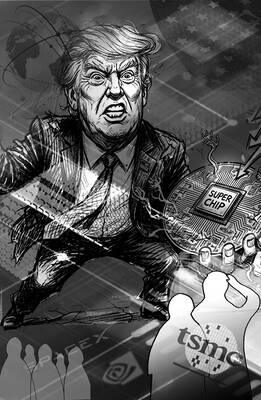
The White House’s decision to take a 9.9 percent stake in Intel Corp is looking like very shrewd business indeed. Since the government bought in at US$20.47 a share last August, the US chipmaker’s surging stock price has delivered the US a US$43 billion return. One of the reasons the investment has so far proved so sound is that the White House has made sure of it. According to The Wall Street Journal, Howard personally pushed deals on Intel’s behalf with some of the most lucrative clients imaginable. They include Nvidia Corp, the company at the heart of the AI
A single photograph can cut through a lot of noise, but it can also be used to misrepresent the truth. At the very least, it can concentrate the mind on something that requires further investigation. On Monday last week, Ma Ying-jeou Foundation CEO Tai Hsia-ling (戴遐齡) and former National Security Council secretary-general King Pu-tsung (金溥聰) held a news conference in which they showed a photograph of former foundation CEO Hsiao Hsu-tsen (蕭旭岑), now Chinese Nationalist Party (KMT) deputy chairman. In the image Hsiao is seated next to Xiamen Taiwan Businessmen Association chairman Han Ying-huan (韓螢煥). The two men were holding
I first met Professor Ray Jiing (井迎瑞) as a film and documentary student at Shih Hsin University’s (SHU) Department of Radio Television and Film in 1988. The following year, he went on to become the director of the Chinese Taipei Film Archive — forerunner of the Taiwan Film and Audiovisual Institute (TFAI). Over his eight-year tenure, Jiing rescued and restored over 200 classic Taiwanese films. In 1997, he established the Graduate Institute of Studies in Documentary and Film Archiving at Tainan National University of the Arts (TNNUA), and I joined the program in his third cohort of students. Beyond a
President William Lai Ching-te’s (賴清德) May 20 second-anniversary address was not just a routine policy review; it was damage control. US President Donald Trump’s remarks — that he did not want to see anyone move toward independence and that the delivery of a major Taiwan arms package could depend on the progress of US-China relations — unsettled Taiwan’s public and created an opening for opposition parties to question whether Taiwan was being treated as a bargaining chip in Washington’s dealings with Beijing. Lai’s speech was designed to close that opening. The address covered the expected ground: sovereignty, cross-strait relations, defense spending,


 RSS
RSS