


In a radical move to outflank the government of Taiwan, CCP leaders sounded out the possibility of inviting figures from outside Taiwan's governing party for discussions on the unification of China and Taiwan. April 2005?
Try April 1985, during the declining years of the Chiang dynasty's one-party state. Apparently, the suggestion came from the widow of People's Republic of China premier Chou En-lai (周恩來) in her capacity as chairperson of the People's Political Consultative Committee. (It also shows what a poor understanding the Beijing authorities had of Taiwan's politics.)
Naturally, such a move was dismissed by the KMT as a "New Trick, Same Game." In its editorial of April 14, 1985, the Free China Journal described Mrs. Chou as "seeking to tempt non-party people into the discussions. A new ploy in the Communist's united front tricks."
The government newspaper (which, interestingly, until six months earlier had been published by one James Soong in his role as director-general of the Government Information Office) then continued, "The government of the Republic of China and the KMT have refused to negotiate because the Communists' record of keeping promises made in negotiations is a disaster. For the Taiwanese, there is nothing to gain, but everything to lose. Tibet is one very good example and Hong Kong is on the same path."
Incidentally, how significant a phrase: "For the people now living in Taiwan" in terms of the people that the KMT felt it represented. And what a good choice of examples: while the rest of the world has been saddened and shocked by subsequent developments in Tibet and Hong Kong, it would seem that Soong and his on-again-off-again buddy, KMT Chairman Lien Chan (連戰), feel that the PRC has changed its spots in the last two decades and is now ready to keep its word.
What promises Lien and Soong are making in Beijing, the people of Taiwan can only wonder and worry.
Mark Caltonhill
Taipei County
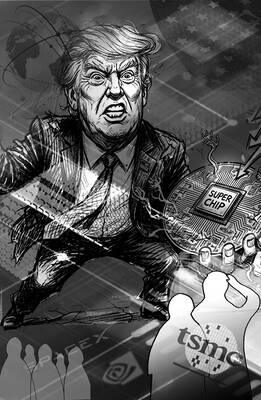
The White House’s decision to take a 9.9 percent stake in Intel Corp is looking like very shrewd business indeed. Since the government bought in at US$20.47 a share last August, the US chipmaker’s surging stock price has delivered the US a US$43 billion return. One of the reasons the investment has so far proved so sound is that the White House has made sure of it. According to The Wall Street Journal, Howard personally pushed deals on Intel’s behalf with some of the most lucrative clients imaginable. They include Nvidia Corp, the company at the heart of the AI
A single photograph can cut through a lot of noise, but it can also be used to misrepresent the truth. At the very least, it can concentrate the mind on something that requires further investigation. On Monday last week, Ma Ying-jeou Foundation CEO Tai Hsia-ling (戴遐齡) and former National Security Council secretary-general King Pu-tsung (金溥聰) held a news conference in which they showed a photograph of former foundation CEO Hsiao Hsu-tsen (蕭旭岑), now Chinese Nationalist Party (KMT) deputy chairman. In the image Hsiao is seated next to Xiamen Taiwan Businessmen Association chairman Han Ying-huan (韓螢煥). The two men were holding
I first met Professor Ray Jiing (井迎瑞) as a film and documentary student at Shih Hsin University’s (SHU) Department of Radio Television and Film in 1988. The following year, he went on to become the director of the Chinese Taipei Film Archive — forerunner of the Taiwan Film and Audiovisual Institute (TFAI). Over his eight-year tenure, Jiing rescued and restored over 200 classic Taiwanese films. In 1997, he established the Graduate Institute of Studies in Documentary and Film Archiving at Tainan National University of the Arts (TNNUA), and I joined the program in his third cohort of students. Beyond a
President William Lai Ching-te’s (賴清德) May 20 second-anniversary address was not just a routine policy review; it was damage control. US President Donald Trump’s remarks — that he did not want to see anyone move toward independence and that the delivery of a major Taiwan arms package could depend on the progress of US-China relations — unsettled Taiwan’s public and created an opening for opposition parties to question whether Taiwan was being treated as a bargaining chip in Washington’s dealings with Beijing. Lai’s speech was designed to close that opening. The address covered the expected ground: sovereignty, cross-strait relations, defense spending,


 RSS
RSS