


One hundred years ago this month, a paper written by an obscure clerk in the Swiss Patent Office in Berne was posted to the German journal, Annalen der Physik. Its thesis was simple: light, then reckoned to be propagated as a wave, was really a stream of individual particles. The views of the previous century's physicists were simply misguided, its author implied.
Thus, the prodigious talent of Albert Einstein announced itself, uncompromisingly, to the world. His study, "On a Heuristic Point of View about the Creation and Conversion of Light," though making little initial impact, went on to become the cornerstone of quantum mechanics and the unleashing of atomic energy. Pretty good for a month's spare-time work.
Then came April, and another paper. This time, Einstein used analyses of solutions of sugar to calculate the size of their molecules (about a 10-millionth of a centimeter in radius, he reckoned -- more or less correctly). He submitted his paper for his Zurich University doctoral dissertation. It was rejected. Too short, said his examiners.
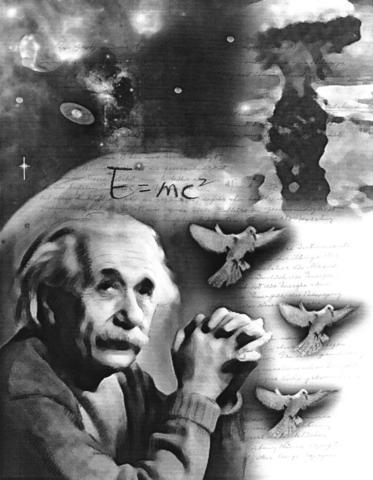
ILLUSTRATION: MAI-YU CHOU
So the ever-impudent Einstein added one extra, vague sentence and returned his dissertation. It was accepted, eventually becoming one of the 20th century's most frequently cited scientific papers. So much for Swiss attention to detail.
And so to May 1905, and Einstein, newly married to his old student flame, Mileva, continued to muse on how atoms behave in liquids, producing a paper which showed their thermodynamic motions were responsible for the strange jiggling of particles suspended in water known as Brownian motion. Not much there, you might think, except for Einstein's ground-breaking use of statistical mechanics, which is now exploited to explain everything from aerosol dispersals to commodity market behavior.
By now, Einstein was on a roll and he produced a real belter for his June offering: "On the Electrodynamics of Moving Bodies." Today, we simply call it the Special Theory of Relativity. Here, Einstein took the notions of absolute space and time that had been enshrined in the theories of Newton and flung them away. There is no such thing as a universal "now," argued Einstein. Our idea of simultaneous events is an illusion. As Peter D Smith says about relativity in Einstein: "The universe is in a real sense no longer a whole but ... a multitude of fragments."
Shattering the cosmos can be tiring, of course, and Einstein, now utterly exhausted, went to bed for a fortnight, leaving Mileva to, as he put it, "solve certain mathematical problems" in his latest paper, thus giving rise to the notion that she was the co-author of his great work, though nearly all biographers now dismiss the idea.
Mileva was little more than a moral support, as Michael White and John Gribbin put it in Einstein: A Life in Science (Free Press, pp279).
In any case, the patent clerk wasn't finished. His relativity paper, among its many revolutionary concepts, placed an absolute limit on the speed of light (30 billion centimeters per second in a vacuum, a constant known as c). Nothing can travel faster, said Einstein. When an object approaches this velocity, the energy used to propel it is turned into mass, making the object heavier and more difficult to accelerate. Thus, energy and mass are equivalent, Einstein wrote in September, in his fifth paper of 1905, a concept which he outlined in what has become the most famous mathematical annotation in the world: E=mc2.
In an intriguing foreword to his essay collection, It Must Be Beautiful: Great Equations of Modern Science (Granta, pp284), editor Graham Farmelo likens the equation to a perfect sonnet. "The great equations are just as rich a stimulus as poetry to the prepared imagination," he says. "Shakespeare could no more have foreseen the multiple meanings readers have perceived in `Shall I compare thee to a summer's day?' than Einstein could have predicted the myriad consequences of his equation." Except that Einstein's equation is beautiful in any language, Shakespeare's in only one.
On the other hand, the equation's beauty is a cold, terrible one. Einstein showed that for any mass (m), if you multiply it twice by the speed of light, the result is its corresponding energy. And there's an awful lot of it, as atomic physicists discovered when they began to use E=mc2 to calculate the energy released in their early fission experiments. The bomb that destroyed Hiroshima in 1945 required many kilograms of uranium to create a sustainable reaction but only about a gram was actually turned into energy. It was still enough to kill more than 100,000 people.
By any standard, 1905 witnessed an astonishing intellectual revolution, thanks to a 26-year-old man who initially had no doctorate, who had been unable to gain even the humblest academic position and did not even have access to an academic library.
Nevertheless, sitting in his tiny apartment where he and Mileva were raising their first son, Hans Albert, or perched at his desk in the Berne Patent Office, Einstein thought about the structure of the universe, before scribbling out, in his spare time, five papers that completely changed our view of the cosmos. As Nigel Calder puts it, rather neatly, in Einstein's Universe: The Layperson's Guide (Penguin, pp191), this was moonlighting on a cosmic scale.
Small wonder 2005 has been named Einstein Year by physicists, offering us a chance to celebrate the centenary of these extraordinary intellectual triumphs. You can listen to Big Audio Dynamite's E=mc2 or DJ Vader's Einstein; or watch Constant Speed, a ballet based on the equation, at Sadler's Wells, London, in May; or catch Insignificance, Terry Johnson's brilliant depiction of a confrontation between Einstein, Marilyn Monroe and Senator Joe McCarthy. A Sheffield Lyceum production is on national tour in the UK, or you can simply read Terry Johnson The Plays: 1 (Methuen, pp209).
Alternatively, you can buy the T-shirts and ties; or attend countless lectures and events to commemorate the centenary; or, best of all, read the avalanche of books, new and repackaged, that has appeared about the man, his life, his times, his spacetime, his thoughts, the fate of his brain, his equations and his universe.
There has never been a better time to take a literary overdose of Einstein.
Of these, Smith's straightforward biography is a perfect place to start. Tight, well-written, strong on historical setting, easily digested and bursting with notes and details of websites, it takes the reader effortlessly through Einstein's arrogant, self-confident youth (he had no academic post in 1905 because he had been so consistently rude to his Zurich University professors) to his transformation to the iconic, bohemian, rheumy-eyed, gently humorous, self-deprecating genius he is remembered as today.
For the science itself, John Rigden's analysis of the great man's five epoch-making papers, Einstein 1905: The Standard of Greatness (Harvard, 173pp) or Farmelo's It Must Be Beautiful are the best bets, particularly the latter, as you get not just explanations of his key 1905 work but several other great theories thrown in for good measure, including Einstein's General Theory of Relativity -- written in 1915 and rated his masterwork -- in which he showed gravity was not a force but a warp in the spacetime continuum.
There were casualties along Einstein's road to greatness, of course, mainly his wives and lovers, whom he treated badly. Indeed, Mileva's first baby with Einstein, their daughter, Lieserl, was given away for adoption before the pair parted on bitter terms a few years later.
Einstein's second wife, his cousin, Elsa, fared only a little better. "Marriage is an undertaking in which, rather shamefully, I failed twice," Einstein acknowledged late in life in a letter to a friend. When faced with personal problems, he simply locked himself away and contemplated his equations.
On the other, he was a pacifist, an internationalist and a courageous opponent of jingoistic nationalism. In 1914, while studying at Berlin University, he unhesitatingly signed an anti-war petition, a brave act in those heady, pro-war days. He also worked tirelessly to help Jews fleeing Nazi Germany and the Soviet Union.
"When Einstein recognized truths about the natural world by pure acts of mind, he exemplified what is best about being human," says Rigden.
"And when, through it all, he exuded a noble modesty, he entered the consciousness of all people."
This is perhaps putting it a little too strongly. Einstein was also a godless man whose waspish views on religion must have offended many, as this quote from Ideas and Opinions by Albert Einstein (Souvenir, pp377) reveals: "I cannot conceive of a God who rewards and punishes his creatures, or has a will of the kind that we experience in ourselves. Neither can I nor would I want to conceive of an individual that survives his physical death: let feeble souls, from fear or absurd egoism, cherish such thoughts." I love that paragraph, but suspect many feeble souls do not.
Better then to remember him by this anonymous epitaph, quoted by Smith, which, if nothing else, neatly celebrates the unique, baffling complexity of his ideas:
There's a wonderful family called Stein,
There's Ep, there's Gert, and there's Ein.
Ep's statues are junk,
Gert's poems are bunk,
And nobody understands Ein.
Einstein, one suspects, would have loved that.
KMT Chairwoman Cheng Li-wun’s (鄭麗文) recent visit to Beijing and her upcoming visit to Washington will serve as a high-level test of her diplomatic mettle. In Beijing, Cheng was received with symbolic gestures, a warm reception, and high-level access. In Washington, she will receive far less pomp and far sharper questions about the KMT’s vision for the future of Taiwan. Her challenge will be to persuade Washington that the KMT’s engagement with China can coexist with strong deterrence. Cheng’s April 7-12 visit to mainland China coincided with an intense period of conflict in Iran. Despite the strategic significance of Cheng’s trip,
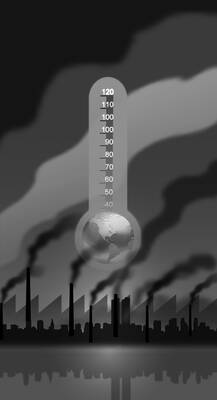
The closure of the Strait of Hormuz has sent the vast Asian chemicals industry into a tailspin. Deprived of the likes of Qatari natural gas and Saudi Arabian oil, the region’s fertilizer and plastics plants are slowing production or even shutting down. Everywhere except China, that is. In petrochemicals, China is unique. As well as a traditional industry that uses oil and gas as feedstock, it has parallel output that relies on its abundant domestic coal. Unsurprisingly, India and other regional powers want to copy and paste the Chinese method. This would not be easy — or climate friendly. The
History might remember 2026, not 2022, as the year artificial intelligence (AI) truly changed everything. ChatGPT’s launch was a product moment. What is happening now is an anthropological moment: AI is no longer merely answering questions. It is now taking initiative and learning from others to get things done, behaving less like software and more like a colleague. The economic consequence is the rise of the one-person company — a structure anticipated in the 2024 book The Choices Amid Great Changes, which I coauthored. The real target of AI is not labor. It is hierarchy. When AI sharply reduces the cost
US President Donald Trump recently repeated his claim that “Taiwan stole America’s chip industry,” reigniting public debate on the issue. As a former Taiwanese minister of economic affairs and an entrepreneur deeply involved in semiconductor supply chain development, I feel a responsibility to clarify this misunderstanding. From the perspective of global industrial evolution and the economic principle of comparative advantage, such a statement appears overly simplistic and risks obscuring the essence of the issue. The rise of Taiwan’s semiconductor industry was not built on “replacing America,” but rather emerged as a result of countries pursuing different development paths within the


 RSS
RSS