

Countries that are rich in natural resources are often poor, because exploiting those resources has taken precedence over good government. Competing oil and mining companies, backed by their governments, are often willing to deal with anyone who can assure them of a concession.
This has bred corrupt and repressive governments and armed conflict. In Africa, resource-rich countries like Congo, Angola and Sudan have been devastated by civil wars. In the Middle East, democratic development has been lagging.
Curing this "resource curse" could make a major contribution to alleviating poverty and misery in the world, and there is an international movement afoot to do just that. The first step is transparency; the second is accountability.
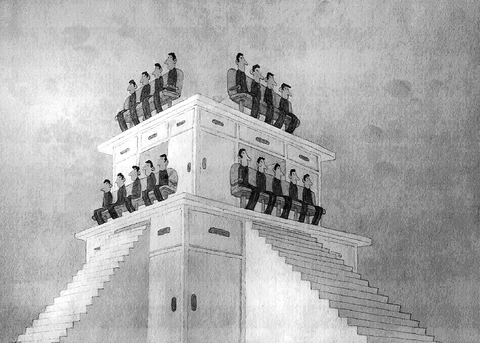
ILLUSTRATION: YU SHA
The movement started a few years ago with the Publish What You Pay campaign, which urged oil and mining companies to disclose payments to governments. In response, the British government launched the Extractive Industries Transparency Initiative (EITI). Three years into the process, the UK convened an important EITI conference in London attended by representatives of governments, business and civil society.
Much has already been accomplished. On the business side, the major international extractive companies have started to acknowledge the value and necessity of greater transparency. British Petroleum has undertaken to disclose disaggregated payment information on its operations in Azerbaijan, and Royal Dutch Shell is doing the same in Nigeria. ChevronTexaco recently negotiated an agreement with Nigeria and Sao Tome that includes a transparency clause requiring publication of company payments in the joint production zone.
Most encouraging is that producing countries themselves are beginning to seize the initiative. Nigeria is reorganizing its state oil company, introducing transparency legislation, and launching sweeping audits of the oil and gas sector. It plans to begin publishing details of company payments to the state this summer.
The Kyrgyz Republic became the first country to report under EITI, for a large gold-mining project. Azerbaijan will report oil revenues later this month. Ghana and Trinidad and Tobago have also signed on. Peru, Sao Tome and Principe, and East Timor are currently in negotiations to implement the initiative.
Equally important, local activists in many of these countries are starting to use EITI as an opening to demand greater public accountability for government spending. My own foundation, the Open Society Institute, has established Revenue Watch programs in producing countries such as Azerbaijan, Kazakhstan, the Kyrgyz Republic, Mongolia and Iraq.
But there is a lot more to be done. Two-thirds of the world's most impoverished people live in about 60 developing or transition countries that depend on oil, mining or gas revenues. The recently published transparency index from Save the Children UK shows that transparency is the exception, not the rule. Many important producing countries have yet to make even a gesture toward disclosure. There is no reason the major Middle Eastern producers should not be part of this transparency push, and Indonesia should join its neighbor East Timor in embracing the EITI. It is also critical that state-owned companies, which account for the bulk of global oil and gas production, be subject to full disclosure.
Other governments need to follow the UK's lead and become involved politically and financially in expanding the EITI. France appears to have done little to encourage countries within its sphere of influence, much less to ensure that its own companies begin disclosing. The Bush administration's recent decision to initiate a parallel anti-corruption process through the G8 leaves the US outside the premier international forum for addressing transparency in resource revenues while unnecessarily reinventing the wheel in the process.
Nor have the US and UK used their power in Iraq to promote transparency in the oil sector. Let us hope that the new Iraqi government does better. It is difficult to see how democracy can take root if the country's most important source of income remains as veiled in secrecy as it was under former Iraqi president Saddam Hussein.
The EITI still has a long way to go, but it is one of the most effective vehicles available for achieving a global standard of disclosure and accountability. This week's summit is an opportunity to assess progress and to define more precisely what it means to implement the EITI by establishing some basic minimum requirements on host countries.
Those committed to seeing the wealth generated by energy and mining finally result in better lives for ordinary people would do well to invest in the initiative during this critical stage. The EITI may not be a catchy acronym, but in concert with civil society efforts such as Publish What You Pay, it promises to do a lot more good in the world than most.
George Soros is president of Soros Fund Management and chairman of the Open Society Institute.
Copyright: Project Syndicate
When Panama severed diplomatic relations with Taiwan and recognized China in 2017, Beijing achieved one of its most important diplomatic victories in Central America. However, nearly a decade later, Panama is demonstrating that diplomatic recognition does not necessarily eliminate Taiwan from a country’s political system. Panama and Taiwan had diplomatic relations for more than 100 years and the goodwill between the countries was displayed last week when Panama’s National Assembly established an interparliamentary exchange group with the Legislative Yuan. Forty-five of the assembly’s 71 lawmakers joined the group, representing more than 60 percent of the legislature. Its members include National Assembly President Shirley
Ten years ago, when I was an undergraduate at National Chung Hsing University (NCHU), there was a referendum on whether to remove a statue of Chiang Kai-shek (蔣介石) from the campus. I wrote to the Liberty Times (the Taipei Times’ sister newspaper) urging faculty, staff and students to vote for its removal. Eventually, the statue was removed from the university. Today, I am filled with emotion at seeing students at Soochow University democratically remove their own statue of Chiang, a figure of authoritarian rule, after it was on display for 48 years The timing is noteworthy, with the nine-in-one local elections approaching.
Beijing has for decades insisted that Taiwan is a matter to be settled between China and the US — or, preferably, by China alone. The strategic environment around Taiwan is making that increasingly difficult. The clearest evidence this week came not from Washington or Beijing, but from Tokyo. Japanese Prime Minister Sanae Takaichi on Tuesday met with US President Donald Trump before his summit with Chinese President Xi Jinping (習近平). Taiwan is expected to feature prominently in US-China talks, particularly as Beijing presses Washington over arms sales to Taipei. However, focusing only on what Trump might or might not concede misses the
On the surface, a radio interview with Democratic Progressive Party and Taipei mayoral candidate Puma Shen (沈伯洋) hosted by television producer Wang Wei-chung (王偉忠) on Sept. 10 came across as an old-time city resident putting questions to a candidate on the campaign trail. Beneath that, however, it was an encounter between two distinct Taiwanese experiences, two generations and two different political vocabularies. Wang grew up in a military dependents’ village. His parents came to Taiwan with the Chinese Nationalist Party (KMT) government, carrying with them the legacy of war, displacement, the loss of a homeland, and an identification with Chinese culture


 RSS
RSS