


I happened to be visiting Beijing when the China's leadership announced the draft "anti-secession law." The belief in China is that President Chen Shui-bian (
Yet this anti-secession legislation is likely to be as counterproductive as China's Taiwan Policy White Paper of 2000, reversing the trend of Taiwan assuming the weakest position in the triangular Taiwan-China-US relationship.
In 1999, the US became rather unsympathetic to Taiwan after former President Lee Teng-hui (
Taiwan's weak position was reversed when China issued its 2000 Taiwan Policy White Paper. In the white paper, China brought up three scenarios in which it would most likely take Taiwan by force. One of these scenarios stated that if Taiwan indefinitely refused to peacefully resolve the cross-strait dispute through negotiations, China could annex Taiwan militarily. This paper immediately generated a backlash in the US, which feared China might resort to force at any time to handle the "Taiwan issue."
Former US president Bill Clinton immediately warned Beijing that the US would continue to reject the use of force to solve the situation, and urged that any change in the status quo would require the Taiwanese people's consent. This turned the tables in Taiwan's favor, putting it in a stronger position than before.
When President Chen put forward the idea of "adopting a new constitution" and "holding a referendum on whether or not to write a new constitution," last year Taiwan again found itself in a disadvantageous position in the China-US-Taiwan relationship.
The US pressured Taiwan not to change the status quo, and claimed that Taiwan was not a sovereign nation. It also said that both sides must move toward "peaceful unification," that the US is not obligated to defend Taiwan and that Taiwan is part of China.
The details of the proposed anti-secession law have yet to be released, but its purpose is to show China's determination to fight against pro-independence forces. It is also a tool in negotiating with the US over the Taiwan issue, and serves as a counterbalance to the US' Taiwan Relations Act.
To demonstrate its anti-independence determination, China will have to deal with the definition of the status quo across the Taiwan Strait. It all boils down to how the Republic of China (ROC) is defined. It is no easy task, and if badly handled it could change the status quo. Taiwan might find a way around the line drawn by Beijing or it may lose restraint.
If China shows its determination to combat pro-independence forces, it must be backed up with the ability to act. In April, in a hearing on Taiwan, James Kelly, the US Assistant Secretary of State for East Asian and Pacific Affairs, said, "The US does not support independence for Taiwan or unilateral moves that would change the status quo as we define it."
This statement indicated that only the US has the power to define the status quo and neither Taiwan nor China can do so.
If Taiwan oversteps China's anti-secession law, but the US does not deem that any change in the status quo has taken place, can China take military action against Taiwan? Or, if China cannot engage in full-scale warfare, might it hunt down pro-independence leaders such as Lee Teng-hui and Chen Shui-bian?
If China fails to act on its new law, and actually is forced to retreat a position dictated by this law, won't this cause pro-independence activists to push even harder for Taiwan's independence?
China seeks to use the anti-secession law and domestic public opinion as a basis for negotiations with the US, but it has failed to realize that the US' Taiwan Relations Act is simply based on the US ability to project power, but really has nothing to do with its domestic law or domestic public opinion.
If public opinion can really be used as a basis for negotiations with the US, then shouldn't China enact a "unification law" rather than making do with anti-secession legislation?
Taiwan should take this opportunity to explain to Washington that if the law passes, it could jeopardize the status quo in cross-strait relations.
Taiwan has to assure the US of the purpose and scope of Taiwan's constitutional re-engineering and mend the rift.
Taiwan should express its determination to maintain the status quo through negotiations and a willingness to explain to China the scope of its constitutional re-engineering, so that the two nations do not get caught in a vicious cycle of misunderstanding that could lead to war.
Tung Chen-yuan is an associate research fellow at the Institute of International Relations at National Chengchi University.
TRANSLATED BY DANIEL CHENG
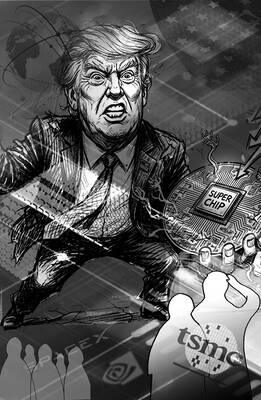
The White House’s decision to take a 9.9 percent stake in Intel Corp is looking like very shrewd business indeed. Since the government bought in at US$20.47 a share last August, the US chipmaker’s surging stock price has delivered the US a US$43 billion return. One of the reasons the investment has so far proved so sound is that the White House has made sure of it. According to The Wall Street Journal, Howard personally pushed deals on Intel’s behalf with some of the most lucrative clients imaginable. They include Nvidia Corp, the company at the heart of the AI
A single photograph can cut through a lot of noise, but it can also be used to misrepresent the truth. At the very least, it can concentrate the mind on something that requires further investigation. On Monday last week, Ma Ying-jeou Foundation CEO Tai Hsia-ling (戴遐齡) and former National Security Council secretary-general King Pu-tsung (金溥聰) held a news conference in which they showed a photograph of former foundation CEO Hsiao Hsu-tsen (蕭旭岑), now Chinese Nationalist Party (KMT) deputy chairman. In the image Hsiao is seated next to Xiamen Taiwan Businessmen Association chairman Han Ying-huan (韓螢煥). The two men were holding
I first met Professor Ray Jiing (井迎瑞) as a film and documentary student at Shih Hsin University’s (SHU) Department of Radio Television and Film in 1988. The following year, he went on to become the director of the Chinese Taipei Film Archive — forerunner of the Taiwan Film and Audiovisual Institute (TFAI). Over his eight-year tenure, Jiing rescued and restored over 200 classic Taiwanese films. In 1997, he established the Graduate Institute of Studies in Documentary and Film Archiving at Tainan National University of the Arts (TNNUA), and I joined the program in his third cohort of students. Beyond a
President William Lai Ching-te’s (賴清德) May 20 second-anniversary address was not just a routine policy review; it was damage control. US President Donald Trump’s remarks — that he did not want to see anyone move toward independence and that the delivery of a major Taiwan arms package could depend on the progress of US-China relations — unsettled Taiwan’s public and created an opening for opposition parties to question whether Taiwan was being treated as a bargaining chip in Washington’s dealings with Beijing. Lai’s speech was designed to close that opening. The address covered the expected ground: sovereignty, cross-strait relations, defense spending,


 RSS
RSS