


Oil prices are now running well above US$50 a barrel, partly owing to short-run supply shocks, such as the Iraq conflict, Nigerian labor disputes, the conflict between Yukos Oil and the Russian government and Florida's recent hurricanes. Oil prices may fall once these shocks dissipate, but speculative effects could keep them relatively high, weakening the world economy and depressing stock markets.
Even a temporary spike in oil prices can have long-term effects because of the social reactions they provoke. High oil prices fuel public discussion about the future of oil prices.
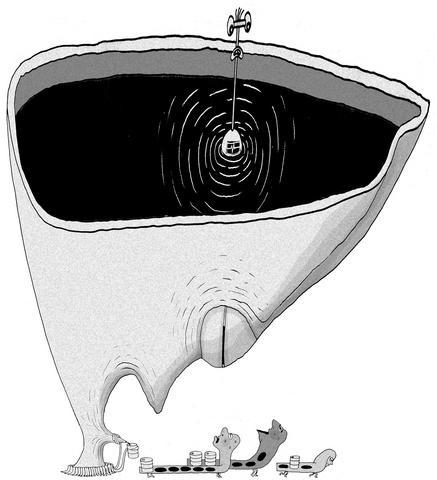
ILLUSTRATION: MOUNTAIN PEOPLE
The outcome of any public discussion can never be known with certainty, but chances are that it will amplify stories that imply risks of higher oil prices.
Experts may say that short-run supply factors caused the recent price increases, but the price increases will nonetheless lend credibility to scarier long-term stories.
The scary story that is being amplified now concerns the developing world, notably China and India, where rapid economic growth -- and no restrictions on emissions under the Kyoto Protocol -- are seen as creating insatiable demands for oil.
The story's premise is that the world will run out of oil faster than we thought, as these billions of people chase their dreams of big houses and sport utility vehicles. Is this plausible?
Certainly, China, India and some other emerging countries are developing fast. But experts find it difficult to specify the long-run implications of this for the energy market.
Too many factors remain fuzzy: the rate of growth of these countries' energy demand, dis-coveries of new oil reserves, developments in oil-saving technology and the ultimate replacement of oil by other energy sources.
But what matters for oil prices now and in the foreseeable future is the perception of the story, not the ambiguities behind it. If there is a perception that prices will be higher in the future, then prices will tend to be higher today. That is how markets work.
If it is generally thought that oil prices will be higher in the future, owners of oil reserves will tend to postpone costly investments in exploration and expansion of production capacity, and they may pump oil at below capacity.
They would rather sell their oil and invest later, when prices are higher, so they restrain increases in supply.
Expectations become self-fulfilling, oil prices rise, a speculative bubble is born.
But if owners of oil reserves think that prices will fall in the long run, they gain an incentive to explore for oil and expand production now in order to sell as much oil as possible before the fall. The resulting supply surge drives down prices, reinforces expectations of further declines, and produces the inverse of a speculative bubble: a collapse in prices.
All of this may seem obvious, but we tend not to think of oil prices as being determined by expectations of future prices.
For example, in January 1974, when the first world oil crisis began, oil prices doubled in just days. The immediate cause was believed to have been Israel's stunning success in the Yom Kippur War, which led Arab oil producers to retaliate by choking off output.
The second crisis, in 1979, is usually attributed to supply disruptions from the Persian Gulf following the Islamic revolution in Iran and the subsequent start of the Iran-Iraq war.
Why, then, did real inflation-corrected oil prices remain at or above their 1974 levels until 1986? Speculative pressures are likely to have been at work, influencing the decisions of OPEC and many others. Although changes in mar-ket psychology are difficult to understand, the broad concerns that underlie such episodes of irrational exuberance are almost always clear.
For example, in 1972, scientists at the Massachusetts Institute of Technology, including computer pioneer Jay Forrester, published The Limits to Growth. The book launched an international debate on whether the world would soon face immense economic problems due to shortages of oil and other natural resources -- problems that seemed to be presaged by OPEC's production cuts 18 months later.
The second crisis was immediately preceded by the accident at the Three Mile Island nuclear reactor in Pennsylvania in March 1979, which reinvigorated the anti-nuclear movement.
With nuclear power -- regarded as the main technological bulwark against depletion of the world's oil supplies -- suddenly suspect, oil prices doubled again by the year's end.
After 1979, fears about limits to growth and nuclear power ebbed. Oil prices gradually fell, and the stock market began its long climb towards its peak in 2000.
But the current rise in oil prices shows that people are still eager to embrace "running out of oil" stories -- this time focused on China and India -- even when short-run factors are to blame.
Indeed, the International Energy Agency (IEA) noted in September that the usual relationship between oil prices and inventory levels has broken down, with prices much higher than the usual relationship would suggest.
The IEA's report calls this breakdown evidence of a "structural shift in the market." But the same pattern followed the 1973 to 1974 and 1979 to 1980 oil crises, when prices dropped from their highest peaks, but stayed quite high for years, representing a drag on the stock market, the housing market, and the world economy.
Let's hope that the effects of the present spike will be more short-lived. But don't hold your breath.
Robert Shiller is professor of economics at Yale University, and author of Irrational Exuberance and The New Financial Order: Risk in the 21st Century.
Copyright: Project Syndicate

KMT Chairwoman Cheng Li-wun’s (鄭麗文) recent visit to Beijing and her upcoming visit to Washington will serve as a high-level test of her diplomatic mettle. In Beijing, Cheng was received with symbolic gestures, a warm reception, and high-level access. In Washington, she will receive far less pomp and far sharper questions about the KMT’s vision for the future of Taiwan. Her challenge will be to persuade Washington that the KMT’s engagement with China can coexist with strong deterrence. Cheng’s April 7-12 visit to mainland China coincided with an intense period of conflict in Iran. Despite the strategic significance of Cheng’s trip,
The closure of the Strait of Hormuz has sent the vast Asian chemicals industry into a tailspin. Deprived of the likes of Qatari natural gas and Saudi Arabian oil, the region’s fertilizer and plastics plants are slowing production or even shutting down. Everywhere except China, that is. In petrochemicals, China is unique. As well as a traditional industry that uses oil and gas as feedstock, it has parallel output that relies on its abundant domestic coal. Unsurprisingly, India and other regional powers want to copy and paste the Chinese method. This would not be easy — or climate friendly. The
US President Donald Trump recently repeated his claim that “Taiwan stole America’s chip industry,” reigniting public debate on the issue. As a former Taiwanese minister of economic affairs and an entrepreneur deeply involved in semiconductor supply chain development, I feel a responsibility to clarify this misunderstanding. From the perspective of global industrial evolution and the economic principle of comparative advantage, such a statement appears overly simplistic and risks obscuring the essence of the issue. The rise of Taiwan’s semiconductor industry was not built on “replacing America,” but rather emerged as a result of countries pursuing different development paths within the
Indonesian President Prabowo Subianto says he knows how to fix the problems facing Indonesia. Yet his economic mismanagement and authoritarian tendencies are steering the nation toward a familiar mix of currency instability and political chaos. The world’s fourth-most populous nation risks reversing the hard-won democratic and business reforms that came after the Asian Financial Crisis in 1997. At that time, the rupiah collapsed and the political upheaval that followed forced former president Haji Mohamed Suharto from power. Prabowo’s administration is ignoring similar warning signs. That disconnect was apparent in a national address on Wednesday, when Prabowo projected the swagger that has


 RSS
RSS