


A year ago it seemed so clear. Then Iraqi president Saddam Hussein's regime, said the politicians and the spies, posed a clear and present danger. It was described most comprehensively on Feb. 5 last year by US Secretary of State Colin Powell in a presentation to the Security Council that laid out the threat in 29 sub-headings.
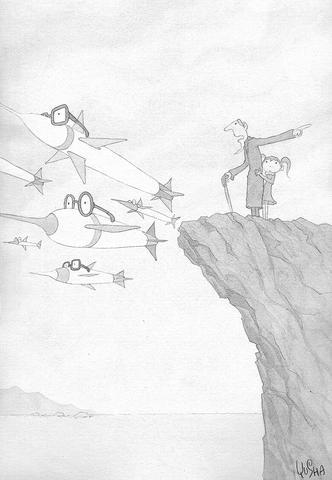
Twelve months have passed, and now the same intelligence officials who produced the stories that scared the world to war are admitting that they got it very badly wrong. And not only do they admit that the intelligence was seriously flawed, they admit, too, that they have known there were no weapons of mass destruction (WMD) in Iraq since the first week of May, a month after Baghdad fell, a secret that has finally lurched into the open.
YUSHA
In a series of interviews, senior former US intelligence officers, members of the weapons community and former senior US policy advisers have said that it was well known in intelligence and senior administration circles by the first week of May that it was extremely unlikely that any weapons would be found.
It is a disclosure that undermines the continued assertions of politicians on both sides of the Atlantic in the months that followed -- including US President George W. Bush and British Prime Minister Tony Blair -- that weapons and weapons programs would be, and had been, found.
The allegations pose serious questions for the British government and the prime minister, raising the possibility that Blair and his officials began their feud with the BBC and Andrew Gilligan after it had become known that the intelligence used to justify Britain's involvement in the war was largely incorrect.
"We had enough evidence at the beginning of May to start asking, `where did we go wrong?'" a senior US intelligence practitioner involved in assessing Iraq's WMD said last week.
The source, an intelligence official who spoke on condition of anonymity, was also scathing about the massive scale of the failure of intelligence over Iraq both in the US and among foreign allies -- alleging that the intelligence community had effectively suppressed dissenting views and intelligence.
The claims are supported by former members of the inspection community and former senior US policy officials who retain close contacts both in the world of intelligence and inspection.
Among them is former UN nuclear inspector David Albright, now president of a Washington think-tank.
"It was known in May," Albright said last week, "that no one was going to find large stockpiles of chemical and biological weapons. The only people who did not know that fact was the public."
The claims that it was widely known in intelligence circles that there were no WMD to be found are confirmed by reports of a statement by an unnamed senior Washington official on May 3, and raised with Blair's office in Downing Street on the same day, that US officials would be "amazed if we found weapons-grade plutonium or uranium."
The official added it was unlikely that large stockpiles of chemical or biological weapons would be found either.
According to the sources contacted last week, the reason for the certainty among intelligence officials was based on the failure of tasked US military units to find any trace of WMD at any of the so-called "sensitive sites" earmarked for inspection, most of which had been visited by late April.
First interviews with senior Iraqi scientists were turning up the same result: the picture painted by the intelligence community of Iraq's WMD was wrong.
The question is, why did the intelligence community get it so wrong? And why, crucially, did Bush and Blair press on for months with their insistence that the WMD existed, after it was clear that the intelligence was hugely flawed?
Robert Einhorn, a former assistant secretary of state for non- proliferation under both Bush and former president Bill Clinton, whose focus was Iraq, believes that missing WMD represent a massive bureaucratic failure by the intelligence community.
Einhorn believes that the most basic intelligence assumptions on Iraq were misguided.
"In retrospect it did not really make sense for Iraq to hold on to large stocks of WMD over a decade to obsolescing junk, when it could meet the letter of the law required by UN resolutions, have sanctions lifted, and covertly develop what you might call a just-in-time WMD capability.
"I am talking about missiles just below the nominal range permitted that could be upgraded quickly, and dual-use facilities that could quickly be turned into a capability for producing chemical and biological weapons.
"What is so remarkable is that it became very quickly apparent in the postwar interviews with scientists and other officials that no one even admitted that even plans such as those existed.
"In our intelligence community there was simply not a lot of incentive to second-guess the casual assumptions of a decade about Iraq. No one was asked to offer alternative explanations for what they were seeing ... to second-guess what had become conventional wisdom."
More serious, in the words of the senior US intelligence official, the intelligence community had forgotten how to do its job.
"We have forgotten how to ask questions. When I started out in intelligence 25 percent of the work would be looking at the current intelligence and 75 percent of the work would be analysing it.
"Now, at a time when we have more intelligence than we have ever had in history, we rely almost exclusively on current intelligence.
"People see stuff and they relate it to what they think they know. They do not ask the hard questions."
He is particularly scathing about the handling of defectors by the US, intelligence that was shared with allies: "Was there ever a study done on this defector intelligence? Did anyone ever ask how good it was? Did anyone ever look deeper into the material? The answer is no."
Worst of all, he believes, intelligence officials failed in one of their most important tasks: They lost the nerve to tell bad news to politicians. "There were dissenting views, analysts who were right. But the dissenters were pushed to the side."
It is a claim corroborated by former CIA anti-terrorism expert Larry Johnson.
"I know for certain that there were analysts in the Defense Intelligence Agency and the State Department and the CIA who took an alternative point of view. [US Vice President] Dick Cheney and [Secretary of Defense] Donald Rumsfeld and ultimately George Bush chose to ignore their cautions. Worst-case scenarios were being taken by policy-makers who were picking and choosing intelligence," he said.
Despite the attempts by the politicians and the spies to blame each other, what emerges from the accounts collected is that the culpability is on both sides: from cherry-picking politicians to intelligence practitioners unwilling to ask difficult questions that might undermine official policy.
The comments are certain to increase pressure on both sides of the Atlantic for independent inquiries into how the intelligence turned out to be so wrong.
Among those who have now joined calls for an inquiry is David Kay, the former head of the Iraq Survey Group, whose resignation comments last week that he now believed the stockpiles of weapons "did not exist" has created political crises in Washington and London.
"It is serious enough," Kay said on Friday. "I wish I believed that it could be done by normal procedures, but I have reluctantly come to the conclusion that we are going to have to go outside for this. Closed orders and secret societies do not engage in internal reform."
The falling-out between the Iraq "hardliners" and the "dissenters" in the intelligence community is mirrored in the bitter recriminations in the weapons inspection community.
And ironically it is Kay who is being blamed for encouraging the politicians in London and Washington.
Albright is harsh in his criticism, claiming that Kay's initial insistence that weapons would be found had made him a "laughing stock."
"The reason that Kay has come clean is that he needed to restore his own credibility. Kay knew a train was coming down the track and jumped out of the way. That is what has caused such immense problems for the administration. He was their strongest terrier and he has turned against them."
A mark of how devastating Kay's declaration has been is evident in the rapid volte-face performed by Bush and his senior officials in recent days, if not by Blair who clings to the belief in the existence of Iraq's WMD.
First to break ranks was Powell, whose presentation at the UN, with its misleading description of experiments on death-row prisoners, of biological armed missiles hidden in palm groves and Iraq's hidden industry of Armageddon, has undermined his credibility.
By last week even Bush was rewriting the reasons for going to war, insisting on Wednesday: "There is no doubt in my mind that Saddam Hussein was a gathering threat to America and others. That's what we know."
While Bush is resisting calls for an inquiry into the intelligence failures, few doubt that damning reports by the House and Senate intelligence committees on the quality of the Iraq intelligence -- due for publication this month -- would be difficult to resist even in an election year.
Blair, too, is likely to face increasing calls for an inquiry when he faces the parliamentary liaison committee this week.
The quality of British intelligence will also come under the spotlight when Downing Street publishes its long-awaited response this week to criticisms from the Intelligence and Security Committee (ISC), which reported last autumn on the September dossier furore.
The ISC concluded the dossier had not been "sexed up," but criticized flaws in the Joint Intelligence Committee (JIC) assessments on which the dossier was based for not making clear "the uncertainties and gaps in the UK's knowledge" of Iraq's banned weapons.
Downing Street will have to tackle its complaints that while there was "convincing intelligence" of chemical and biological weapons, the JIC assessment did not "precisely reflect" what agents had reported and the dossier should have made clear both that Saddam was no direct threat to mainland UK, and that it was not known for sure that he was still producing banned weapons.
"You know, a lot of people have been in denial on this," the senior US intelligence source said. "Some of them still are."

The White House’s decision to take a 9.9 percent stake in Intel Corp is looking like very shrewd business indeed. Since the government bought in at US$20.47 a share last August, the US chipmaker’s surging stock price has delivered the US a US$43 billion return. One of the reasons the investment has so far proved so sound is that the White House has made sure of it. According to The Wall Street Journal, Howard personally pushed deals on Intel’s behalf with some of the most lucrative clients imaginable. They include Nvidia Corp, the company at the heart of the AI
A single photograph can cut through a lot of noise, but it can also be used to misrepresent the truth. At the very least, it can concentrate the mind on something that requires further investigation. On Monday last week, Ma Ying-jeou Foundation CEO Tai Hsia-ling (戴遐齡) and former National Security Council secretary-general King Pu-tsung (金溥聰) held a news conference in which they showed a photograph of former foundation CEO Hsiao Hsu-tsen (蕭旭岑), now Chinese Nationalist Party (KMT) deputy chairman. In the image Hsiao is seated next to Xiamen Taiwan Businessmen Association chairman Han Ying-huan (韓螢煥). The two men were holding
I first met Professor Ray Jiing (井迎瑞) as a film and documentary student at Shih Hsin University’s (SHU) Department of Radio Television and Film in 1988. The following year, he went on to become the director of the Chinese Taipei Film Archive — forerunner of the Taiwan Film and Audiovisual Institute (TFAI). Over his eight-year tenure, Jiing rescued and restored over 200 classic Taiwanese films. In 1997, he established the Graduate Institute of Studies in Documentary and Film Archiving at Tainan National University of the Arts (TNNUA), and I joined the program in his third cohort of students. Beyond a
A recent report concerning a student who is suing his teacher posed the question in its headline: Does failing a student in two subjects constitute bullying? The college student in Chiayi County apparently sought NT$2 million (US$63,603) in state compensation, but a court dismissed the case. The first reaction of many might have been to ask: What has happened to students nowadays? Some say that teachers have lost their authority, while others say students are overindulged. Some even start reminiscing over the days when “whatever the teacher says goes.” However, the real issue might be overlooked if emotional reactions like that are the


 RSS
RSS