


In the last presidential election, the Chinese Nationalist Party (KMT) exposed the Chung Hsing Bills Finance case, which caused a dramatic change in the election situation. James Soong (
It is difficult to predict how this politically sensitive case, which is very likely to influence another election, will turn out. If the prosecutors indict Soong before next year's presidential election, then Soong, the People First Party (PFP) and the entire pan-blue camp will use the claim of political persecution as a major campaign strategy. An indictment would be deleterious to the blue camp, because the Democratic Progressive Party (DPP) government apparently cannot manipulate the prosecutors to either indict him or not.
The public's judgment is already very clear. According to an opinion poll conducted by TVBS on Oct. 24, 53 percent of the public believes Soong has not clarified the matter. Only 16 percent believes he has, while 31 percent has no opinion. The Chung Hsing case is obviously a major test for Soong. It definitely has an impact on the Lien-Soong ticket, but ultimately it is not the most crucial factor.
There are apparently more important factors behind the continuing slide in support rates for the Lien-Soong ticket. In the final analysis, the problem lies with the political characters of Lien and Soong.
The two have been adapting to their roles of presidential and vice presidential candidate. But their basic political characters have not seen any fundamental change. At best, Lien has merely shifted from a gentle appearance to being relatively more abusive. But Lien started heaping abuse on people in the previous election. Soong's criticism of Lien at the time was right on the mark -- he said Lien's special quality is that he does not take any stances on any matter. Soong also stressed that "a person who has no views of his own cannot be a president." Does Lien have any views or stances now? He doesn't, in Soong's eyes, as one can clearly see in Soong's raw obstructionism during the Legislative Yuan's review of Grand Justice nominees in the previous legislative session.
Soong is very domineering, believing that he can control the country by adopting the traditional style of being close to the people. He almost views himself as a wise emperor. He accumulated massive political resources during his days as KMT secretary-general and provincial governor. Many political figures yield obedience to him.
In a democratic era, such an attitude in itself will be faced with a major predicament. The PFP has found it difficult to break free from the predicament of a one-man party. While calling Soong a man with "a wolf's heart and a dog's lungs" in March 2000, Lien also ridiculed his camp as "a small gang talking about being above parties and factions." Soong's single-minded wish to be a wise emperor in a democratic era has a direct bearing on the PFP's failure to widen its scope.
There is a fundamental contradiction in the cooperation between a man with no views and a man with a wolf's heart and a dog's lungs. Even if they win the presidential election, they will not be able to resolve the problems created by such political characters. Lien and Soong need to change their political characters thoroughly if they are really sincere about taking up the heavy responsibility of leading the country.
Chiu Hei-yuan is a professor of sociology at National Taiwan University and a member of the Taipei Society.
Translated by Francis Huang
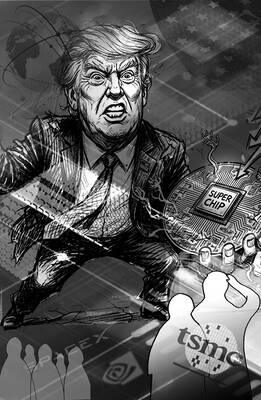
The White House’s decision to take a 9.9 percent stake in Intel Corp is looking like very shrewd business indeed. Since the government bought in at US$20.47 a share last August, the US chipmaker’s surging stock price has delivered the US a US$43 billion return. One of the reasons the investment has so far proved so sound is that the White House has made sure of it. According to The Wall Street Journal, Howard personally pushed deals on Intel’s behalf with some of the most lucrative clients imaginable. They include Nvidia Corp, the company at the heart of the AI
A single photograph can cut through a lot of noise, but it can also be used to misrepresent the truth. At the very least, it can concentrate the mind on something that requires further investigation. On Monday last week, Ma Ying-jeou Foundation CEO Tai Hsia-ling (戴遐齡) and former National Security Council secretary-general King Pu-tsung (金溥聰) held a news conference in which they showed a photograph of former foundation CEO Hsiao Hsu-tsen (蕭旭岑), now Chinese Nationalist Party (KMT) deputy chairman. In the image Hsiao is seated next to Xiamen Taiwan Businessmen Association chairman Han Ying-huan (韓螢煥). The two men were holding
I first met Professor Ray Jiing (井迎瑞) as a film and documentary student at Shih Hsin University’s (SHU) Department of Radio Television and Film in 1988. The following year, he went on to become the director of the Chinese Taipei Film Archive — forerunner of the Taiwan Film and Audiovisual Institute (TFAI). Over his eight-year tenure, Jiing rescued and restored over 200 classic Taiwanese films. In 1997, he established the Graduate Institute of Studies in Documentary and Film Archiving at Tainan National University of the Arts (TNNUA), and I joined the program in his third cohort of students. Beyond a
President William Lai Ching-te’s (賴清德) May 20 second-anniversary address was not just a routine policy review; it was damage control. US President Donald Trump’s remarks — that he did not want to see anyone move toward independence and that the delivery of a major Taiwan arms package could depend on the progress of US-China relations — unsettled Taiwan’s public and created an opening for opposition parties to question whether Taiwan was being treated as a bargaining chip in Washington’s dealings with Beijing. Lai’s speech was designed to close that opening. The address covered the expected ground: sovereignty, cross-strait relations, defense spending,


 RSS
RSS