


For three years, America's president has pursued a unilateralist agenda, ignoring all evidence that contradicts his positions, and putting aside basic and longstanding American principles.
Take global warming. Here US President George W. Bush is conspicuously absent without leave (AWOL in military jargon). Time and again, he questions the scientific evidence. (Of course, Bush's academic credentials were never very impressive.) Bush's position is more than wrong; it is an embarrassment.
Indeed, when asked by Bush to look into the matter, the US National Academy of Sciences came to a resounding verdict (the only one they could honestly reach) that greenhouse gases are a menace. But America's automakers love their gas-guzzlers, and Bush's oil industry pals want no interference with their destruction of the planet's atmosphere. So no change in policy.
In Iraq, Bush again pursued a unilateralist agenda, saying that there was incontrovertible evidence of a link with al-Qaeda, and that former Iraqi president Saddam Hussein had weapons of mass destruction. Even before the invasion, there was overwhelming evidence that Bush was lying. Detection technology made it clear that Iraq did not have nuclear weapons, as chief UN inspector Hans Blix pointed out.
It's possible that Bush read those reports, but that they were beyond his comprehension. It is also possible that he did not believe what he read. Whatever the case, American policy was not based on evidence.
Since the Cold War's end, America is the world's sole superpower. Yet it has failed to exercise the kind of leadership needed to create a new world order based on principles like fairness. Europe and the rest of the world are aware of this; but they don't vote in American elections. Even so, the rest of the world is not powerless. Instead, the rest of the world should just say no.
America has not won the hearts and minds of those in Iraq; indeed, it has lost them, just as it has lost the hearts and minds of much of the world. The US wants to retain control of the occupation, but it wants others to receive the bullets now mowing down American soldiers. UN soldiers should not bear the consequence of America's failure to manage the occupation, so US cries for financial help should fall on deaf ears.
What sympathy does the US agenda deserve, when Bush has ladled out tax cuts of hundreds of billions of dollars to the richest people in the world. It was not long ago that a Republican Congress held up US$1 billion of UN dues, and threatened that it would only pay what it owed if the UN satisfied a raft of conditions. America's unwillingness to provide small sums to wage peace contrasts sharply with the huge amounts Congress quickly granted to wage war.
Advocates of a softer approach say that if the UN stays on the sidelines, it will become irrelevant; by participating in Iraq, it will build trust with the US, so that the next time a dispute such as this arises, America will turn earlier to the UN. Nonsense. Those in the White House today believe in realpolitik. They don't believe in loyalty or trust. If history matters, it matters most significantly in this: those who have shown that they can be pushed around will be pushed around again. If there is a next time, the US will make its judgments on what is in its best interests, regardless of what the UN does.
I normally write about economics, not politics. But in the new world of globalization, there is greater economic interdependence, which requires more collective action, rules and institutions, and an international rule of law. Economic globalization has, however, outpaced political globalization; the processes for decision making are far from democratic, or even transparent. In no small measure, the failures of globalization can be traced to the same mindset that led to the failures in Iraq: multilateral institutions must serve not just one country's interest, but all countries'.
At the recent WTO meeting in Cancun, the developing countries put the US -- and Europe -- on notice that this system can no longer continue. In that case, Europe was as much the culprit as America. Europe has no trouble seeing the dangers of unilateralism in America's actions, in everything from abandoning Kyoto to its refusal to join the International Criminal Court. But Europe should also reflect on its own practices, including trade policy, where the EU works systematically to unbalance the global trade regime against developing countries, despite promising that those imbalances would be corrected in the current round of trade negotiations.
Here, Europe acts like the US, which has long talked the rhetoric of free trade, while its actions have long ignored the principles. Forget about America's rhetoric of upholding fairness and justice; in trade negotiations, the US ignores the pleas of the poorest countries of the world to eliminate the cotton subsidies that have had so devastating an effect on them.
If we are to make the world politically more secure and economically more stable and prosperous, political globalization will have to catch up with economic globalization. Principles of democracy, social justice, social solidarity, and the rule of law need to be extended beyond national boundaries. Europe and the rest of the world will have to do their part -- abiding by these principles themselves, and giving each other, and America, a shove in the right direction. Right now, this entails "Just Saying No" to Bush.
Joseph Stiglitz, a Nobel laureate in economics, is professor of economics at Columbia University and was chairman of the Council of Economic Advisers to former president Bill Clinton and chief economist and senior vice president at the World Bank.
Copyright: Project Syndicate
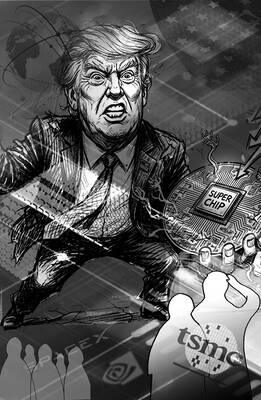
The White House’s decision to take a 9.9 percent stake in Intel Corp is looking like very shrewd business indeed. Since the government bought in at US$20.47 a share last August, the US chipmaker’s surging stock price has delivered the US a US$43 billion return. One of the reasons the investment has so far proved so sound is that the White House has made sure of it. According to The Wall Street Journal, Howard personally pushed deals on Intel’s behalf with some of the most lucrative clients imaginable. They include Nvidia Corp, the company at the heart of the AI
In a Taiwanese university classroom, a lecturer asks in English: “Can anyone give me an example from Taiwan?” Students look down. No one answers. After class, one student writes on the course platform in Mandarin: “I understood the concept, but I didn’t know how to answer in English.” That moment highlights a key issue in Taiwan’s English-medium instruction (EMI) reform: It is not just about more English-taught courses, but whether students can learn, participate and belong. EMI expansion is part of the Bilingual 2030 policy and the Ministry of Education’s BEST Program, aiming to improve English ability, support EMI teaching
A single photograph can cut through a lot of noise, but it can also be used to misrepresent the truth. At the very least, it can concentrate the mind on something that requires further investigation. On Monday last week, Ma Ying-jeou Foundation CEO Tai Hsia-ling (戴遐齡) and former National Security Council secretary-general King Pu-tsung (金溥聰) held a news conference in which they showed a photograph of former foundation CEO Hsiao Hsu-tsen (蕭旭岑), now Chinese Nationalist Party (KMT) deputy chairman. In the image Hsiao is seated next to Xiamen Taiwan Businessmen Association chairman Han Ying-huan (韓螢煥). The two men were holding
The Ministry of the Interior, working with the navy and coast guard, is organizing Taiwan’s first joint exercise simulating escort tankers carrying liquefied natural gas (LNG) and oil through a Chinese blockade. The drills simulate fuel transport along three maritime corridors leading toward Japan, the Philippines and the US. Deputy Minister of the Interior Sawyer Mars (馬士元) said that a blockade of the Taiwan Strait would amount to “almost a 100 percent blockade of the regional energy supply.” Minister of National Defense Wellington Koo said planning to counter a blockade is standard practice in Taipei. While the exercise is limited in


 RSS
RSS