


The British political class is in deep crisis. Its promises are not trusted, its words are not believed. The people who are meant to be our leaders no longer get any real purchase on the public mind.
Many of them know it. Oliver Letwin, one of the few political voices who retains the calm and quizzical tone of a normal human being, alluded to it last Monday morning. The political class needs rescuing from a predicament that poisons the life of the entire country.
The agents of such a rescue are, in fact, to hand. But they lie outside the political class, and the government, befitting its own blindness to the problem, seems determined not to recruit them.
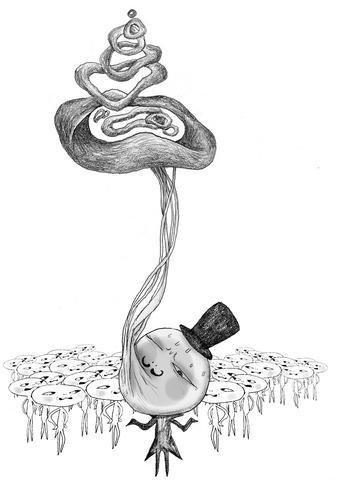
ILLUSTRATION: MOUNTAIN PEOPLE
The Hutton inquiry looks like one form of rescue. Enter the independent judge. He is assigned to drain the heat of partisan battle out of the appalling death of David Kelly. Judges are trusted as politicians seldom are. Lord Hutton, who spent years on the Northern Ireland bench, knows what it is to pick a way between some of the most unforgiving partisans in the world. He may break free from his narrow terms of reference, and plunge into the minutiae about the infamous September dossier -- the 45-minute deployment time for Iraqi weapons of mass destruction, and all that -- that brought about this bloody mess. It will be, after all, hard to divine what Kelly told Gilligan about what Campbell did or did not do without getting into that. The ball of wool is bound to unravel some of the way.
But that's not what the government wants. It wants the threads kept tightly furled. In that respect, Kelly's death is a kind of lurid convenience. It demands inquiry. There has to be a judge. The apparatus of judicial reassurance can therefore be wheeled in, giving a perhaps unwary public the sense that the politicians have subcontracted what bothers people to this agent of untarnished credibility.
However, they have not. The Kelly tragedy is a pimple on the hide of a bigger elephant. Why did British Prime Minister Tony Blair go to war? Was there a discrepancy between his stated reasons and his real reasons? Did he and his people distort intelligence assessments for propaganda (an issue now dogging US President George W. Bush and receiving serious Congressional inquiry)? Was the country manoeuvred into war on a false bill of goods, drawn up sincerely or otherwise? These questions have attracted much more scepticism after the "victory" than before.
They've also been more openly discussed. The intelligence world now has its own briefing methods, which open the sacred veil of silence that has seen off the demands for inquiries in the past.
Defending its refusal to let another judge in to examine the big picture, the government points to the foreign affairs committee and the intelligence and security committee of the Commons. But the one was kept away from key witnesses, the other meets in secret and reports only to the prime minister.
There were times when this might have satisfied a trusting public. Now it runs into the political class problem. Nobody will easily trust the words of political insiders, often not very eminent, reporting to the Supreme Insider and awaiting any acts of censorship it suits him to perform. What the questions need is examination and answer by an outsider, whether a judge or (if such a person exists -- another decline produced by 20 years of partisan politics) a former mandarin of the status of Lord Franks who did the job after the Falklands war.
For the government to concede this, however, would be to sacrifice, as they believe, control. They will not do it. Mirroring the public's lack of trust in government is ministers' lack of trust in the people. They prefer to tough it out on the basis of their own power, rather than delegate decisions to another power, even when that power might be the people themselves.
The case for a referendum on the future European constitution exposes the same pattern of behavior. The government rejects it.
I've argued before that this will be a serious political error. On political grounds alone, the coming stage of constitutional reform offers a perfect opportunity to confront British, or rather English, voters with the choice that has to be made: do they want to be in the EU as about to be roughly shaped, or not? The changes put on the table by the Giscard d'Estaing convention are a clever, moderate and acceptable mix. This is the moment and the method to decide whether the Europhobia that wants to set the clock back several decades will continue to corrode our relations and undermine our ambitions for the indefinite future, or not.
But there's another reason to favour a referendum. It would be a surrender of political power to popular power. It would say: we the political class are failing you, we have not listened enough, we have not been interested in your voices except once every four years, we face a rather desperate need to find new routes to public trust. So we are letting go. We acknowledge that this change in the shape of the EU is indeed constitutional, does mark something pretty big, and merits the thumbprint of the nation to endorse it.
This would be a risky thing to do. The disease of the political class may have reached so far into the nation's bloodstream that when the dominant set of politicians argues for a verdict, that will be enough to send the people the other way. Certainly Blair has far to travel if he is ever to become once again an asset rather than a liability to any of the European causes in which he undoubtedly believes. Whether the referendum were on the euro or the constitution, he would have reason to view it with special trepidation - as, no doubt, he would the judge set loose to examine who told the truth about the case for war against Iraq.
But the alternative is to watch the political class sink further in public esteem. High among the counts against it, some of them exhibited over both Iraq and Europe, are its capacity for twisting evidence, its relentless indulgence in casuistry (viz that Europe is not a constitutional issue, or that the September dossier was in no way souped up), its inability to admit any but the least offensive errors (viz that the February dossier was copied off the web), and its ironclad defensiveness in all circumstances.
I write as one who is not an enemy of politicians, and does not believe their motives are invariably suspect. But the class has a lot to be defensive about. It has come to be seen by many voters if not yet as a public enemy then certainly as suspect number one in the debauching of public life. The Brits' pride in their public standards, compared with those of other countries, lies in ruins. The people offer one road back -- if Blair can bear to trust anyone but himself.
Taiwan-India relations appear to have been put on the back burner this year, including on Taiwan’s side. Geopolitical pressures have compelled both countries to recalibrate their priorities, even as their core security challenges remain unchanged. However, what is striking is the visible decline in the attention India once received from Taiwan. The absence of the annual Diwali celebrations for the Indian community and the lack of a commemoration marking the 30-year anniversary of the representative offices, the India Taipei Association and the Taipei Economic and Cultural Center, speak volumes and raise serious questions about whether Taiwan still has a coherent India
Recent media reports have again warned that traditional Chinese medicine pharmacies are disappearing and might vanish altogether within the next 15 years. Yet viewed through the broader lens of social and economic change, the rise and fall — or transformation — of industries is rarely the result of a single factor, nor is it inherently negative. Taiwan itself offers a clear parallel. Once renowned globally for manufacturing, it is now best known for its high-tech industries. Along the way, some businesses successfully transformed, while others disappeared. These shifts, painful as they might be for those directly affected, have not necessarily harmed society
Democratic Progressive Party (DPP) spokesman Justin Wu (吳崢) on Monday rebuked seven Chinese Nationalist Party (KMT) lawmakers for stalling a special defense budget and visiting China. The legislators — including Weng Hsiao-ling (翁曉玲), Yeh Yuan-chih (葉元之) and Lin Szu-ming (林思銘) — attended an event in Xiamen, China, over the weekend hosted by the Xiamen Taiwan Businessmen Association, where they met officials from Beijing’s Taiwan Affairs Office (TAO). “Weng’s decision to stall the special defense budget defies majority public opinion,” Wu said, accusing KMT legislators of acting as proxies for Beijing. KMT Legislator Wu Tsung-hsien (吳宗憲), acting head of the party’s Culture and Communications
Legislators of the opposition parties, consisting of the Chinese Nationalist Party (KMT) and the Taiwan People’s Party (TPP), on Friday moved to initiate impeachment proceedings against President William Lai (賴清德). They accused Lai of undermining the nation’s constitutional order and democracy. For anyone who has been paying attention to the actions of the KMT and the TPP in the legislature since they gained a combined majority in February last year, pushing through constitutionally dubious legislation, defunding the Control Yuan and ensuring that the Constitutional Court is unable to operate properly, such an accusation borders the absurd. That they are basing this


 RSS
RSS