


US President George W. Bush's determination to act on Iraq without broad international support may be returning to haunt him as the US military struggles to secure and stabilize the country, and few nations appear willing to help out.
India last week rejected a US appeal for 17,000 troops, and key allies like France and Germany say they won't send troops without backing from the UN Security Council.
With the pullout of some US soldiers delayed, and the Pentagon even contemplating adding to the 148,000 strong force in Iraq, the US and Britain face mounting challenges in Iraq with little military assistance from other countries.
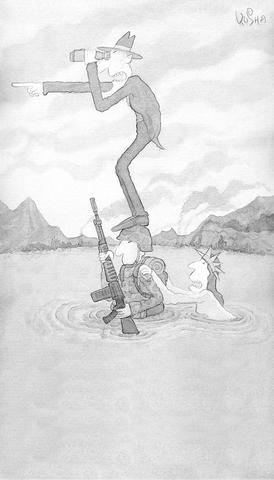
The difficult position in which the US-led coalition now finds itself in Iraq, analysts say, can be traced to the months leading up to the war, when the US failed to secure the support of key countries and made it clear it would handle former president Saddam Hussein alone if it had to.
"The fact is that the failure to gain international community consensus for the war in Iraq is now responsible for the coalition not having what the United States and Iraq needs to develop politically, economically and socially," said retired Army general William Nash, who is now senior fellow at the Council on Foreign Relations.
The Pentagon has been scrambling to find countries willing to assist the already strained US occupation. Only Poland and Spain -- two countries that backed the invasion -- have offered significant military support with logistical support from NATO.
US Secretary of Defense Donald Rumsfeld, increasingly under pressure from Congress to put differences aside and enlist NATO, told lawmakers last week he would welcome the help of other countries, including Germany and France, two nations that bitterly opposed the war.
But so far those calls have gone unheeded, in part because of the "arrogant behavior" exhibited by Bush's administration in the months leading up to the war, says Leon Fuerth, who served as former vice president Al Gore's national security adviser.
"The [Bush] administration needlessly offended people and scared people with its behavior," said Fuerth, now a professor of international relations at George Washington University, in a phone interview.
Bush administration officials, however, assert the US had multilateral support for the war, pointing to a list of some 50 countries that offered a variety of political or logistical support, including Poland and Spain.
But most of those countries have not provided, as the military says, "boots on the ground."
The US is reviewing its options, including the possibility of widening the UN role in Iraq, passing another resolution that explicitly asks nations to provide troops, or pursuing a collective role for NATO.
US Secretary of State Colin Powell said Wednesday he has been talking to UN Secretary General Kofi Annan about a new UN mandate, but added they were only preliminary discussions.
The deteriorating situation in Iraq requires the US involve other countries, said Zbigniew Brzezinski, who served as former president Jimmy Carter's national security adviser.
Brzezinksi said the diplomacy before the war has come back "to haunt us" and the Bush administration must quickly bring an international approach to governing Iraq and a greater role for NATO.
"Unless the United States moves more quickly to do two things -- grant much more authority to the Iraqis much sooner and to internationalize the overall occupation -- we will not have the kind of international support needed militarily and financially," Brzezinski said in an interview.
Regardless of the bitterness over the war, many countries seem willing to put aside those differences and join the effort to secure Iraq's future and alleviate the burden on the US, he said.
While the US explores options, there is debate within the Bush administration on which course to take. While US diplomats see the benefits of a wider UN role, the Pentagon has been reluctant to involve the UN in military operations, and certainly would not be willing to put US troops under a UN command.
Jack Spencer, a national security analyst at the conservative Heritage Foundation, said he also believes the US must soon bring the UN and NATO into the fray, but rejects assertions the US should have gotten more international support before invading Iraq.
"Had we waited around to build a military coalition we would not have gotten this war over as quickly as we did with the relatively few numbers of casualties," he said.
From the Iran war and nuclear weapons to tariffs and artificial intelligence, the agenda for this week’s Beijing summit between US President Donald Trump and Chinese President Xi Jinping (習近平) is packed. Xi would almost certainly bring up Taiwan, if only to demonstrate his inflexibility on the matter. However, no one needs to meet with Xi face-to-face to understand his stance. A visit to the National Museum of China in Beijing — in particular, the “Road to Rejuvenation” exhibition, which chronicles the rise and rule of the Chinese Communist Party — might be even more revealing. Xi took the members
A Pale View of Hills, a movie released last year, follows the story of a Japanese woman from Nagasaki who moved to Britain in the 1950s with her British husband and daughter from a previous marriage. The daughter was born at a time when memories of the US atomic bombing of Nagasaki during World War II and anxiety over the effects of nuclear radiation still haunted the community. It is a reflection on the legacy of the local and national trauma of the bombing that ended the period of Japanese militarism. A central theme of the movie is the need, at
The Chinese Nationalist Party (KMT) and the Taiwan People’s Party (TPP) on Friday used their legislative majority to push their version of a special defense budget bill to fund the purchase of US military equipment, with the combined spending capped at NT$780 billion (US$24.78 billion). The bill, which fell short of the Executive Yuan’s NT$1.25 trillion request, was passed by a 59-0 margin with 48 abstentions in the 113-seat legislature. KMT Chairwoman Cheng Li-wun (鄭麗文), who reportedly met with TPP Chairman Huang Kuo-chang (黃國昌) for a private meeting before holding a joint post-vote news conference, was said to have mobilized her

Before the Chinese Communist Party (CCP) and its People’s Liberation Army (PLA) can blockade, invade, and destroy the democracy on Taiwan, the CCP seeks to make the world an accomplice to Taiwan’s subjugation by harassing any government that confers any degree of marginal recognition, or defies the CCP’s “One China Principle” diktat that there is no free nation of Taiwan. For United States President Donald Trump’s upcoming May 14, 2026 visit to China, the CCP’s top wish has nothing to do with Trump’s ongoing dismantling of the CCP’s Axis of Evil. The CCP’s first demand is for Trump to cease US


 RSS
RSS