


Today, the people of Hong Kong are set to hold the biggest street demonstration since the terri-tory's handover to China in 1997. According to a report in the Hsin Pao newspaper, the government has conducted a survey on the matter. The authorities were shocked to find out that 18 percent of the territory's residents said they would participate in the demonstration.
Chinese Premier Wen Jiabao's (溫家寶) trip to Hong Kong was moved ahead a day in order to avoid the demonstration and the embarrassment. Wen will not get to see the Hong Kong people's anger against Chief Executive Tung Chee-hwa (董建華) and his government. The organizers estimate that 100,000 people will show up for today's demonstration, but the authorities have made preparations for 200,000.
The demonstration is primarily aimed at the legislation mandated by Article 23 of the territory's Basic Law. Tung's government has stubbornly insisted on enacting the law, ignoring the opinions of residents and displaying an extremely thuggish and arrogant attitude. On top of this, the government has -- by its obstinacy and incompetence over the past six years -- caused Hong Kong to sink to the status of the worst-off among the "four Asian dragons."
The political system arranged by China in 1997 ensured that the government can do whatever it wants. The people cannot express their opinions at the ballot box. Some media institutions have also been bought off by China. Having no other choice, the people can only vote with their feet. The US has expressed concern about Hong Kong, but China has invariably rebutted it as "interference in domestic affairs."
Also, some clowns in Hong Kong have ferociously lashed out at the US. Tsang Hin-chi (曾憲梓), a standing committee member of the National People's Congress, warned the US about China's "strength." Martin Lee (李柱銘), the former Democratic Party chairman who has worked to publicize Hong Kong's situation and sought help from the international community, was rebuked by Tung and accused by pro-Communist people of being a collaborator.
The seeds of the Hong Kong people's current predicament were sowed 20 years ago, when China and the UK started negotiations on the territory's future. At the time, the people were deprived of any opportunity to state their opinions. Beijing rejected the participation of residents' representatives in the negotiation, on the grounds that it opposed a "three-legged stool." Nor did Beijing allow the people to express their wishes through a referendum. The so-called "China experts" in Britain dared not oppose Beijing.
As a result, the opinions of the people were ignored. Six million Hong Kong residents were handed over to China's authoritarian regime along with the land. It was a powerful countercurrent against the tide of democracy, followed by an interlude in which China decided to build a nuclear power plant in Daya Bay, which is adjacent to Hong Kong. One million Hong Kong people joined a signature drive to oppose the plant, but Beijing simply ignored it.
No matter how many residents oppose Article 23, the government has always used various despicable ploys to label them a minority opinion. This is because Hong Kong does not have a democratic political system. And of course the government will not allow a referendum on the matter.
Margaret Ng (吳靄儀), a mem-ber of the Legislative Council, asked Tung: How many residents will have to take to the streets to make him stop the legislation? Tung refused to answer the question -- what is he going to do if the number he mentions actually takes to the streets?
But don't expect the authorities to stop the legislation even if 1 million people take to the streets. It may even suppress the opposition harder. But if the people of Hong Kong do not rise and protest, they will lose all opportunities to make improvements and allow themselves to be trampled upon at will.
This reminds one of the referendum issue in Taiwan. If the people of Taiwan are deprived of their rights because of China's opposition, then their nation's destiny will be just like Hong Kong's. Ultimately, not only major public policies but Taiwan's very future could be determined through referendums. No one must be allowed to depict referendums as solely concerned with "Taiwan independence."
According to some opinion polls, a majority of the public supports the pan-blue camp. In that case, unification with China may also have the support of the majority of the people. By opposing referendums, Beijing is opposing a model of democracy, not Taiwan's independence. It is concerned that referendums in Taiwan may stimulate the Chinese public's demands for democracy. This is why Beijing is opposing even referendums on public policies that do not involve Taiwan's future status.
In fact, Taiwan's presidential elections, the first of which was held in 1996, have some characteristics of a referendum -- with each person casting one vote. That was why Beijing fired missiles to oppose the democratic elections. If Taiwanese fears of rising tensions in the Taiwan Strait had been justifiable, then they should have canceled the 1996 presidential elections. Otherwise, why oppose a referendum now?
The US has expressed "concern" because it now needs China's help in the war against terrorism. The US is not opposing the people's basic rights. In light of the Chinese government's thuggish behavior, Taiwan absolutely must not give up on this principle. But it should also maintain necessary coordination with the US.
Referendums can be held on any appropriate issue at any appropriate time. Let Beijing get used to them, just like it's gotten used to Taiwan's democratic elections.
Paul Lin is a political commentator based in New York.
Translated by Francis Huang
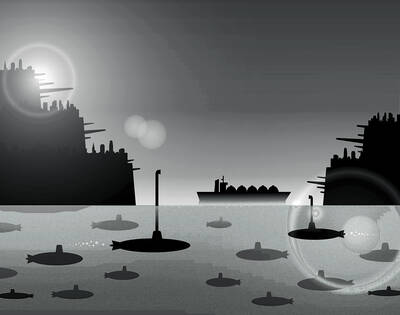
In the event of a war with China, Taiwan has some surprisingly tough defenses that could make it as difficult to tackle as a porcupine: A shoreline dotted with swamps, rocks and concrete barriers; conscription for all adult men; highways and airports that are built to double as hardened combat facilities. This porcupine has a soft underbelly, though, and the war in Iran is exposing it: energy. About 39,000 ships dock at Taiwan’s ports each year, more than the 30,000 that transit the Strait of Hormuz. About one-fifth of their inbound tonnage is coal, oil, refined fuels and liquefied natural gas (LNG),
To counter the CCP’s escalating threats, Taiwan must build a national consensus and demonstrate the capability and the will to fight. The Chinese Communist Party (CCP) often leans on a seductive mantra to soften its threats, such as “Chinese do not kill Chinese.” The slogan is designed to frame territorial conquest (annexation) as a domestic family matter. A look at the historical ledger reveals a different truth. For the CCP, being labeled “family” has never been a guarantee of safety; it has been the primary prerequisite for state-sanctioned slaughter. From the forced starvation of 150,000 civilians at the Siege of Changchun
The two major opposition parties, the Chinese Nationalist Party (KMT) and the Taiwan People’s Party (TPP), jointly announced on Tuesday last week that former TPP lawmaker Chang Chi-kai (張啟楷) would be their joint candidate for Chiayi mayor, following polling conducted earlier this month. It is the first case of blue-white (KMT-TPP) cooperation in selecting a joint candidate under an agreement signed by their chairpersons last month. KMT and TPP supporters have blamed their 2024 presidential election loss on failing to decide on a joint candidate, which ended in a dramatic breakdown with participants pointing fingers, calling polls unfair, sobbing and walking
In the opening remarks of her meeting with Chinese President Xi Jinping (習近平) in the Great Hall of the People in Beijing on Friday, Chinese Nationalist Party (KMT) Chairwoman Cheng Li-wun (鄭麗文) framed her visit as a historic occasion. In his own remarks, Xi had also emphasized the history of the relationship between the KMT and the Chinese Communist Party (CCP). Where they differed was that Cheng’s account, while flawed by its omissions, at least partially corresponded to reality. The meeting was certainly historic, albeit not in the way that Cheng and Xi were signaling, and not from the perspective


 RSS
RSS