


When the SARS panic was at its height last month in Shanghai, the city information department called an urgent press conference. The international car show had just been closed down hurriedly and a team from the World Health Organization was in town. Foreign and domestic journalists packed the room -- some wearing masks -- but they were soon disappointed. A senior official read out an empty statement and then fled without taking questions. His helpful aide had the door open so he could make a quick getaway.
From the cover-up earlier this year to today's comparatively open coverage, it has been a steep learning curve for China's media bureaucrats and for determined journalists pushing at the limits of control.
The epidemic was reported briefly in February when officials in Guangdong Province -- where it broke out -- sought to allay panic. The subject was then banned from all the Chinese media for almost a month in the run-up to and during the National People's Congress -- when only good news is allowed.
After the Congress was over, and the virus had spread north to Beijing, the government at first tried to minimize the crisis.
However the reality of overflowing fever wards, revealed by a whistle-blowing doctor who spoke to the foreign press, finally forced China's leaders -- President Hu Jintao (
Under the shock of SARS, say optimistic analysts, the shift to openness may become irreversible.
"SARS has shattered the philosophy among some bureaucrats that silence on negative things might sustain their power," writes Beijing journalist Lei Xiong. "Now they are made to see that they may lose the power if they fail to give priority to people's well-being."
In private, others are more critical.
"They were playing politics with our lives," says a reporter on a Guangzhou newspaper. "They did not even take the trouble to find out the truth for themselves. The system has got to change."
Is the SARS crisis a "wake-up call" for Beijing that will finally bring about radical changes in the approach to press freedom that even some officials admit privately are long overdue? It is, after all, the first time that high officials have been sacked for negligence, and that a cover-up has been widely admitted. It is now a crime to conceal epidemics.
Or, as more pessimistic observers argue, will the system simply yield some ground while maintaining intact most of its controls?
In the space of a few days in mid-May, the censors blocked out a CNN report on SARS while it was being transmitted via Chinese satellite to authorized mainland viewers. A sophisticated tracking system was used to catch "rumor mongers" who send SMS messages about SARS -- and now face prosecution. Southern Weekend, China's most outspoken newspaper and often in trouble, was criticized for publishing "state secrets" in articles about SARS. And messages taking a "negative" tone posted on internet bulletin boards were either blocked by monitors or removed within minutes of appearing.
A more balanced view sees the media progress over SARS as limited but still significant. It is the latest incremental gain made by Chinese journalists who have "seized the hour" (in Chairman Mao's old phrase) whenever they get the chance.
Chinese reporters who investigate sensitive stories on the ground are supposed to seek permission first from the "relevant authorities." It is the same Catch 22 that faces foreign journalists.
If permission is requested, it will be refused. To go ahead anyway risks being accused of "illegal news-gathering." Chinese journalists have one advantage: they can make a quick entry and exit from the local area with less chance of exposure. But while the foreign journalists only risk the next visa renewal if caught, the domestic reporters risk their jobs.
Some metropolitan dailies, especially the new tabloids which challenge the monopoly of the long-established Communist Party organs, are more willing to take a chance. Journalists from these papers have been threatened and beaten up while covering industrial accidents such as the mining tragedies which kill more than 5,000 workers every year.
Two years ago they filed the first domestic reports on the HIV-Aids scandal in Henan Province in which thousands of peasants were infected with the virus by commercial blood collectors. The operation had been backed by local health officials who then covered up the spread of the virus.
The China Youth and Beijing Youth newspapers often carry hard-hitting reports on natural disasters. In Shanghai, the New People's Weekly has published exposes of social evils such as prostitution and toxic waste.
When SARS appeared in Guangdong Province in January this year, a news blackout was imposed while rumors spread of a new deadly plague which could "kill within a day." The tabloidSouthern Metropolitan Daily received thousands of agitated inquiries from readers, and begged for permission to publish. The provincial government, alarmed by a wave of panic buying as people stocked up on medicine, disinfectants and food, briefly allowed the press to report that everything was "under control."
Gratefully -- or more likely with tongue in cheek -- Southern Weekend and other papers applauded the government for its openness.
They argued that the only way to maintain "social order" (always the regime's top priority) was to keep the public well informed.
Then came the second clampdown in the run-up to the National People's Congress. Southern Weekend stood alone in publishing a bold call for press freedom. It quoted journalists and academics who urged the government not to suppress "negative news". No one mentioned SARS but the link was clear -- for those who knew about the virus.
"The popular press is not just a mouthpiece for important government and party information," wrote former People's Daily editor Zhou Ruijin. "It should also publish in a timely manner what society needs to know."
The grim joke is that Hu and Wen now have to cope with the consequences of a news blackout imposed to give them an easy ride at the Congress where they were formally elected. During that fatal month the virus spread unchecked into the heart of Beijing -- including a case in the top leadership's own guarded compound.
Much of the coverage today adopts the upbeat tone demanded by the party's propaganda departments, but some is more critical, particularly of the poor state of public health in the countryside.
The wide-ranging financial weekly Caijing has documented the death of a retired woman who brought the virus to Shanxi Province and was not diagnosed in time. Her brother had just died in a SARS-infected hospital in Beijing. What a pity, said Caijing, that she "didn't read English or surf the Web or listen to rumors (about the virus)". She might have been able to tell the doctors why she was so ill.
In China's only half-free press, irony is often the most effective weapon.
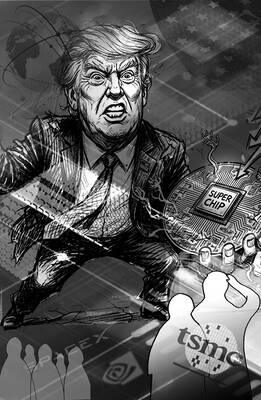
The White House’s decision to take a 9.9 percent stake in Intel Corp is looking like very shrewd business indeed. Since the government bought in at US$20.47 a share last August, the US chipmaker’s surging stock price has delivered the US a US$43 billion return. One of the reasons the investment has so far proved so sound is that the White House has made sure of it. According to The Wall Street Journal, Howard personally pushed deals on Intel’s behalf with some of the most lucrative clients imaginable. They include Nvidia Corp, the company at the heart of the AI
A single photograph can cut through a lot of noise, but it can also be used to misrepresent the truth. At the very least, it can concentrate the mind on something that requires further investigation. On Monday last week, Ma Ying-jeou Foundation CEO Tai Hsia-ling (戴遐齡) and former National Security Council secretary-general King Pu-tsung (金溥聰) held a news conference in which they showed a photograph of former foundation CEO Hsiao Hsu-tsen (蕭旭岑), now Chinese Nationalist Party (KMT) deputy chairman. In the image Hsiao is seated next to Xiamen Taiwan Businessmen Association chairman Han Ying-huan (韓螢煥). The two men were holding
I first met Professor Ray Jiing (井迎瑞) as a film and documentary student at Shih Hsin University’s (SHU) Department of Radio Television and Film in 1988. The following year, he went on to become the director of the Chinese Taipei Film Archive — forerunner of the Taiwan Film and Audiovisual Institute (TFAI). Over his eight-year tenure, Jiing rescued and restored over 200 classic Taiwanese films. In 1997, he established the Graduate Institute of Studies in Documentary and Film Archiving at Tainan National University of the Arts (TNNUA), and I joined the program in his third cohort of students. Beyond a
President William Lai Ching-te’s (賴清德) May 20 second-anniversary address was not just a routine policy review; it was damage control. US President Donald Trump’s remarks — that he did not want to see anyone move toward independence and that the delivery of a major Taiwan arms package could depend on the progress of US-China relations — unsettled Taiwan’s public and created an opening for opposition parties to question whether Taiwan was being treated as a bargaining chip in Washington’s dealings with Beijing. Lai’s speech was designed to close that opening. The address covered the expected ground: sovereignty, cross-strait relations, defense spending,


 RSS
RSS