


EFL study tips
I write to respond to the comments of Chang Yen-chung on the teaching of English in your country, ("Letters," Jan. 15, page 8).
The first thing you must do is define why you are learning English. By this I mean; be clear as to whether you are going to learn English, or any other foreign language, to converse with foreigners, to write English translations of Chinese books or other material, to move to another country where English is the language of use, and so on.
This may sound simplistic but it is very important because these different goals require very different levels of understanding. The students themselves can do a great deal to help themselves in this matter. They can, for example, buy English newspapers such as the Taipei Times and learn to read them. Also, the Internet can be of enormous benefit here because of its ability to give you access to any country's press and literature. Students can also seek out places where English is spoken regularly and learn from the people they meet. Another possibility is for students to seek English-speaking pen-pals with whom to exchange letters or e-mail.
Most important of all, any English program must teach the student how to think in English. If you cannot think in English you will never be able to learn to speak or write effectively in English. No one, regardless of his or her skill at memorization, can hold more than one language at a time in his or her mind. As a personal example of this, I live in Canada and own several power tools which are made in Taiwan. The machines are very well made and work perfectly. But the operators manuals can be very difficult to understand because they were translated into English by people who were still thinking in Chinese. Other examples can be found on a Web site called, www.engrish.com. These examples may seem amusing to us Westerners, but I don't think they are amusing to the people who wrote them.
I agree completely with Chang Yen-chung's idea that English immersion is one of the best ways to learn. If a student is placed in an environment in which English is the only language that is spoken or written, he or she is forced to learn it. This can be difficult to do in reality though. Exchange programs with English-only schools are one possibility, although I don't know how practicable that is in Taiwan. Advanced students might consider an exchange program with a school in the US or Canada, although again I do not know how practical this is.
Lastly, any person hired to teach English in your country should have at least a basic understanding of your culture and history and speak a little Chinese. This will add enormously to his or her credibility with the students. My nephew is teaching English in South Korea and is taking a sabbatical to attend a Korean university to study the Korean language and culture. He thinks it will help him a great deal to relate to his students in the future.
Earl Goudie
British Columbia,Canada
Two sides to IPR issues
Your editorial "Taiwan: keep walking with IPR" is simplistic (Jan. 16, page 8).
The recently settled Californian class action against Microsoft has shown that consumers may be overcharged when buying from monopolies. IPR creates a monopoly. So governments need to back up the privilege of intellectual property rights with laws that ensure consumers are not overcharged.
People have no respect for thieves; but when consumers see that they are being overcharged, who are the thieves?
Rick Jelliffe
Sydney, Australia
North Korean movie reviews
I didn't see the new Bond movie Die Another Day, but now that I have read the review from the North Korean SCPRF press office, I'm glad I didn't. The SCPRF is the Secretariat of the Committee for the Peaceful Reunification of the Fatherland. But I suppose everybody already knows that. Who doesn't read the SCPRF movie reviews in the DPRK press these days?
The SCPRF thought the Bond movie wasn't too good except for its special effects. In fact it was mostly nothing but a "dirty and cursed burlesque" and a "premeditated act of mocking."
The villain in the movie does not represent the true face of North Korea. That the movie came from the American motion picture industry only proves one thing: the US is "the headquarters that spreads abnormality, degeneration, violence and fin de siecle, corrupt, sex culture."
Eric Mader-Lin
Taipei
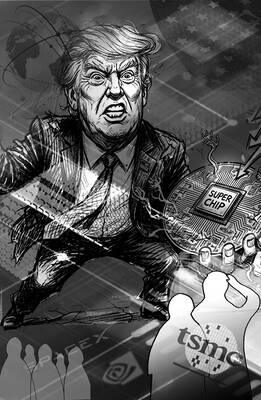
The White House’s decision to take a 9.9 percent stake in Intel Corp is looking like very shrewd business indeed. Since the government bought in at US$20.47 a share last August, the US chipmaker’s surging stock price has delivered the US a US$43 billion return. One of the reasons the investment has so far proved so sound is that the White House has made sure of it. According to The Wall Street Journal, Howard personally pushed deals on Intel’s behalf with some of the most lucrative clients imaginable. They include Nvidia Corp, the company at the heart of the AI
In a Taiwanese university classroom, a lecturer asks in English: “Can anyone give me an example from Taiwan?” Students look down. No one answers. After class, one student writes on the course platform in Mandarin: “I understood the concept, but I didn’t know how to answer in English.” That moment highlights a key issue in Taiwan’s English-medium instruction (EMI) reform: It is not just about more English-taught courses, but whether students can learn, participate and belong. EMI expansion is part of the Bilingual 2030 policy and the Ministry of Education’s BEST Program, aiming to improve English ability, support EMI teaching
The Ministry of the Interior, working with the navy and coast guard, is organizing Taiwan’s first joint exercise simulating escort tankers carrying liquefied natural gas (LNG) and oil through a Chinese blockade. The drills simulate fuel transport along three maritime corridors leading toward Japan, the Philippines and the US. Deputy Minister of the Interior Sawyer Mars (馬士元) said that a blockade of the Taiwan Strait would amount to “almost a 100 percent blockade of the regional energy supply.” Minister of National Defense Wellington Koo said planning to counter a blockade is standard practice in Taipei. While the exercise is limited in
A single photograph can cut through a lot of noise, but it can also be used to misrepresent the truth. At the very least, it can concentrate the mind on something that requires further investigation. On Monday last week, Ma Ying-jeou Foundation CEO Tai Hsia-ling (戴遐齡) and former National Security Council secretary-general King Pu-tsung (金溥聰) held a news conference in which they showed a photograph of former foundation CEO Hsiao Hsu-tsen (蕭旭岑), now Chinese Nationalist Party (KMT) deputy chairman. In the image Hsiao is seated next to Xiamen Taiwan Businessmen Association chairman Han Ying-huan (韓螢煥). The two men were holding


 RSS
RSS