


The public outrage in Taiwan over an ad that implied Taiwan goods are substandard by the maker of Johnnie Walker whisky, and the passage of a resolution by Taiwan's Legislative Yuan that urged suspension of sales of the whisky for one year as punishment for the ad would seem to suggest that Taiwanese do care about their country's image. But, the overflow of counterfeit goods, which is becoming an increasingly sore spot in Taiwan's relationship with important trade partners such as the US, would seem to suggest the opposite.
In fact, it was revealed this week that pirated DVDs of the latest James Bond movie Die Another Day are already hot-selling items in night markets. Worse yet, reportedly the pirates were so brazen as to run the line "come get me, if you can, [Minister of Justice] Chen Ding-nan (
Surely Taiwanese consumers must know that Taiwan's reputation as a haven for counterfeiting isn't exactly facilitating a positive international image of their country. Yet, counterfeit goods continue to do enormously well.
The reason may be that, as much as Taiwanese care about the image of their country in the international community, any such concern fades in the face of a good bargain. So, money saved from buying pirated CDs and DVDs in night markets at a price less than one-tenth of the sale price of non-pirated copies must mean much more than the international image of Taiwan to many Taiwanese. If that is the case, then the image of this country isn't worth much after all.
Theft of intellectual property is of course not a problem unique to Taiwan. What is unique and almost fascinating about the case, is the way that many purchasers of pirated goods openly claim, in a righteous attitude, that they are doing nothing wrong. During recent negotiations with the Board of Foreign Trade, it must have been an eye-opener for the American side to see so many college students, many of whom were from top universities, protesting against US pressure on the Taiwan government to clean up unauthorized copying of foreign textbooks on campus.
One argument purchasers of pirated goods often raise is that they don't want to pay an arm and a leg for so-so CDs and DVDs, and that it is the movie industry's own fault for not being unable to produce something more marketable. This begs the question, why don't they simply refuse to buy these so-so CDs and DVDs and let the laws of supply and demand work? Their argument falls on its face because top-selling movies and albums on the legal market also happen to be top sellers on the pirated market.
Then there are those who respond by mixing the issues, labeling American pressure to crack down on piracy as foreign oppression, they find justification for refusing to comply with intellectual property rights (IPR) laws.
On Tuesday, during a meeting with US Congressman F. James Sensenbrenner Jr., who is the chairman of the House Judiciary Committee, President Chen Shui-bian (
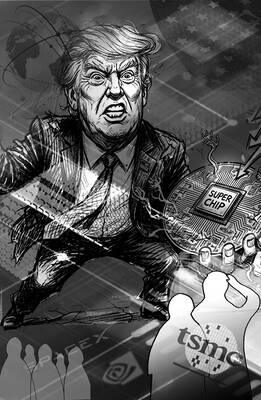
The White House’s decision to take a 9.9 percent stake in Intel Corp is looking like very shrewd business indeed. Since the government bought in at US$20.47 a share last August, the US chipmaker’s surging stock price has delivered the US a US$43 billion return. One of the reasons the investment has so far proved so sound is that the White House has made sure of it. According to The Wall Street Journal, Howard personally pushed deals on Intel’s behalf with some of the most lucrative clients imaginable. They include Nvidia Corp, the company at the heart of the AI
In a Taiwanese university classroom, a lecturer asks in English: “Can anyone give me an example from Taiwan?” Students look down. No one answers. After class, one student writes on the course platform in Mandarin: “I understood the concept, but I didn’t know how to answer in English.” That moment highlights a key issue in Taiwan’s English-medium instruction (EMI) reform: It is not just about more English-taught courses, but whether students can learn, participate and belong. EMI expansion is part of the Bilingual 2030 policy and the Ministry of Education’s BEST Program, aiming to improve English ability, support EMI teaching
The Ministry of the Interior, working with the navy and coast guard, is organizing Taiwan’s first joint exercise simulating escort tankers carrying liquefied natural gas (LNG) and oil through a Chinese blockade. The drills simulate fuel transport along three maritime corridors leading toward Japan, the Philippines and the US. Deputy Minister of the Interior Sawyer Mars (馬士元) said that a blockade of the Taiwan Strait would amount to “almost a 100 percent blockade of the regional energy supply.” Minister of National Defense Wellington Koo said planning to counter a blockade is standard practice in Taipei. While the exercise is limited in
A single photograph can cut through a lot of noise, but it can also be used to misrepresent the truth. At the very least, it can concentrate the mind on something that requires further investigation. On Monday last week, Ma Ying-jeou Foundation CEO Tai Hsia-ling (戴遐齡) and former National Security Council secretary-general King Pu-tsung (金溥聰) held a news conference in which they showed a photograph of former foundation CEO Hsiao Hsu-tsen (蕭旭岑), now Chinese Nationalist Party (KMT) deputy chairman. In the image Hsiao is seated next to Xiamen Taiwan Businessmen Association chairman Han Ying-huan (韓螢煥). The two men were holding


 RSS
RSS