


During their meeting in Crawford, Texas, in late October, Chinese President Jiang Zemin (
Jiang's offer was made mainly out of consideration of the following points.
First, the US began to strengthen military exchanges with Taiwan when former US president Bill Clinton was in power. Although the US Congress did not pass the Taiwan Security Enhancement Act, most of the provisions of that bill can be seen in various national defense authorization and appropriation bills.
In addition to the massive arms sales to Taiwan by the Bush government in April last year, the US plan to include Taiwan in its missile defense system is interpreted by Beijing as another step toward a quasi-military coalition with Taiwan. Adding to China's concerns are pro-independence forces. Beijing has sought to reverse this trend.
Second, the Bush administration's speedy deployment of its global missile defense system is ostensibly aimed at "rogue states" and the "axis of evil."
But Beijing is aware that the US views China as a potential enemy and therefore wishes to disabuse the American people of that image.
Third, whenever China demands that the US abide by the terms of the joint communique and scale down its arms sales to Taiwan, the US always rejects the plea, raising the issue of China's missile threats against Taiwan.
And fourth, Taiwan has launched a campaign to oppose China's missile deployment along its southeast coast, which has hurt China in the international community.
China can expect to benefit from its offer. First, it hopes the US administration will appreciate its "goodwill" and be further persuaded that China can be its partner.
Second, the American people might indeed change their impression of China.
Third, the offer will have an international public-relations effect, even before any negotiations with the US.
Fourth, since the deterrence effect on Taiwan of ballistic missiles has been diminishing, China has little to lose by removing them. If an emergency were to arise in the Taiwan Strait or if Taiwan decided to declare independence, China could simply redeploy them with considerable effect.
And fifth, Beijing wants to sound out the US about its real intentions in selling weapons to Taiwan.
But Jiang's offer will not necessarily serve its intended purposes. There are several reasons for this. First, US arms sales to Taiwan are conducted in accordance with the Taiwan Relations Act and supervised by Congress.
Second, the arms sales form an element of US global strategic considerations.
Third, they involve the US military-industrial complex and reflect the interests of the US weapons industry.
Fourth, since contradictions and conflicts still exist between the basic structural and strategic interests of the US and China, it is not easy for them to reach common ground on this issue.
And fifth, in this post-Cold War era, the US would not go so far as sacrificing arms sales to Taiwan for the sake of its war on terror.
Because the US and China are working closely together in the fight against terrorism, however, we should keep in mind that the US might, under various pretexts, stop providing certain weapons systems to Taiwan temporarily or even for a protracted period.
Although Taiwan only has limited influence on this issue, the government should still comment publicly in response.
Taipei may say that it welcomes any statements and gestures from Beijing which are conducive to peaceful dialogue across the Strait, that it welcomes Beijing's offer to remove the missiles or place a freeze on deployments, and that it hopes Beijing can express genuine goodwill by removing the missiles unconditionally.
Further, it could say that Taiwan's ballistic missiles and the cruise missiles deployed on Kidd-class destroyers and F-16 fighter planes all have long ranges, but that Taiwan has no intention of launching them unless it is attacked. Taipei may warmly welcome any indication from Beijing that it is disposed to negotiate on confidence-building measures with Taipei regarding missile deployments.
Finally, if China ignores Taiwan's goodwill or does not reciprocate, Taiwan should explain to the world that China's offer to remove missiles in exchange for reduced US arms sales to Taiwan was an insincere offer.
Edward Chen is the director of the Graduate Institute of American Studies at Tamkang University.
Translated by Jackie Lin
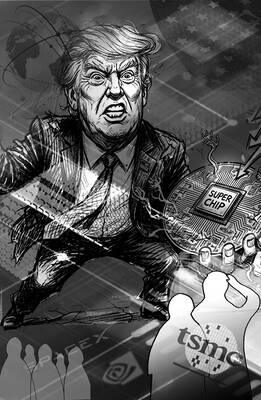
The White House’s decision to take a 9.9 percent stake in Intel Corp is looking like very shrewd business indeed. Since the government bought in at US$20.47 a share last August, the US chipmaker’s surging stock price has delivered the US a US$43 billion return. One of the reasons the investment has so far proved so sound is that the White House has made sure of it. According to The Wall Street Journal, Howard personally pushed deals on Intel’s behalf with some of the most lucrative clients imaginable. They include Nvidia Corp, the company at the heart of the AI
The Ministry of the Interior, working with the navy and coast guard, is organizing Taiwan’s first joint exercise simulating escort tankers carrying liquefied natural gas (LNG) and oil through a Chinese blockade. The drills simulate fuel transport along three maritime corridors leading toward Japan, the Philippines and the US. Deputy Minister of the Interior Sawyer Mars (馬士元) said that a blockade of the Taiwan Strait would amount to “almost a 100 percent blockade of the regional energy supply.” Minister of National Defense Wellington Koo said planning to counter a blockade is standard practice in Taipei. While the exercise is limited in
A single photograph can cut through a lot of noise, but it can also be used to misrepresent the truth. At the very least, it can concentrate the mind on something that requires further investigation. On Monday last week, Ma Ying-jeou Foundation CEO Tai Hsia-ling (戴遐齡) and former National Security Council secretary-general King Pu-tsung (金溥聰) held a news conference in which they showed a photograph of former foundation CEO Hsiao Hsu-tsen (蕭旭岑), now Chinese Nationalist Party (KMT) deputy chairman. In the image Hsiao is seated next to Xiamen Taiwan Businessmen Association chairman Han Ying-huan (韓螢煥). The two men were holding
I first met Professor Ray Jiing (井迎瑞) as a film and documentary student at Shih Hsin University’s (SHU) Department of Radio Television and Film in 1988. The following year, he went on to become the director of the Chinese Taipei Film Archive — forerunner of the Taiwan Film and Audiovisual Institute (TFAI). Over his eight-year tenure, Jiing rescued and restored over 200 classic Taiwanese films. In 1997, he established the Graduate Institute of Studies in Documentary and Film Archiving at Tainan National University of the Arts (TNNUA), and I joined the program in his third cohort of students. Beyond a


 RSS
RSS