


It has been 55 years since the 228 Incident occurred in 1947. Over the past 10 years, the government has apologized for the incident, erected a memorial, built a museum, designated a public holiday, set up a foundation and enacted legislation to compensate the victims and their families and restore their reputations. But every year, when the 228 anniversary comes, family members of victims still feel a pain that just won't go away.
The 228 Incident began in Taipei City but the unrest spread to all of Taiwan. Being the mayor of Taipei City, I have the responsibility to express condolences to the victims of the incident on behalf of all Taipei residents and to extend our regards to their families who lived in the shadow of suffering for many long years.
At the same time, looking toward the future, I am willing to take a look back at this incident, which had such an impact on Taiwan's history, from a different point of view.
The 228 Incident occurred at a time when the public was facing dire circumstances caused by the Chinese Civil War that followed World War II. The government of then governor Chen Yi (
After the incident, the government was not only unable to reflect on it or practice democracy in accordance with the wishes of the people, but instead sent troops to suppress the resulting uprising and make widespread arrests, leaving a deep scar in the history of Taiwan. We should bear this bloody lesson in mind and not repeat it. We should seek to transform it into a firm belief in democracy and the action to uphold it.
I believe that although democracy provides a basic guarantee for a stable society, the system has to be promoted by people and its success or failure still relies on whether the good aspects of human nature can be brought into full play. Can the 228 Incident give us an opportunity to develop those aspects? I believe so.
Some mainlanders were beaten and injured during the 228 Incident and its aftermath. But a committee established by the Taiwanese elite promptly controlled the situation through broadcasts.
At the beginning of March 1947, the committee released an official Letter to the Nation's Compatriots (告全國同胞書), which said, "The occurrence of the 228 Incident was aimed at cleaning up corruption among public officials and striving for political reforms in Taiwan and not at rejecting the mainland compatriots. We welcome you to participate in the task of reforming Taiwan's politics and help bring Taiwan's politics to a clear state as soon as possible. It is hoped that compatriots from various provinces who are concerned about the nation can enthusiastically take part and shake hands with us ... The beatings of some mainland compatriots on Feb. 28 resulted from fleeting misunderstandings. We feel greatly distressed by them, for it was also a disaster for our compatriots ..."
This was a solemn statement by Taiwanese representatives. The protection of upright and innocent mainlanders by Taiwanese was common at the grassroots level of society. For example, Yan Chia-kan (嚴家淦), then director of the finance bureau in the Taiwan governor's office, was protected by Lin Hsien-tang (林獻堂) and Luo Wan-chu (
We should always remember that, whether we are dealing with committees or the public, the majority of Taiwanese showed a high degree of care and love for mainlanders. They have been brave and benevolent, asking nothing in return. Some even sacrificed their lives to protect others.
After military suppression began in Taiwan on March 10, The Horrifying Inspection, based on the 228 Incident, was created by Huang Jungtsan (黃榮燦), a block print artist who arrived in Taiwan from China shortly after retrocession. This piece was later published in the Shanghai newspaper Wen Wei Po (文匯報), expressing the anger felt by mainland intellectuals over the government's bloody suppression as well as their sympathy for the Taiwanese people.
In fact, Chinese publications outside Taiwan blamed the government for the incident, accusing it of being delinquent in carrying out its duties and criticizing the deployment of troops to suppress the uprising as a big mistake. There were pages and pages of criticism in the Hsinwen Tienti (新聞天地), the Analects Fortnightly (論語半月刊), the Chengchi Monthly (正氣月刊) and even in the China-US Weekly (中美週報).
By March 14, the crackdown had already caused severe casualties. A strident column in the Ta Kung Pao (
Today, most of Taiwan's historians believe that the Chinese Communist Party played a very limited role in the "228 Incident." The support for Taiwan among the intelligensia in the mainland was not incited by any political party, as they were simply expressing their innermost thoughts.
However, the 228 Incident also highlighted the bright side of human nature, which has deeply inspired me. The state machine must remain neutral and law and order in a democratic society must be maintained. The basis for this is unity among the ethnic groups. Only this bright side of human nature can prevent the scars of the incident -- which have yet to heal completely -- from widening.
Unity among the ethnic groups has been the foundation on which we strove together for Taiwan's economic and political miracles in the second half of last century. It has also become the unshakable foundation of our society.
To commemorate the 228 Incident today, we must also safeguard peace -- apart from mourning the dead and comforting those still alive. We must not allow our civilization to be damaged or humanity to be distorted by war. We must uphold brotherly love and let it become the driving force behind sincere unity and continual progress in society in Taiwan.
Ma Ying-jeou is the mayor of Taipei City.
Translated by Francis Huang, Jackie Lin, Perry Svensson
and Eddy Chang
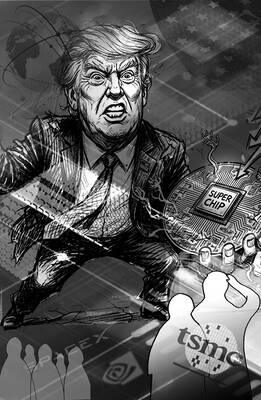
The White House’s decision to take a 9.9 percent stake in Intel Corp is looking like very shrewd business indeed. Since the government bought in at US$20.47 a share last August, the US chipmaker’s surging stock price has delivered the US a US$43 billion return. One of the reasons the investment has so far proved so sound is that the White House has made sure of it. According to The Wall Street Journal, Howard personally pushed deals on Intel’s behalf with some of the most lucrative clients imaginable. They include Nvidia Corp, the company at the heart of the AI
A single photograph can cut through a lot of noise, but it can also be used to misrepresent the truth. At the very least, it can concentrate the mind on something that requires further investigation. On Monday last week, Ma Ying-jeou Foundation CEO Tai Hsia-ling (戴遐齡) and former National Security Council secretary-general King Pu-tsung (金溥聰) held a news conference in which they showed a photograph of former foundation CEO Hsiao Hsu-tsen (蕭旭岑), now Chinese Nationalist Party (KMT) deputy chairman. In the image Hsiao is seated next to Xiamen Taiwan Businessmen Association chairman Han Ying-huan (韓螢煥). The two men were holding
I first met Professor Ray Jiing (井迎瑞) as a film and documentary student at Shih Hsin University’s (SHU) Department of Radio Television and Film in 1988. The following year, he went on to become the director of the Chinese Taipei Film Archive — forerunner of the Taiwan Film and Audiovisual Institute (TFAI). Over his eight-year tenure, Jiing rescued and restored over 200 classic Taiwanese films. In 1997, he established the Graduate Institute of Studies in Documentary and Film Archiving at Tainan National University of the Arts (TNNUA), and I joined the program in his third cohort of students. Beyond a
President William Lai Ching-te’s (賴清德) May 20 second-anniversary address was not just a routine policy review; it was damage control. US President Donald Trump’s remarks — that he did not want to see anyone move toward independence and that the delivery of a major Taiwan arms package could depend on the progress of US-China relations — unsettled Taiwan’s public and created an opening for opposition parties to question whether Taiwan was being treated as a bargaining chip in Washington’s dealings with Beijing. Lai’s speech was designed to close that opening. The address covered the expected ground: sovereignty, cross-strait relations, defense spending,


 RSS
RSS