


The shelves are packed with imported food, but the ersatz prosperity of the newly opened “Gaza Mall” hides the lingering malaise haunting the impoverished territory.
The two-story supermarket in Gaza City opened its doors shortly after Israel partially lifted a four-year blockade of the Hamas-run enclave in June following an international outcry over the deadly seizure of an aid flotilla.
Three months later, it sells everything from Nestle cereals and Galaxy chocolate to blue jeans and toys, nearly everything imported from Israel. Newly released data show the economy is starting to recover.
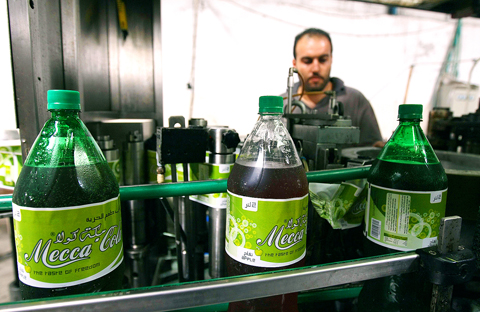
PHOTO: AFP
But weary factory owners say they are being squeezed out of business by the new imports and more than a third of the Gaza workforce remains unemployed.
“Because of the entry of products from Israel, the West Bank and Jordan after the Freedom Flotilla incident we had to stop one of our production lines,” said Musa Siyam, the owner of the Mecca Cola plant outside Gaza City. “We couldn’t compete on price because there are still raw materials we cannot bring into Gaza ... I had to lay off 20 workers.”
Sunlight slants down from the factory’s high metal walls through a splattering of bullet holes left over from the 2008 to 2009 Gaza war and machines struck by rockets sit unused in the darker corners.
Siyam had already shut down two other production lines because of damage from the war, but kept the factory afloat by bringing in raw materials through smuggling tunnels from Egypt and selling to the besieged local market.
But even with the easing of the blockade, he has not been able to bring in carbon dioxide, forcing him to manufacture his own at much greater expense.
“We can’t compete with them on price ... The prices have fallen so far that we don’t make a profit anymore and sometimes we lose money,” he said.
His experience is shared by other factory owners and in part explains findings by the IMF presented to international donors last week on the sidelines of the UN General Assembly.
It found Gaza’s economy had grown by 16 percent in the first half of the year — from an extremely low base — but that unemployment had held steady at 37 percent, among the highest in the world.
“Producers are still constrained from the input side and the output side,” said Oussama Kanaan, the report’s author, adding that the growth rate would soon wane if further restrictions were not lifted.
Even with the partial easing, Gaza is only importing a fraction of what it was prior to the blockade.
“Raw materials are now 4 percent of 4,000 trucks a month as opposed to 13.5 percent of 10,400 trucks a month,” said Sari Bashi, the head of the Gisha Legal Center, an Israeli group that tracks the closures.
“Other than allowing in Israeli-made consumer products and some raw materials, there has been no change. Export is banned, the movement of people is banned and Israel’s economic warfare is far from over,” she added.
Israeli officials have denied restricting civilian imports and blamed the Western-backed Palestinian Authority for failing to coordinate shipments.
“We have said the crossing is able to handle 250 trucks [per day],” said Major Guy Inbar of the Israeli government’s coordination and liaison office. “They never could get to that number because of problems of coordination.”
The Palestinian Authority — which was driven out of Gaza by Hamas and has been confined to the West Bank since 2007 — has denied such allegations, insisting that Israel makes the final decision on all goods that go in.
Meanwhile, Israel has ruled out any exports as long as there are no Palestinian security forces to inspect shipments, fearing that Hamas — a militant group sworn to its destruction — would smuggle in fighters.
The Abu Dan textile factory in the northern town of Beit Lahiya is a fading vestige of a once-thriving industry that shipped clothes to Israel and further afield before the export lanes were shut.
Before the closures the factory employed up to 150 workers and produced 2,000 to 3,000 pieces per day, all for export to Israel. Now it produces a tenth as much and employs at most 60 or 70 people, mostly temporary help ahead of holidays. There have been no exports since 2006.
The factory is a cavernous void, with vast, empty rooms littered with piles of fabric clippings. In one corner around 25 workers grind away at sewing machines, but the rest of the building is dark and silent.
“The Gaza market is small, and when there are goods coming in from Israel and Egypt it can’t bear much more,” owner Jihad Abu Dan said. “Israel allows everything to enter, but doesn’t allow anything out, so they are really just taking our money.”
After pacing the empty factory he unlocks the administrative offices, now mostly used for storage. The conference room and the general manager’s office look like they were ransacked, and a long reception desk has been taken apart and moved to avoid water seeping down from an upper floor.
“I don’t like to come here,” he says as he locks the door again on the scene of a past life. “It makes me sick.”
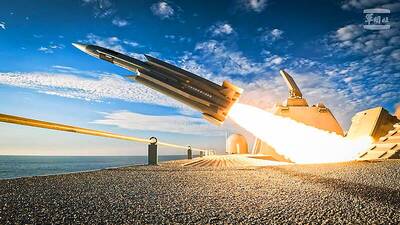
DETERRENCE: With 1,000 indigenous Hsiung Feng II and III missiles and 400 Harpoon missiles, the nation would boast the highest anti-ship missile density in the world With Taiwan wrapping up mass production of Hsiung Feng II and III missiles by December and an influx of Harpoon missiles from the US, Taiwan would have the highest density of anti-ship missiles in the world, a source said yesterday. Taiwan is to wrap up mass production of the indigenous anti-ship missiles by the end of year, as the Chungshan Institute of Science and Technology has been meeting production targets ahead of schedule, a defense official with knowledge of the matter said. Combined with the 400 Harpoon anti-ship missiles Taiwan expects to receive from the US by 2028, the nation would have

North Korea yesterday fired about 10 ballistic missiles to the sea toward Japan, the South Korean Joint Chiefs of Staff (JCS) said, days after Pyongyang warned of “terrible consequences” over ongoing South Korea-US military drills. Pyongyang recently dashed hopes of a diplomatic thaw with Seoul, Washington’s security ally, describing its latest peace efforts as a “clumsy, deceptive farce.” Seoul’s military detected “around 10 ballistic missiles launched from the Sunan area in North Korea toward the East Sea [Sea of Japan] at around 1:20pm,” JCS said in a statement, referring to South Korea’s name for the body of water. The missiles

‘UNWAVERING FRIENDSHIP’: A representative of a Japanese group that co-organized a memorial, said he hopes Japanese never forget Taiwan’s kindness President William Lai (賴清德) yesterday marked the 15th anniversary of the Tohoku earthquake and tsunami, urging continued cooperation between Taiwan and Japan on disaster prevention and humanitarian assistance. Lai wrote on social media that Taiwan and Japan have always helped each other in the aftermath of major disasters. The magnitude 9 earthquake struck northeastern Japan on March 11, 2011, triggering a massive tsunami that claimed more than 19,000 lives, according to data from Japanese authorities. Following the disaster, Taiwan donated more than US$240 million in aid, making it one of the largest contributors of financial assistance to Japan. In addition to cash donations and
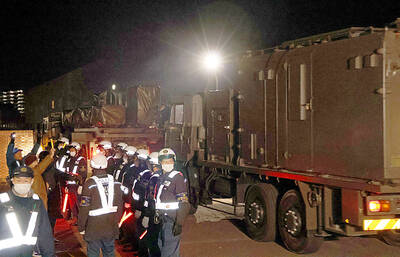
CLOSER TO CHINA: The upgraded Type-12 missile has a range of about 1,000km, compared with the original model’s range of 200km, and can reach mainland China Japan is preparing to deploy its first batch of domestically developed long-range missiles, with their launchers arriving at an army camp yesterday, as the country accelerates its offensive capability in response to rising challenges in the region. The upgraded Type-12 land-to-ship missiles are to be deployed at Camp Kengun in Japan’s southwestern prefecture of Kumamoto by the end of this month, completing the process of deployment, Japanese Chief Cabinet Secretary Minoru Kihara said without giving details. Army vehicles carrying the launchers and other equipment arrived past midnight in a highly secretive mission criticized by residents. Dozens of people stood outside of the


 RSS
RSS