


Housed in a mysterious castle designed to be the spiritual home of the Nazi global empire after World War II, a museum devoted to Adolf Hitler’s murderous SS opened on Thursday last week.
The 7 million euro (US$10 million) museum, dubbed the world’s first dedicated entirely to the SS, charts its growth from Hitler’s elite guard to a band of more than 1 million men who committed unspeakable crimes across Europe.
Among previously unseen items is SS leader Heinrich Himmler’s diary, showing visits to the castle planned in his spidery script, as well as uniforms and devices used to test whether officers were “Aryan” enough.
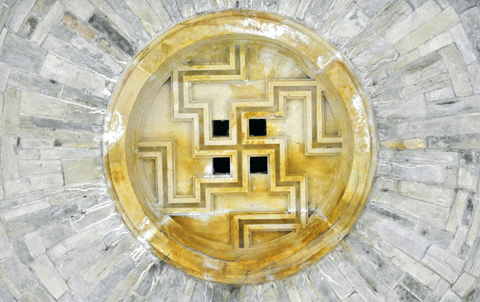
PHOTO: AFP
Also included with the 1,000 pieces on show are two “death’s head rings,” silver bands engraved with Himmler’s signature given to senior officers, with a skull, swastika and the Sig Rune, the instantly recognizable SS symbol.
Wewelsburg Castle, an imposing 17th century triangular edifice on a hilltop south of Hanover in central Germany, itself played a pivotal role in SS history.
Himmler took out a 100-year lease on the castle in 1934, just after Hitler’s Nazi party came to power, and intended to transform it into a training school for elite SS officers.
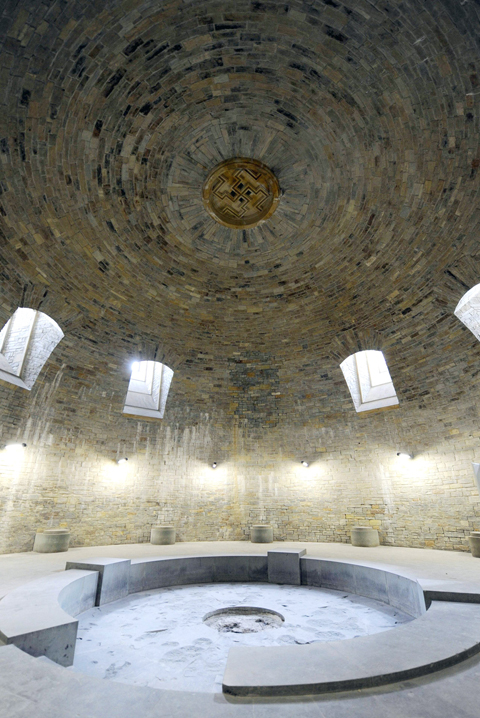
PHOTO: AFP
Later he developed more ambitious plans to take over the surrounding village and build an SS capital city with the castle at “the center of the new world” after the “final victory.”
Wewelsburg hosted meetings of top SS generals, including a key rendezvous in June 1941 on the eve of the invasion of Russia where Himmler told the assembled Nazis the goal was “to kill 30 million Slavs.”
Himmler ordered bizarre renovations to the castle, creating a spooky circular crypt with a gas pipe in the floor for an eternal flame, a Nazi swastika in the ceiling and 12 pedestals at even intervals around the walls.
This room has given rise to a host of myths about Wewelsburg, that it was conceived as “Himmler’s Camelot,” designed to hold meetings with his 12 top generals as King Arthur once convened the Knights of the Round Table.
Moritz Pfeiffer, a 27-year-old historian who helped design the permanent exhibition, said torch-bearing SS guards or statues probably stood on the pedestals, but he scotched the myth that Himmler conducted bizarre pagan rituals in the echoing crypt.
“That can’t be scientifically proven. We know the number 12 crops up time and again in the castle, but we can’t say exactly what that means,” he said.
Directly above the crypt is the “Hall of the Supreme SS Leaders,” another circular room supported by 12 stone pillars with a mysterious occult symbol known as the “schwarze Sonne” or “black sun” set in the floor.
The symbol, a dark circle with 12 crooked “spokes” making up the “sun,” has baffled historians and fascinated neo-Nazis who have adopted it as an alternative sign to the swastika, which is banned in Germany.
Indeed, the castle has become a magnet for neo-Nazis and authorities are aware the new museum could attract unwanted attention from the far-right.
“We had people coming to the castle and performing the Hitler salute. You can only deflect this way of thinking if you show where it leads,” said Heinz Koehler, the deputy head of the local administration. “We reserve the right to throw people out.”
Among those expected to attend the opening was 104-year-old Leopold Engleitner, an Austrian survivor of the concentration camp near the castle where 3,900 people were held. One third of the inmates died.
The museum commemorates victims of the camp, including Guenter Ransenberg, a 15-year-old Jewish boy who accidentally hit the daughter of an SS officer during a friendly snowball fight.
He was hanged for “racial crimes.”

‘NO SECURITY RISK’: The Railway Bureau reassured the public that the technicians’ activities were limited to technical guidance and did not involve sensitive systems The Railway Bureau yesterday said it had invited eight Chinese technicians to assist with an airport MRT construction project. The bureau issued the confirmation after an Internet user said Chinese nationals had entered the construction zone of Taiwan Taoyuan International Airport’s Terminal 3 project. They asked why “individuals from an enemy state” were allowed access to such a major national infrastructure project, which raised serious concerns over Taiwan’s industrial safety, sensitive systems and information security. The bureau’s Northern Region Engineering Branch Office said subcontractor Taiwan Handle Industrial Co (台灣手把工業) of the Taoyuan airport MRT’s “Contract No. CU05 Project A14 Station Civil, MEP &

A US uncrewed surface vessel (USV) encountered multiple Chinese warships during an autonomous transit of the Taiwan Strait, US defense company Seasats said in a statement on Wednesday. Seasats announced that a Lightfish USV had completed the first autonomous transit of the Taiwan Strait. Over five days, the USV traversed the entire length of the Strait while constantly monitoring surface vessel traffic, the company said. The Lightfish encountered multiple Chinese warships, one of which was a Chinese People’s Liberation Army Navy (PLAN) Type 056 corvette, it said. The Chinese vessels were operating “well within Taiwan’s exclusive economic zone without transmitting their identity via the
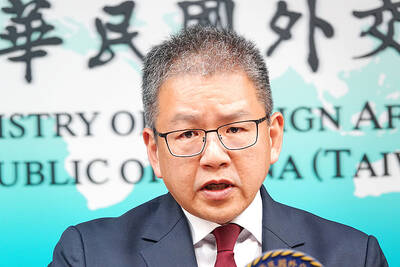
Taiwan is still in the process of assessing the possibility of recruiting workers from Eswatini, the Ministry of Foreign Affairs said yesterday, adding that its goal is to help Eswatini upgrade its vocational training centers. If there are plans to recruit workers from Eswatini, safeguarding national security, protecting public health and ensuring the employment rights of Taiwanese would be prerequisites, Department of West Asian and African Affairs Director-General Yen Chia-liang (顏嘉良) told a news conference. Key considerations would also include filling labor shortages in specific industries, and fostering bilateral professional and technical exchanges, he said. Yen was asked about the progress of labor
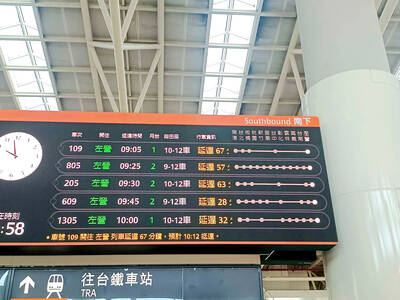
The nation’s usually punctual high-speed rail system yesterday was hit by major disruptions after all scheduled services were canceled and replaced with three hourly trains offering only non-reserved seating, affecting more than 200,000 passengers. Preliminary findings indicate the disruption was caused by a faulty power module in a track switch control cabinet, Taiwan High-Speed Rail Corp (THSRC) said, adding that as a full system inspection could only be conducted after operations end for the day, a decision on whether normal service would resume today would be announced before the first train departs. During a routine inspection early yesterday, a switch signal abnormality


 RSS
RSS