


A ustralians Lesley and Doug McGrath have for decades battled ocean swells that have eaten away at the backyard of their multimillion-dollar Sydney home.
They bought an old beach shack on Collaroy Beach in 1976 and replaced it with a two-story home anchored to the land by 12m long piers, a concrete slab and an underground seawall of giant boulders.
Even with all that protection, the fury of the ocean has at times torn up their backyard, large chunks of prime real estate disappearing under waves. With scientists predicting a 90cm sea level rise in Sydney by 2050 because of climate change, the house itself may yet be in danger.
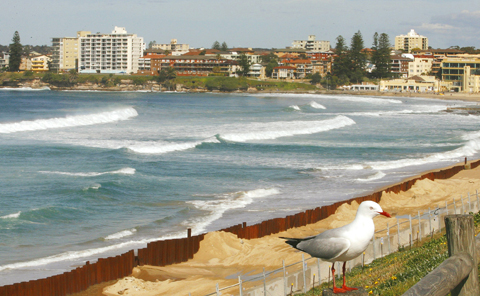
PHOTO: REUTERS
The McGrath home is one of an estimated 700,000 plus coastal properties in Australia alone that are threatened by rising seas.
Around the world, owners of prized seaside properties face the prospect of not just losing their homes but receiving no compensation as insurance policies may not cover climate change losses in the future.
“If you live in paradise you accept what the ocean gives and takes. We’re not worried,” Lesley McGrath said.
Her family photo album tells an amazing story of their battle against the ocean: At times, an expansive beach separates their home from the sea, and at other times, the surf is so close that photos show her son jumping into the water from the backyard.
Sea levels are widely expected to rise about 1m this century because of climate change, faster than the 18cm to 59cm outlined in a UN Intergovernmental Panel on Climate Change report in 2007. And coastal communities around the world are already feeling the destructive effects of more frequent and violent ocean storms — a portent of rising seas.
CLIMATE REFUGEES
The first wave of climate change refugees have started leaving their island homes in the South Pacific as storm surges contaminate fresh water supplies and flood coastal crop lands.
“We have a feeling of anxiety, a feeling of uncertainty because we know that we will be losing our homes. It’s our identity. It’s our whole culture at stake,” says Ursula Rakova, from Carteret Island off Bougainville in Papua New Guinea.
Carteret islanders have decided to abandon their island home for the nearby and bigger Bougainville island after years of worsening storm surges and king tides infected their fresh water supplies and ruined their staple banana and taro crops.
John Vaughan is fighting in court for the right to try and save his multimillion dollar beach house.
Waves washed away 800m² of Vaughan’s beachfront land in May after a bad cyclone and storm season, wiping more than A$1 million (US$850,000) off the value of the property, real estate agents said.
Vaughan fears that if he is not allowed to build a stone seawall, his home may one day become worthless.
“I’d be on the edge of an island and washed away probably,” he said.
Sydney Coastal Councils, which represents 15 local governments, says the multimillion dollar price tags of beachfront homes are unrealistic given climate change.
“A lot of those structures have been put in place without any consideration of climate change. Private properties in coastal areas don’t reflect the risk,” said Wendy McMurdo, chairwoman of Sydney Coastal Councils.
In Australia, 711,000 homes and billions of dollars in assets and infrastructure are at risk from rising sea levels and storm surges, the climate change office said.
Coastal flooding and erosion already costs the nation’s most populous state, New South Wales, A$200 million a year.
Australian coastal authorities fear litigation may rise as more and more people try to save their properties from storm surges and rising sea levels or lose property to the ocean.
“It’s in no one’s interest for decisions on the impact of climate change to be made by the courts,” McMurdo said.
DEFEND OR RETREAT
Australia is an island continent with 80 percent of its 21 million people living on the coast, but combating rising sea levels is piecemeal, McMurdo said.
Authorities are split on adopting a policy of retreat or defend against rising seas.
Those opposed to defending the coast argue seawalls and breakwaters often see the beach lost to a stone structure, prevent the shoreline from naturally adapting to changing ocean conditions and move the problem further along the coast.
Byron Bay, a resort town in Queensland state, has had a retreat policy for 20 years, angering residents who bought multimillion dollar beach homes in recent years.
One hour drive north, a defensive line of seawalls and years of pumping sand onto beaches has replenished the tourist Gold Coast, protecting them from powerful cyclones this year.
In Sydney, there is little chance of retreat given the high coastal population. A sea level rise of just 20cm and a 1-in-50 year storm would see Narrabeen beach recede by 110m, causing about A$230 million damages.
Sand pumping may help homes at Collaroy Beach, south of Narrabeen where the local council has a policy of buying threatened homes, bulldozing them and building protective sand dunes. In Sydney’s south, a metal sea barrier has been planted at Cronulla Beach to stop wave erosion of an existing seawall.
There’s a sign in the heart of Florida’s Everglades wetlands that sums up the threat of rising sea levels. Located many kilometers from any coast, it reads “Rock Reef Pass — Elevation 3 feet.”
Coastal authorities in Florida routinely replenish beaches by dredging sand from offshore or importing it from the Carribbean.
The Florida Keys, Miami Beach, Sanibel and Captiva, and Palm Beach, the exclusive east coast hideaway of the super-wealthy, are all built on barrier islands and some experts believe these sand islands would be swamped by rising seas.
“With a 3-foot [90cm] sea level rise, most of the lower half of the Everglades disappears. Much of the Keys are under water,” said Brian Soden, professor of oceanography at Miami University.
But its not just high priced beachhouses that are at risk from storm surges and rising seas. Parts of Cape Canaveral, home of the Kennedy Space Center and the space shuttle launch pads, and Tampa Bay are considered vulnerable to rising seas.
In Sydney, a city of 4 million people, coastal sewage and stormwater systems work on gravity and rising sea levels and storm surges threaten to overload the aging infrastructure.
“The biggest risk is to infrastructure on the coast and that will be the most expensive risk. A huge amount of government infrastructure is within that coastal zone in Sydney; there are hospitals, storage, electricity, water,” McMurdo said.
NO INSURANCE
Nineteen of the 20 biggest property losses in Australia in the past 40 years have been weather related. Cyclones, storms and floods account for 80 percent of the total cost of natural disasters from 1967 to 1999. But you cannot be insured for rising sea levels in Australia, and the Insurance Council of Australia does not see that policy changing, despite identifying 896,000 residential properties it says have “significant exposure.”
“I do not believe that a commercial [insurance] product, on present analysis, is viable,” said Karl Sullivan, general manager, policy risk and disaster planning directorate, Insurance Council of Australia.
Risk averse insurance firms, with their passion for actuarial tables and probabilities, are as much in the dark as everyone else when it comes to the unknown consequences of climate change.
“If we had this conversation in 100 years time, it would really be anyone’s guess. It comes down to how well the community can mitigate the risks that are present there,” Sullivan said.
CREDIT-GRABBER: China said its coast guard rescued the crew of a fishing vessel that caught fire, who were actually rescued by a nearby Taiwanese boat and the CGA Maritime search and rescue operations do not have borders, and China should not use a shipwreck to infringe upon Taiwanese sovereignty, the Coast Guard Administration (CGA) said yesterday. The coast guard made the statement in response to the China Coast Guard (CCG) saying it saved a Taiwanese fishing boat. The Chuan Yu No. 6 (全漁6號), a fishing vessel registered in Keelung, on Thursday caught fire and sank in waters northeast of Diaoyutai Islands (釣魚台). The vessel left Keelung’s Badouzih Fishing Harbor (八斗子漁港) at 3:35pm on Sunday last week, with seven people on board — a 62-year-old Taiwanese captain surnamed Chang (張) and six

RISKY BUSINESS: The ‘incentives’ include initiatives that get suspended for no reason, creating uncertainty and resulting in considerable losses for Taiwanese, the MAC said China’s “incentives” failed to sway sentiment in Taiwan, as willingness to work in China hit a record low of 1.6 percent, a Ministry of Labor survey showed. The Directorate-General of Budget, Accounting and Statistics (DGBAS) also reported that the number of Taiwanese workers in China has nearly halved from a peak of 430,000 in 2012 to an estimated 231,000 in 2024. That marked a new low in the proportion of Taiwanese going abroad to work. The ministry’s annual survey on “Labor Life and Employment Status” includes questions respondents’ willingness to seek employment overseas. Willingness to work in China has steadily declined from

LEVERAGE: China did not ‘need to fire a shot’ to deny Taiwan airspace over Africa when it owns ‘half the continent’s debt,’ a US official said, calling it economic warfare The EU has raised concerns about overflight rights following the delay of President William Lai’s (賴清德) planned state visit to the Kingdom of Eswatini after three African nations denied overflight clearance for his charter at the last minute. Taiwanese allies Paraguay and Saint Kitts and Nevis, as well as several US lawmakers and the Inter-Parliamentary Alliance on China (IPAC) condemned China for allegedly pressuring the countries. Lai was scheduled to fly directly to Taiwan’s only African ally from yesterday to Sunday to celebrate the 40th anniversary of King Mswati III’s accession and his 58th birthday, but Seychelles, Mauritius and Madagascar suddenly revoked

The number of pet cats in Taiwan surpassed that of pet dogs for the first time last year, reaching 1,742,033, a 32.8 percent increase from 2023, the Ministry of Agriculture said yesterday, citing a survey. By contrast, the number of pet dogs declined slightly by 1.2 percent over the same period to 1,462,528, the ministry said. Despite the shift, households with dogs still slightly outnumber those with cats by 1.2 percent. However, while the number of households with multiple dogs has remained relatively stable, households keeping more than two cats have increased, contributing to the overall rise in the feline population. The trend


 RSS
RSS