


People admiring Thomas Moran’s tranquil View of Fairmont Waterworks, Philadelphia (from about 1860) or Childe Hassam’s bucolic Old House and Garden, East Hampton (1917) in the show on American Impressionism at the Millennium Gate Museum in Atlanta this summer might be surprised to learn the identity of the curator: Bank of America.
Since the 1960s, when Chase Manhattan Bank assembled one of the first major corporate art collections under the guidance of its president, David Rockefeller, banks and other large companies have been acquiring fine art as a way to give their offices a cultured, dignified aura. Over time many companies have expanded these collections — with in-house curators to oversee them — and lent works to museums and other exhibition spaces, mostly for marketing reasons.
But a few corporations, including JPMorgan Chase, Deutsche Bank and UBS, have occasionally gone a step further, lending out complete shows. And Bank of America has lately gone further still, creating a roster of ready-made shows that it provides to museums at a nominal cost to them — essentially turnkey exhibitions.
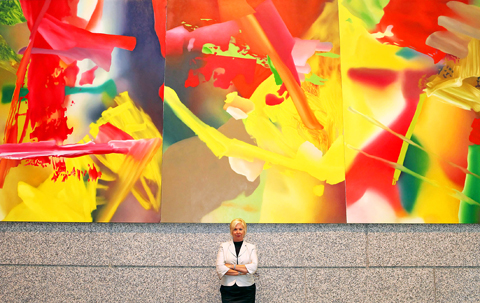
PHOTO: NY TIMES NEWS SERVICE
Traditionally museums have been loath to allow the sponsors of an exhibition a significant role in curatorial decision-making — particularly when the sponsor is a corporation, given the potential taint of commercialization and artistic compromise. Major museums still draw the line there.
“What is crucial is curatorial independence,” said Glenn Lowry, the director of the Museum of Modern Art, “the ability of a curator to make his or her own decisions about what would constitute an exhibition.”
Lowry said his museum would show a corporate collection only if the majority of what was on show was donated, as was the case with the museum’s UBS show in 2005.
“That’s our safeguard,” he said. “We’ve had real input because it’s a gift to the museum. What’s going to be displayed is not going back on the market.”
Rodney Cook, president of the National Monuments Foundation, which owns the Millennium Gate, said he was unconcerned about the potential commercial implications of mounting a Bank of America show.
“Is there a problem with enhancing the value of a great collection?” he said. “The quality of this collection I would say enhances the museum more than the museum enhances the collection. It’s some of the greatest pictures in America history. If our new museum can improve on the value of the bank’s collection, God bless America.”
Given the economic downturn, which has forced the cancelation, postponement or prolonging of exhibitions across the country, more small and midsize art institutions may be increasingly open to ready-made shows.
“It relieves the pressure of having to always initiate shows,” said Holly Block, executive director of the Bronx Museum of the Arts, which recently mounted “Collected Visions: Modern and Contemporary Works from the JPMorgan Chase Art Collection,” featuring about 70 works by some 60 artists, to commemorate the bank’s 50 years of collecting. “It’s very costly, and there’s not a lot of money out there right now for exhibitions. Last year was very, very hard for us to raise money. So anywhere we can create partnerships and consortiums, it’s a win-win situation.”
Block said the show also allowed the Bronx Museum to fill two galleries that otherwise would have been closed during the show’s two-month duration because of budget constraints, and to exhibit work it would not have otherwise been able to obtain.
“This was an incredible opportunity,” she said. “It’s the first time we had Andy Warhol at the Bronx Museum.”
Started two years ago, the Bank of America program placed 12 shows last year and has placed 10 so far this year, with 10 more scheduled for next year and 6 for 2011. And there is a waiting list.
“At first we were calling museums,” said Rena DeSisto, the bank’s global arts marketing and philanthropy executive. “Now the calls are coming in to us.”
DeSisto said the bank had initially hoped to place its shows in big museums, to build credibility, but has come to realize that its collection could instead play an important role in serving institutions with fewer resources.
“Smaller community museums with more need began to ask for our program,” she said. “They just don’t have the deep pockets, and they don’t have the luxury of saying, `We don’t do corporate collections,’ nor do they frankly have the snobbery about it.”
Given the current state of the economy and the considerable expense of maintaining and storing art, corporations might be expected to want to sell all or part of their collections, and many smaller companies are doing some divesting. But Bank of America determined that there were other marketing benefits to be gained from their collection.
“We have determined that a sale would result in an overall loss or a break-even, and that it is better used as a community support and marketing tool,” she said.
Bank of America said its cost per exhibition can range from US$5,000 to US$25,000, depending on how far the artwork needs to travel. DeSisto said the expenditure — which she declined to quantify — has paid off.
“The income we have generated through increased business is superior to any income we could generate from selling the collection,” she said. “Attracting even one individual client can cover the entire cost of lending a turnkey exhibition.”
Other banks too have recognized the potential for such intangible dividends. “
“It’s not about collecting as an investment strategy,” said Gary Hattem, president of the Deutsche Bank Americas Foundation in New York, which administers the bank’s philanthropic activities in the US, Latin America and Canada. “It’s really about being fully engaged in the communities in which we do business.”
Deutsche Bank, with a collection of about 56,000 pieces, has made art “a major part of our identity as a bank,” said Liz Christensen, the company’s curator for the Americas.

ROLLER-COASTER RIDE: More than five earthquakes ranging from magnitude 4.4 to 5.5 on the Richter scale shook eastern Taiwan in rapid succession yesterday afternoon Back-to-back weather fronts are forecast to hit Taiwan this week, resulting in rain across the nation in the coming days, the Central Weather Administration said yesterday, as it also warned residents in mountainous regions to be wary of landslides and rockfalls. As the first front approached, sporadic rainfall began in central and northern parts of Taiwan yesterday, the agency said, adding that rain is forecast to intensify in those regions today, while brief showers would also affect other parts of the nation. A second weather system is forecast to arrive on Thursday, bringing additional rain to the whole nation until Sunday, it
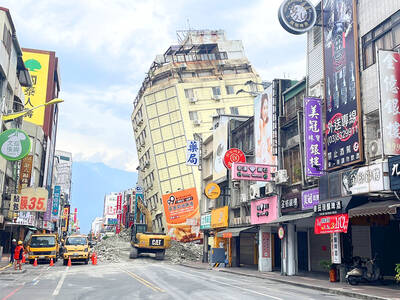
LANDSLIDES POSSIBLE: The agency advised the public to avoid visiting mountainous regions due to more expected aftershocks and rainfall from a series of weather fronts A series of earthquakes over the past few days were likely aftershocks of the April 3 earthquake in Hualien County, with further aftershocks to be expected for up to a year, the Central Weather Administration (CWA) said yesterday. Based on the nation’s experience after the quake on Sept. 21, 1999, more aftershocks are possible over the next six months to a year, the agency said. A total of 103 earthquakes of magnitude 4 on the local magnitude scale or higher hit Hualien County from 5:08pm on Monday to 10:27am yesterday, with 27 of them exceeding magnitude 5. They included two, of magnitude

CONDITIONAL: The PRC imposes secret requirements that the funding it provides cannot be spent in states with diplomatic relations with Taiwan, Emma Reilly said China has been bribing UN officials to obtain “special benefits” and to block funding from countries that have diplomatic ties with Taiwan, a former UN employee told the British House of Commons on Tuesday. At a House of Commons Foreign Affairs Committee hearing into “international relations within the multilateral system,” former Office of the UN High Commissioner for Human Rights (OHCHR) employee Emma Reilly said in a written statement that “Beijing paid bribes to the two successive Presidents of the [UN] General Assembly” during the two-year negotiation of the Sustainable Development Goals. Another way China exercises influence within the UN Secretariat is

Taiwan’s first drag queen to compete on the internationally acclaimed RuPaul’s Drag Race, Nymphia Wind (妮妃雅), was on Friday crowned the “Next Drag Superstar.” Dressed in a sparkling banana dress, Nymphia Wind swept onto the stage for the final, and stole the show. “Taiwan this is for you,” she said right after show host RuPaul announced her as the winner. “To those who feel like they don’t belong, just remember to live fearlessly and to live their truth,” she said on stage. One of the frontrunners for the past 15 episodes, the 28-year-old breezed through to the final after weeks of showcasing her unique


 RSS
RSS