


The Internet has changed many things, of course, but one of its more far-reaching effects has been to transform the economics of innovation.
Big corporate research and development laboratories — at IBM, General Electric (GE), Hewlett-Packard and a handful of other companies — have their roots and rationale in the industrial era, when communication was costly, information traveled slowly and social networks were fostered at conferences and lunchrooms instead of over the Web.
Crowdsourcing and other new, more open models of innovation are really byproducts of the low-cost communication and new networks of collaboration made possible by the Internet.
PHOTO: AFP
So, in the Internet era, what is the continuing role and comparative advantage of the corporate research and development (R&D) lab?
Its role will be smaller and its advantage diminished, said Michael Schrage, a research fellow at the Center for Digital Business at the Sloan School of Management at the Massachusetts Institute of Technology (MIT). The idea-production process, Schrage said, will continue to shift away from the centralized model epitomized by large corporate labs, going from “proprietary innovation to populist innovation.”
Much of traditional corporate R&D spending, he said, has been subsidized by profits that are increasingly under Internet-era pressures.
“The economic case for a lot of in-house R&D no longer makes sense,” Schrage said.
The best bet for corporate R&D labs, he said, is to adopt a “federated” model that leverages all the innovative work by outsiders in universities, start-ups, business partners and government labs. The corporate lab’s role, then, is to be more of a coordinator and integrator of innovation, from both outside and inside the company walls.
Though hardly alone, Hewlett-Packard has aggressively adopted that approach in the last two years, after Prith Banerjee became the senior vice president for research. Under Banerjee, former dean of engineering at the University of Illinois at Chicago, HP Labs has not only narrowed its focus, placing larger bets on fewer projects, but has also systematically sought outside ideas.
HP now runs a yearly online contest, soliciting grant proposals from universities worldwide. The company lists eight fields in which it is seeking advanced research, and scientists suggest research projects in those fields.
The HP grants are typically about US$75,000 a year, and many of the collaborative projects are intended to last three years. In June, the company announced the 61 winners from 46 universities and 12 countries, including 31 projects receiving a second year of funding.
“We are tapping the collective intelligence, selectively, of leading academics around the world,” Banerjee said.
Alan Willner, an electrical engineer at the University of Southern California, is one of those academics. He is an expert in photonics, using light photons instead of electrons to transmit information. The goal of the project with HP is to cut power consumption and increase data-transmission speeds between computers in data centers, and eventually even inside of chips.
The HP project, he said, supports a research student, provides insights from HP scientists and has helped double the productivity of his research team, whose members have co-authored 21 conference and journal papers related to the project in the last year.
Another name on all those papers is Raymond Beausoleil, an HP research fellow. The USC team, Beausoleil said, has helped fill a gap in photonics expertise in the company’s research program and accelerated its progress. He said that HP Labs has long worked with university professors, but that the outreach tended to be informal and ad hoc.
“Before,” he said, “there wasn’t necessarily a mandate to collaborate.”
Opening up is a good approach to some problems. But tight-knit teams inside corporate labs, experts say, can outshine the open model when working on multidisciplinary challenges in projects soon heading to market.
GE built up a biosciences unit, starting in 2004, to help push its diagnostic imaging technology to new commercial frontiers. Last year, GE and the University of Pittsburgh Medical Center developed a prototype scanner that sharply cuts the time needed to digitize images on pathology slides.
Now, the GE researchers are working on the software and data analysis tools to look into such images for a deeper understanding of diseases. GE is collaborating with Eli Lilly and the Memorial Sloan-Kettering Cancer Center. But the core is a 15-person team at GE Research that includes computer scientists, molecular biologists, chemists and statisticians.
“It really helps to have the close and constant communications loops within the team, because engineers have to learn a lot of biology and biologists have to learn a lot of engineering,” said Fiona Ginty, a bioinformatics scientist who leads the project.
Probably more than any other company, IBM has successfully reinvented its R&D labs over the years, analysts say. Jolted by its early-1990s tailspin, IBM opened its labs to the outside world and to customers. Since the mid-1990s, it has sharply shifted its research focus toward its growth engines of software and services.
IBM is a major underwriter of open research in universities, but also collects more patents for its own use than any other company, year after year.
The open innovation model, said John Kelly, senior vice president and director of research, has many advantages. But he points to several innovations that became products after originating in IBM labs.
“You can’t leave discovery completely to others and to chance,” he said.
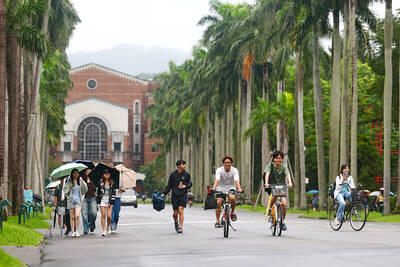
National Taiwan University (NTU) yesterday said it disqualified a person from an entrance examination for using AI smart glasses to cheat, along with two others for making untruthful statements in their curriculum vitae. The three applicants were given null scores, Taiwan’s highest-ranked university said, calling on prospective students to be honest in the admissions process. NTU registrar Lee Hung-sen (李宏森) said that the cheating applicant wore a hat and thick-rimmed glasses to the second written exam for medical school, claiming that they felt cold. Suspicions were aroused when the applicant stared oddly at the test for long stretches while steadily bringing the paper
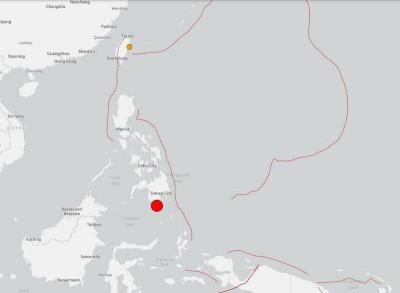
A magnitude 7.8 earthquake struck off the southern coast of Mindanao in the Philippines at 7:38am today, prompting the US Tsunami Warning System to issue an alert for neighboring countries, including Taiwan. The system issued a purple alert indicating a "tsunami threat." The potential threat zone includes Taiwan, the Philippines, Papua New Guinea, Yap and Palau. Philippine authorities were assessing the damage from the quake, with the office of civil defense seeking to verifying initial reports that 15 people had been killed and 129 injured in the region, mostly from falling debris. Arlene Hollero, disaster chief of Maasim town in the Philippines' Sarangani Province,

‘GRAY ZONE’ PRESSURE: Beijing’s activities are intended to create the deceitful impression that China has jurisdiction over the area around Taiwan, the CGA said Taiwan’s rights over its territorial waters and exclusive economic zone must not be violated by any country, the Mainland Affairs Council said yesterday, adding that it will not accept any unprovoked actions. The council issued the remarks in response to the China Coast Guard conducting maritime enforcement drills near eastern Taiwan and claiming to fully exercise China’s maritime administrative law enforcement authority. The Coast Guard Administration (CGA) has been closely monitoring the situation and is taking concrete steps to defend the nation’s sovereignty and secure its waters, the council said. China has no sovereign rights over the waters off eastern
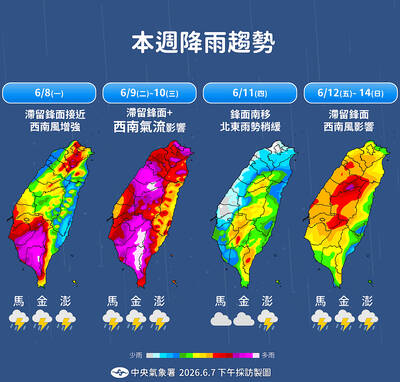
Heavy rain is expected to affect parts of Taiwan this week, the Central Weather Administration (CWA) said yesterday as a meteorologist said the active part of the annual plum rain season has started. A stationary plum rain front and southwesterly winds would bring unstable weather and abundant moisture to Taiwan from today for about a week, with the heaviest rainfall forecast for tomorrow and Wednesday, the CWA said. The agency said western and northeastern Taiwan, and mountainous areas in the east and southeast, could expect showers or thunderstorms on those two days, with localized heavy rain possible. Other parts of


 RSS
RSS