


Parent groups in the UK have condemned a new Internet game in which girls as young as nine are encouraged to "buy" their virtual dolls breast operations and facelifts.
The aim of the Miss Bimbo beauty contest game, which was launched in Britain last month, is to become the "hottest, coolest, most famous bimbo in the whole world," and contestants who compete against each other are told to "stop at nothing," even "meds or plastic surgery," to ensure their dolls win.
Children are given a naked virtual character to look after. They compete against other players to earn "bimbo" dollars so they can dress her in sexy outfits and take her clubbing. They are given missions, including securing plastic surgery at the game's clinic to give their dolls bigger breasts, and they have to keep her at her target weight with diet pills.
Although it is free to play, when the contestants run out of virtual cash they have to send text messages costing ?1.50 (US$3) each or use PayPal to top up their accounts.
Bill Hibberd, of parents' rights group Parentkind, said the game sends a dangerous message to young girls.
"It is one thing if a child recognizes it as a silly and stupid game," he said. "But the danger is that a nine-year-old fails to appreciate the irony and sees the bimbo as a cool role model. Then the game becomes a hazard and a menace."
"Children's innocence should be protected as far as possible. It depends on the background and mindset of the child, but the danger is that after playing the game some will then aspire to have breast operations and take diet pills," Hibberd said.
He added that the game also posed a financial danger for parents if they did not keep an eye on the text messages that were sent.
In France, where Miss Bimbo's sister Web site was condemned by dietitians and parents when it began last year, one parent threatened the creators with legal action after his daughter ran up a ?100 mobile bill sending text messages without his knowledge.
The British version already has nearly 200,000 players, most of whom are girls aged between nine and 16. There are 1.2 million players in France.
One parent said the Web site's creators were irresponsible. Nick Williams, from Shrewsbury, Shropshire, said he was appalled when he saw his daughters Katie, nine, and Sarah, 14, playing the game.
"I noticed them looking at possible breast operations and facelifts for their bimbos at the game's plastic surgery clinic," said Williams, a 42-year-old accountant.
"Katie is far too young for that kind of thing and it is irresponsible of the site's creators to be leading young girls astray. They are easily influenced at that age as to what is cool," he said.
The creators of Miss Bimbo insist it is "harmless fun."
"It is not a bad influence for young children. They learn to take care of their bimbos. The missions and goals are morally sound and teach children about the real world," said Nicolas Jacquart, the 23-year-old Web designer from Tooting, south London who created the site.
"If they eat too much chocolate in the game, it is bad for their bimbos' bodies and their happiness levels compared to if they eat fruit and vegetables, which reinforces positive healthy eating messages," he said.
"If they are having problems with boyfriends or at work, the bimbos can talk through them with a psychiatrist," Jacquart said.
"The breast operations are just one part of the game and we are not encouraging young girls to have them, just reflecting real life," he said.

A signaling system malfunction disrupted high-speed rail (HSR) services beginning at 8am today, with trains temporarily reduced to three northbound and three southbound trains per hour as authorities conduct inspections. The malfunction occurred on a section of track in Miaoli County during pre-operation checks early this morning, forcing northbound and southbound trains to use a single track, the HSR operator said. The regular schedule has been replaced with three hourly trains offering only nonreserved seating in each direction, stopping at every station, it said, adding that business class cars would still have reserved seating. Departures from terminal stations are scheduled at the top

Taiwan is still in the process of assessing the possibility of recruiting workers from Eswatini, the Ministry of Foreign Affairs said yesterday, adding that its goal is to help Eswatini upgrade its vocational training centers. If there are plans to recruit workers from Eswatini, safeguarding national security, protecting public health and ensuring the employment rights of Taiwanese would be prerequisites, Department of West Asian and African Affairs Director-General Yen Chia-liang (顏嘉良) told a news conference. Key considerations would also include filling labor shortages in specific industries, and fostering bilateral professional and technical exchanges, he said. Yen was asked about the progress of labor

A US uncrewed surface vessel (USV) encountered multiple Chinese warships during an autonomous transit of the Taiwan Strait, US defense company Seasats said in a statement on Wednesday. Seasats announced that a Lightfish USV had completed the first autonomous transit of the Taiwan Strait. Over five days, the USV traversed the entire length of the Strait while constantly monitoring surface vessel traffic, the company said. The Lightfish encountered multiple Chinese warships, one of which was a Chinese People’s Liberation Army Navy (PLAN) Type 056 corvette, it said. The Chinese vessels were operating “well within Taiwan’s exclusive economic zone without transmitting their identity via the
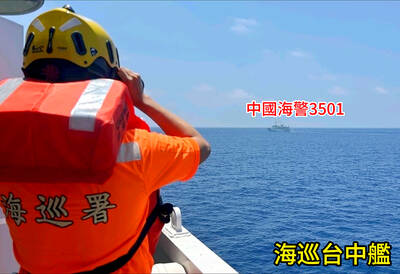
VERBOSE VESSELS: A CGA cutter and a China Coast Guard exchanged verbal barbs for more than a day in Taiwanese-controlled waters before the Chinese vessel left The Taiwanese and Chinese coast guards had a standoff near the strategically located Pratas Islands (Dongsha Islands, 東沙群島) in the north of the South China Sea, the Coast Guard Administration (CGA) said yesterday. The two sides engaged in intense radio exchanges over sovereignty claims during the 33-hour standoff. China Coast Guard vessel 3501 eventually left the restricted waters, 26.6 nautical miles (49.2km) west of the Pratas Islands, at 5pm yesterday, the CGA said. Lying approximately between southern Taiwan and Hong Kong, the Taiwan-controlled Pratas are seen by some security experts as vulnerable to Chinese attack due to their distance — more than


 RSS
RSS