


Turbulence on world stock markets has fueled a new gold rush, sending high-tech traders in search of the same "barbaric" treasure mankind has lusted after for millennia.
It was British economist John Maynard Keynes who called gold a "barbaric relic" early last century, but modern investors are showing the same enthusiasm for the precious metal as the grizzled prospectors of legend.
"We have to put gold into perspective right now with the meltdown in the financial system," Far East Capital chairman Warwick Grigor said. "There's great fear out there and gold stands out as a safe haven."
"When there's fear of inflation gold is something investors want to purchase because there is a very limited supply -- you can't flood the market with gold," he said.
"Governments can print money -- that creates inflation. Paper money is just a promise and that promise gets abused constantly by governments," Grigor said.
Gold hit an all-time peak of US$923.73 an ounce on the London Bullion Market on Friday after a week in which global stock markets plunged on fears of a recession in the US.
To staunch the bloodbath on the markets, the US Federal Reserve intervened with a surprise 75 basis points cut in interest rates, a move Grigor described as a short-term fix that would push up inflation.
While gold's rarity is cited as the main reason it will maintain its value in volatile times for stocks and paper money it also seems to wield a primitive fascination beyond its worth.
"Gold may not be rational but human beings are not necessarily rational either," author and analyst Trevor Sykes said.
"Gold has been around for about 3,000 years whereas paper money has been around for only a couple of hundred years and the way things are going I would back gold to outlast most of the paper money in this world," he said.
"It does make nice jewelry, it's very attractive, it appeals to our primeval urges and it looks like it's got a terrific future," Sykes said.
It has been used for centuries as a symbol of wealth in anything from jewelry to gold bathroom fittings or even the coffin of Egyptian Pharaoh Tutankhamun, who died more than 3,000 years ago.
As currency, the history of gold coins is usually traced through the Roman Empire back to Lydia in what is now Turkey, where it is believed the first real coins were struck around the 6th century BC.
In modern times, the Bretton Woods system introduced after World War II obliged countries to maintain the value of their currencies in a tight link to gold, but the mechanism collapsed in 1971.
Recent events, however, have shown that when stocks and paper money are stumbling, investors head to the soft, malleable metal with its seductive gleam.
"A share in a company is worth nothing -- you can't eat it, you can't do anything with it, it's all paper," Grigor said.
"I buy specimen gold and gold nuggets and store it away because that doesn't disappear overnight like shares can," Grigor said, pointing to the fact that an ounce of gold will still buy a good suit as it did a century ago.
He said that gold would trade up to US$1,500 or US$2,000 an ounce within a year or two.
Sykes also backed the metal to become increasingly precious as the US dollar underwent a de facto devaluation.
"Since about the end of World War II the US dollar has been the world's reserve currency, but the US economy has considerable problems," he said. "They are simply printing more money to buy their way out on the grounds that everyone accepts the US dollar."
Extreme devaluations such as those in Germany in 1923, Hungary in 1946 and right now in Zimbabwe, where inflation is running at an official 8,000 percent, had seen people lose faith entirely in the currency, he said.
"Suddenly you needed a wheelbarrow of notes to buy a loaf of bread," he said.
"A piece of paper money, which we all worship in Australia, is only worth the credit of the government that issues it, whereas gold is a constant," Sykes said.
"A gold bar is 100 percent gold and it's the same in Australia as it is in China or the United States or South Africa," he said.
"Gold acts like a currency. In places like the Middle East, India and large chunks of Asia, it is a currency," he said.
"It doesn't pay dividends it doesn't pay interest, but its portable and it has a very durable history," Sykes said.

FALSE DOCUMENTS? Actor William Liao said he was ‘voluntarily cooperating’ with police after a suspect was accused of helping to produce false medical certificates Police yesterday questioned at least six entertainers amid allegations of evasion of compulsory military service, with Lee Chuan (李銓), a member of boy band Choc7 (超克7), and actor Daniel Chen (陳大天) among those summoned. The New Taipei City District Prosecutors’ Office in January launched an investigation into a group that was allegedly helping men dodge compulsory military service using falsified medical documents. Actor Darren Wang (王大陸) has been accused of being one of the group’s clients. As the investigation expanded, investigators at New Taipei City’s Yonghe Precinct said that other entertainers commissioned the group to obtain false documents. The main suspect, a man surnamed

DEMOGRAPHICS: Robotics is the most promising answer to looming labor woes, the long-term care system and national contingency response, an official said Taiwan is to launch a five-year plan to boost the robotics industry in a bid to address labor shortages stemming from a declining and aging population, the Executive Yuan said yesterday. The government approved the initiative, dubbed the Smart Robotics Industry Promotion Plan, via executive order, senior officials told a post-Cabinet meeting news conference in Taipei. Taiwan’s population decline would strain the economy and the nation’s ability to care for vulnerable and elderly people, said Peter Hong (洪樂文), who heads the National Science and Technology Council’s (NSTC) Department of Engineering and Technologies. Projections show that the proportion of Taiwanese 65 or older would
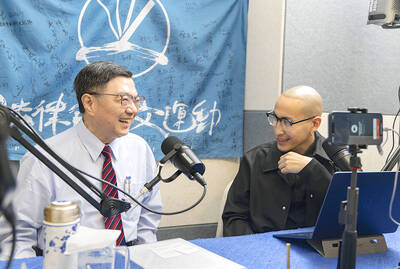
The government is considering polices to increase rental subsidies for people living in social housing who get married and have children, Premier Cho Jung-tai (卓榮泰) said yesterday. During an interview with the Plain Law Movement (法律白話文) podcast, Cho said that housing prices cannot be brought down overnight without affecting banks and mortgages. Therefore, the government is focusing on providing more aid for young people by taking 3 to 5 percent of urban renewal projects and zone expropriations and using that land for social housing, he said. Single people living in social housing who get married and become parents could obtain 50 percent more
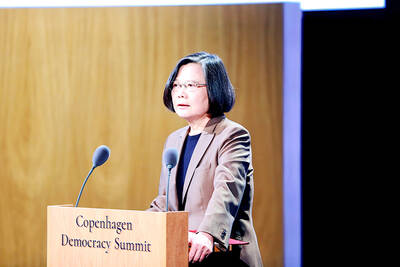
Democracies must remain united in the face of a shifting geopolitical landscape, former president Tsai Ing-wen (蔡英文) told the Copenhagen Democracy Summit on Tuesday, while emphasizing the importance of Taiwan’s security to the world. “Taiwan’s security is essential to regional stability and to defending democratic values amid mounting authoritarianism,” Tsai said at the annual forum in the Danish capital. Noting a “new geopolitical landscape” in which global trade and security face “uncertainty and unpredictability,” Tsai said that democracies must remain united and be more committed to building up resilience together in the face of challenges. Resilience “allows us to absorb shocks, adapt under


 RSS
RSS