


European exporters and US tourists yearning for a stronger dollar may have to wait a while yet, thanks in part to two men: the top US and European central bankers, Ben Bernanke and Jean-Claude Trichet.
A much-hoped-for comeback of the battered dollar may not come until the middle of the year, economists and currency strategists say. That's when economic conditions might lead to a change in central bank interest-rate policy.
The dollar's dramatic dive against the euro last year raised the profile of central banks, particularly in Europe where the European Central Bank (ECB) is a relatively new creation.
Nine years ago, when the euro was created, the ECB was a distant institution known mainly to the financial community. In a 1999 survey, 24 percent of Europeans said they had never heard of the central bank.
Notoriety has grown as pressure to help exporters such as Airbus -- which claims to lose 1 billion euros (US$1.47 billion) for every 10 cent rise in the euro -- has been directed at the ECB by governments seeking a scapegoat.
French President Nicolas Sarkozy even made anti-ECB rhetoric part of his election campaign.
The dollar's 11 percent fall against the euro last year makes Europe an expensive tourist destination for Americans, while giving a competitive advantage to US goods.
On Friday, the euro was trading at US$1.4779. That compares with a record high of US$1.4967 in November and a record low of US$0.82 touched in October 2000.
The dollar's weakness poses a dilemma for Trichet, whose signature appears on all euro bank notes. It helps tame inflation -- by making imported goods cheaper -- in a period where the central bank is faced with sharp rises in food and energy prices.
But the expensive euro is squeezing exporters, and economists question how much lower the dollar can go before the European economy buckles.
While the ECB could intervene in currency markets to prevent excessively rapid exchange rate moves, there is little it can do to stem a long-term trend.
One weapon is interest rates, set by central banks to strike a balance between economic growth and inflation. As well as taming price rises -- the goal of central banks everywhere -- higher interest rates also boost the attractiveness of a currency.
Unfortunately for European exporters, the ECB and the US Federal Reserve's current policy is likely to further depress the dollar, with the Fed leaning toward interest rate cuts and the ECB standing firm and suggesting rates might have to go up.
Worried about the sagging US economy, the Fed is cutting borrowing costs, while the ECB has threatened to raise interest rates to control inflation.
Sickly economic growth in the US combined with an expected cut in interest rates could depress the euro-dollar exchange rate to as low as US$1.50 by mid-year, according to Michael Schubert, a senior economist at Commerzbank in Frankfurt.
To bolster the economy, the Fed lowered its key rate three times last year. Its last cut, on Dec. 11, left the rate at 4.25 percent, a two-year low.
Bernanke pledged on Thursday to slash interest rates yet again to prevent housing and credit problems from plunging the US into a recession.
Meanwhile, in Europe, Trichet struck a hawkish note on Thursday, saying the bank "remains prepared to act preemptively" to keep inflation in check. On Thursday, policymakers voted to keep the benchmark rate at 4 percent.
As the Fed's rate cuts kick in, the US economy should shake off its gloom.
Further stimulation could come from temporary tax cuts, which may be announced by US President George W. Bush in his Jan. 28 State of the Union address.
"2008 should be the year of the dollar," said Andrew Wilkinson, senior market analyst at Interactive Brokers Group LLC in Greenwich, Connecticut.
"So many people are so bearish that it can't go on forever. You can't continually devalue the dollar," he said.
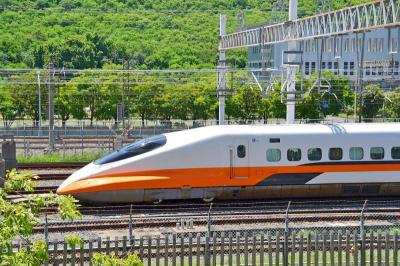
A signaling system malfunction disrupted high-speed rail (HSR) services beginning at 8am today, with trains temporarily reduced to three northbound and three southbound trains per hour as authorities conduct inspections. The malfunction occurred on a section of track in Miaoli County during pre-operation checks early this morning, forcing northbound and southbound trains to use a single track, the HSR operator said. The regular schedule has been replaced with three hourly trains offering only nonreserved seating in each direction, stopping at every station, it said, adding that business class cars would still have reserved seating. Departures from terminal stations are scheduled at the top

Taiwan is still in the process of assessing the possibility of recruiting workers from Eswatini, the Ministry of Foreign Affairs said yesterday, adding that its goal is to help Eswatini upgrade its vocational training centers. If there are plans to recruit workers from Eswatini, safeguarding national security, protecting public health and ensuring the employment rights of Taiwanese would be prerequisites, Department of West Asian and African Affairs Director-General Yen Chia-liang (顏嘉良) told a news conference. Key considerations would also include filling labor shortages in specific industries, and fostering bilateral professional and technical exchanges, he said. Yen was asked about the progress of labor

A US uncrewed surface vessel (USV) encountered multiple Chinese warships during an autonomous transit of the Taiwan Strait, US defense company Seasats said in a statement on Wednesday. Seasats announced that a Lightfish USV had completed the first autonomous transit of the Taiwan Strait. Over five days, the USV traversed the entire length of the Strait while constantly monitoring surface vessel traffic, the company said. The Lightfish encountered multiple Chinese warships, one of which was a Chinese People’s Liberation Army Navy (PLAN) Type 056 corvette, it said. The Chinese vessels were operating “well within Taiwan’s exclusive economic zone without transmitting their identity via the
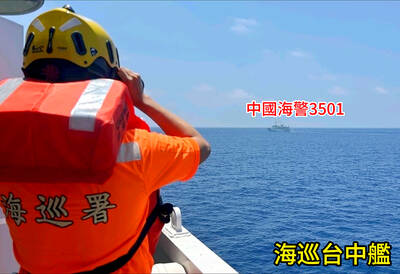
VERBOSE VESSELS: A CGA cutter and a China Coast Guard exchanged verbal barbs for more than a day in Taiwanese-controlled waters before the Chinese vessel left The Taiwanese and Chinese coast guards had a standoff near the strategically located Pratas Islands (Dongsha Islands, 東沙群島) in the north of the South China Sea, the Coast Guard Administration (CGA) said yesterday. The two sides engaged in intense radio exchanges over sovereignty claims during the 33-hour standoff. China Coast Guard vessel 3501 eventually left the restricted waters, 26.6 nautical miles (49.2km) west of the Pratas Islands, at 5pm yesterday, the CGA said. Lying approximately between southern Taiwan and Hong Kong, the Taiwan-controlled Pratas are seen by some security experts as vulnerable to Chinese attack due to their distance — more than


 RSS
RSS