


s shoppers arm themselves for post-Thanksgiving bargain hunting later this week, they'll also indulge in another, newer annual tradition: surfing the Web for advance information about Black Friday retail sales.
By organizing sale prices from scattered newspaper circulars into a single database, the Internet has made it easy to search for particular items and compare prices -- too easy, at least in the eyes of many major retailers.
For the last several years, Wal-Mart Stores and other large chains have threatened legal action to intimidate Web sites that get hold of advertising circulars early and publish prices online ahead of company-set release dates. The retailers' threats rest upon some dubious legal arguments, however, which may be the reason they haven't shown a keen interest in actually going to court over the issue.

PHOTO: NY TIMES NEWS SERVICE
Wal-Mart has been among the most aggressive retailers in trying to cow consumer Web sites. Last month, it sent a cease-and-desist letter to BFAds.net, a site devoted to publishing Black Friday ads. Wal-Mart sent the letter even before BFAds had published Wal-Mart's sale prices, so the cease-and-desist letter would be more properly called a "don't even think about it" letter.
Wal-Mart asserts that its sales-price data are "protected by copyright and other laws." The "other laws" were never identified or explained in the letter and the claim of copyright protection for facts themselves, like sales prices, was rejected by the courts long ago. In a 1991 case, for example, the Supreme Court ruled that names and phone numbers in a telephone directory could not be copyrighted and thus could be freely copied.
BFAds operates two months a year, as a sideline for a 20-year-old college student, Michael Brim, and his business partner, Dan Silvers, also a college student. The Wal-Mart letter posed a quandary for Brim. Should he assert his rights as a publisher who believes he has broken no laws? Or should he acknowledge that Wal-Mart (with revenue last year of US$349 billion) and its law firm of Baker Hostetler (600 partner attorneys) had the resources to litigate him out of existence?
Brim chose the latter. He announced on his site that he had no other choice but to heed Wal-Mart's letter. When Macy's sent a similar letter, he gave ground again, under protest.
BFAds did not post sale prices early for Wal-Mart and Macy's this year.
Wendy Seltzer, a fellow at the Berkman Center for Internet and Society at Harvard Law School, said she believed that companies like Wal-Mart dispatched the letters without intending to pursue the matter in court, where their claims would be put to a test before a judge.
"It's cheap to send out lots of letters," she said. "If many sites take the material down, that's good bang for the buck."
Seltzer oversees the Chilling Effects Clearinghouse, a Web site that publicizes what it calls corporate misuse of cease-and-desist letters to curb legally protected speech on the Internet. The clearinghouse, sponsored by the Electronic Frontier Foundation and the clinics of seven law schools, posts copies of cease-and-desist letters that Wal-Mart, Macy's and others send to Web publishers. One aim of the project is to publicly shame companies that casually dash off the letters.
Wal-Mart defends its practice.
"All retailers are harmed in the same way when this information is leaked -- it tips off competitors," Wal-Mart spokesman John Simley said.
But he also said he was unaware of any time when Wal-Mart had taken a Web site to court for divulging Black Friday sale prices prematurely. I was curious to learn what criminal statutes Wal-Mart referred to when it alerted BFAds' principals in its letter about the possibility that they may have engaged in "criminal activity." Simley declined to be specific, other than to say that "there are laws to protect advertisers."
Baker Hostetler didn't respond to my requests for a similar tutorial.
If early disclosure was indeed a grave concern of everyone in retailing, why has Best Buy come around to the idea that Black Friday sales sites, above all else, offer an opportunity for free advertising, whetting appetites with a sneak preview of what will be officially announced?
At present, Best Buy's only concern is that inaccurate information may circulate on the sites, so it encourages customers to verify prices on its own site before going to the store.
Brian Lucas, a Best Buy spokesman, said: "We don't want people to wait in a line all night for a deal that doesn't exist."
Best Buy's stance has changed considerably since 2002, when, like other retailers, it sent threatening letters to Web publishers.
In 2003, it did the same -- and one site, FatWallet.com, struck back with a lawsuit asking a judge to declare that sale prices cannot be copyrighted.
The case was dismissed on a technicality, but Fat Wallet is now happy to dare retailers to give it a chance to go to court again.
Tim Storm, FatWallet's founder and chief executive, said his company tells any retailer who makes threats.
"Are you guys sure you really want to do this?" he said.
To date, he says, no company has answered yes.

ROLLER-COASTER RIDE: More than five earthquakes ranging from magnitude 4.4 to 5.5 on the Richter scale shook eastern Taiwan in rapid succession yesterday afternoon Back-to-back weather fronts are forecast to hit Taiwan this week, resulting in rain across the nation in the coming days, the Central Weather Administration said yesterday, as it also warned residents in mountainous regions to be wary of landslides and rockfalls. As the first front approached, sporadic rainfall began in central and northern parts of Taiwan yesterday, the agency said, adding that rain is forecast to intensify in those regions today, while brief showers would also affect other parts of the nation. A second weather system is forecast to arrive on Thursday, bringing additional rain to the whole nation until Sunday, it

LANDSLIDES POSSIBLE: The agency advised the public to avoid visiting mountainous regions due to more expected aftershocks and rainfall from a series of weather fronts A series of earthquakes over the past few days were likely aftershocks of the April 3 earthquake in Hualien County, with further aftershocks to be expected for up to a year, the Central Weather Administration (CWA) said yesterday. Based on the nation’s experience after the quake on Sept. 21, 1999, more aftershocks are possible over the next six months to a year, the agency said. A total of 103 earthquakes of magnitude 4 on the local magnitude scale or higher hit Hualien County from 5:08pm on Monday to 10:27am yesterday, with 27 of them exceeding magnitude 5. They included two, of magnitude
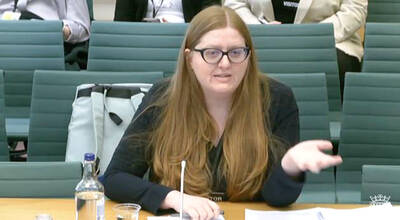
CONDITIONAL: The PRC imposes secret requirements that the funding it provides cannot be spent in states with diplomatic relations with Taiwan, Emma Reilly said China has been bribing UN officials to obtain “special benefits” and to block funding from countries that have diplomatic ties with Taiwan, a former UN employee told the British House of Commons on Tuesday. At a House of Commons Foreign Affairs Committee hearing into “international relations within the multilateral system,” former Office of the UN High Commissioner for Human Rights (OHCHR) employee Emma Reilly said in a written statement that “Beijing paid bribes to the two successive Presidents of the [UN] General Assembly” during the two-year negotiation of the Sustainable Development Goals. Another way China exercises influence within the UN Secretariat is

Taiwan’s first drag queen to compete on the internationally acclaimed RuPaul’s Drag Race, Nymphia Wind (妮妃雅), was on Friday crowned the “Next Drag Superstar.” Dressed in a sparkling banana dress, Nymphia Wind swept onto the stage for the final, and stole the show. “Taiwan this is for you,” she said right after show host RuPaul announced her as the winner. “To those who feel like they don’t belong, just remember to live fearlessly and to live their truth,” she said on stage. One of the frontrunners for the past 15 episodes, the 28-year-old breezed through to the final after weeks of showcasing her unique


 RSS
RSS