


Until recently, Bill Allayaud, who works as a director for the Sierra Club in Sacramento, thought people who checked labels on clothing or toys to make sure they were "Made in the USA." were everything he was not: flag-waving, protectionist, even a little xenophobic.
But lately, he said, he is becoming one of them.
"Everything I buy now, I look at the label," said Allayaud, 56, who explained that the "buy American" movement -- long popular among blue-collar union workers and lunch-pail conservatives -- no longer seemed so jingoistic and was actually starting to come into vogue for liberals like himself who never before had a philosophical problem with Japanese cars or French wine.

PHOTO: NY TIMES NEWS SERVICE
He said the reasons for his change of heart are many: a desire to buy as many "locally made" products as possible to reduce carbon emissions from transporting them; a worry about toxic goods made in the third world; and a concern that the rising tide of imports will damage the economy and hurt everybody.
"Every time you see `Made in China,"' he said, "you think, `wait a minute, something's not right here."'
"Made in the USA" used to be a label flaunted primarily by consumers in the Rust Belt and rural regions. Increasingly, it is a status symbol for cosmopolitan bobos and it is being exploited by the marketers who cater to them.
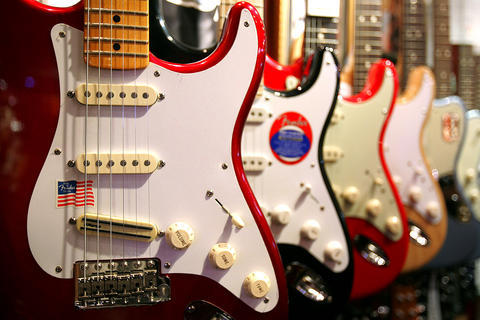
PHOTO: NY TIMES NEWS SERVICE
For many the label represents a heightened concern for workplace and environmental issues, consumer safety and premium quality.
"It involves people wanting to have guilt-free affluence," Alex Steffen, executive editor of www.worldchanging.com, a Web site devoted to sustainability issues, said in an e-mail message. "So you have not only the local food craze but things like American apparel, or Canadian diamonds instead of African `blood diamonds,' or local-crafted toys."
With so many mass-market goods made off-shore, US-made products, which are often more expensive, have come to connote luxury. New Balance produces less expensive running shoes abroad, but it still makes the top-of-the-line 992 model -- which the company says requires 80 manufacturing steps and costs US$135 -- in Maine. A favorite in college towns from Cambridge, Massachusetts to Berkeley, California, each model 992 features a large, reflective "USA" logo on the heel, and a US flag on the box.
American Apparel, which carries the label "Made in Downtown LA" in every T-shirt and minidress, famously brought sex appeal to clothing basics that are promoted as "sweatshop free." In the process, it won the allegiance of young taste-makers.
Many US designers now showing collections at New York Fashion Week, which runs through Wednesday, will have their goods stitched in foreign factories, a reflection of the battering of US garment manufacturing.
From 2001 until last year, clothing production in the US declined 56 percent, the American Apparel & Footwear Association said.
US high-fashion designers who do make clothes domestically tend to be too small, or in the case of Oscar de la Renta and Nicole Miller, willing to pay a premium in labor costs in order to maintain strict quality control.
But these brands have yet to exploit the cachet of "Made in the USA" in their marketing, in the way that some non-runway labels have seized upon. The designer Steven Alan, for one, while avoiding the Bryant Park tents, makes his distinctive rumpled dress shirts, which sell for US$168, in factories in the US, many in New York City.
His "Made in the USA" labels include an embroidered US flag, which he said helps send a subtle message to his target consumer -- downtown, hip, discerning -- that his clothes are not just another mass-market knock-off from Asia.
Even though it is not always justified, "there is a perception that because it is made overseas," he said, clothing is produced to the "lowest common denominator -- there is not the attention to detail."
Any move by the affluent left to conspicuously "Buy American" seems like an inversion of the internationalist sensibility that it always wore as a badge of distinction, said Robert Frank, an economics professor at the Johnson school of management at Cornell. These people tended to be ardent free-traders as recently the Clinton years.
"They always think of themselves as more sophisticated," Frank said. "The farther away something comes from, the presumption, the better it is."
The evolving image of many US-made products as small-batch, high-craftsmanship products is true in other connoisseur-friendly industries as well.
Fender, the guitar maker, builds entry-level electric guitars in Mexico, but it still makes higher-end Stratocasters and Telecasters -- including its hand-made Custom Shop models, which sell for several thousand dollars -- in California.
In bicycles, too, Schwinn and Huffy have decamped to Asia, leaving high-end specialty companies like Trek and Cannondale alone making bikes in this country, where there is "a greater sense of craft and small scale," said Matthew Mannelly, the chief executive officer of Cannondale. The company recently started producing its "entry level" bikes, priced US$500 to US$1,000, in Asia, but says it still makes the bulk of its product line -- and its best bikes -- in Bedford, Pennsylvania.
The new prestige of "Made in America" was not lost on Elizabeth Preston, a cycling advocate in Washington. While Preston, 33, said that politically she is as "as far left as you can go," she nonetheless felt drawn to the "Handbuilt in the USA" sticker on the US$1,250 Trek road bike she bought for her boyfriend a few weeks ago. Since then, she has been showing off the sticker to friends.
"There's something about the idea of the workmanship and supporting the United States' economy," she said.
The recent recalls of Mattel toys, made in China with lead-based paint, prompted many parents to seek US-made toys. Joan Blades of Berkeley, president of MomsRising.org, a mothers' rights advocacy group with 100,000 members, said many parents are going to be checking labels and favoring US-made products, even if they are as simple as wooden blocks, as the holiday season approaches.
"I think more and more mothers are going to be particularly distrustful of goods made in China," she said.
Indeed, some domestic companies, such as Stack & Stick, which produces building blocks, or Little Capers, which makes superhero costumes, are working US flags and "Made in the USA" messages into their advertising, as well as marketing themselves as a safe alternative.
Skeptics say there are limits to how far the National Public Radio demographic will go as it flirts with a cause long associated with the Rush Limbaugh crowd. It is hard to imagine, say, that people who tote reusable cotton bags to Whole Foods will ditch their beloved Saabs for a US-made Chevrolet Cobalt.
"People like that don't even know where the Chevy store is," said Ernie Boch, president of Boch Automotive in Norwood, Massachusetts, who operates Honda, Subaru and Toyota dealerships in the Northeast. "It's kind of like people who stay at the Four Seasons. They've heard of Motel 6, but they don't stay there. It's not part of their vernacular."
Nonetheless, the new interest from yuppies in seeking out domestically made products is evident to traditionalists like John Ratzenberger, best known as the actor who played Cliff in Cheers, who grew up in the factory town of Bridgeport, Connecticut and is now the host of John Ratzenberger's Made in America, a Travel Channel show that celebrates craftsmanship at factories.
"When we started doing this show, we were accused of being xenophobic, flag-wavers," said Ratzenberger, whose show began five years ago. "The more we did our show, the more people are looking around in their own towns, realizing once these companies close, it's going to affect the fabric of their communities. Things they took for granted, like sponsors for Little League for example, aren't there."
"This," he said, "goes right across the political spectrum."

NO-LIMITS PARTNERSHIP: ‘The bottom line’ is that if the US were to have a conflict with China or Russia it would likely open up a second front with the other, a US senator said Beijing and Moscow could cooperate in a conflict over Taiwan, the top US intelligence chief told the US Senate this week. “We see China and Russia, for the first time, exercising together in relation to Taiwan and recognizing that this is a place where China definitely wants Russia to be working with them, and we see no reason why they wouldn’t,” US Director of National Intelligence Avril Haines told a US Senate Committee on Armed Services hearing on Thursday. US Senator Mike Rounds asked Haines about such a potential scenario. He also asked US Defense Intelligence Agency Director Lieutenant General Jeffrey Kruse

INSPIRING: Taiwan has been a model in the Asia-Pacific region with its democratic transition, free and fair elections and open society, the vice president-elect said Taiwan can play a leadership role in the Asia-Pacific region, vice president-elect Hsiao Bi-khim (蕭美琴) told a forum in Taipei yesterday, highlighting the nation’s resilience in the face of geopolitical challenges. “Not only can Taiwan help, but Taiwan can lead ... not only can Taiwan play a leadership role, but Taiwan’s leadership is important to the world,” Hsiao told the annual forum hosted by the Center for Asia-Pacific Resilience and Innovation think tank. Hsiao thanked Taiwan’s international friends for their long-term support, citing the example of US President Joe Biden last month signing into law a bill to provide aid to Taiwan,

China’s intrusive and territorial claims in the Indo-Pacific region are “illegal, coercive, aggressive and deceptive,” new US Indo-Pacific Commander Admiral Samuel Paparo said on Friday, adding that he would continue working with allies and partners to keep the area free and open. Paparo made the remarks at a change-of-command ceremony at Joint Base Pearl Harbor-Hickam in Hawaii, where he took over the command from Admiral John Aquilino. “Our world faces a complex problem set in the troubling actions of the People’s Republic of China [PRC] and its rapid buildup of forces. We must be ready to answer the PRC’s increasingly intrusive and
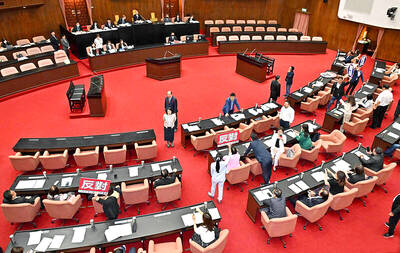
STATE OF THE NATION: The legislature should invite the president to deliver an address every year, the TPP said, adding that Lai should also have to answer legislators’ questions The Chinese Nationalist Party (KMT) yesterday proposed inviting president-elect William Lai (賴清德) to make a historic first state of the nation address at the legislature following his inauguration on May 20. Lai is expected to face many domestic and international challenges, and should clarify his intended policies with the public’s representatives, KMT caucus secretary-general Hung Meng-kai (洪孟楷) said when making the proposal at a meeting of the legislature’s Procedure Committee. The committee voted to add the item to the agenda for Friday, along with another similar proposal put forward by the Taiwan People’s Party (TPP). The invitation is in line with Article 15-2


 RSS
RSS