


Khaled Awad is a risk taker. A doctor by training, he decided at age 26 to give up a secure position in one of Egypt's state-run hospitals to do something considered crazy by most of his countrymen -- start his own business.
Awad, whose firm transmits stock market data directly to mobile phones, is so unusual in Egypt that business people and academics are still trying to agree on a common Arabic word for "entrepreneur."
Yet as unemployment remains high across the Middle East, efforts to promote such risk-taking are considered key to boosting countries like Egypt. In a region with corruption-ridden economies and a chronic lack of opportunity for those lacking political connections, there is often a link between economic stagnation and political extremism.
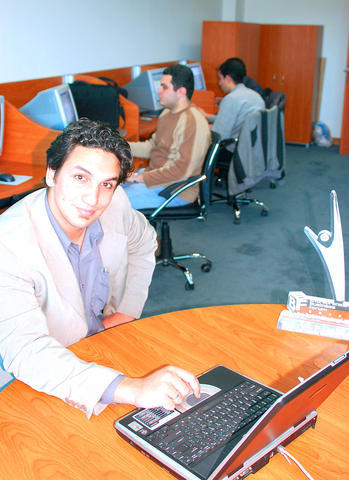
PHOTO: AP
In Egypt, the creation of small and medium sized companies is considered a key factor for economic growth. The country does have a few well known entrepreneurial success stories, such as Cilantro, a trendy chain of coffee shops, and Otlob.com, a popular home delivery Web site.
But such examples are hard to find. Instead, would-be entrepreneurs continue to face barriers that complicate efforts to turn the germ of an idea into a large and profitable company.
One is the cultural reluctance to cast aside relative stability for the unknown.
"They assume I am crazy," Awad said of his friends.
Likewise, Nagla Akl, who started a successful marketing agency in Alexandria at age 21, encountered serious resistance from both friends and family.
"I come from a very conservative family," she said. "So they basically hid from the rest of the family I was working on my own for two or three years."
Instead, they said she worked for a magazine because they thought it was too "wild" that she had her own company.
The risk aversion comes, in part, from Egypt's socialist roots. Until recently, every Egyptian who graduated from a university was guaranteed a government job -- swelling the country's bureaucracy and setting limits on many people's goals.
A spate of economic reforms have been put in place in recent years. But many entrepreneurs feel their needs have been neglected, and regulations still bar the way.
Bankruptcy, for example, is still considered criminal in Egypt. In many countries, business failure is accepted as an inevitable byproduct of innovation. But in Egypt, stories of businessmen who go bankrupt run alongside tales of common criminals in newspapers.
A debtor also is deprived of his right to vote, prohibited from working in any commercial profession until he pays back his loans and may also be banned from leaving the country.
Bankruptcy's negative reputation stems from 1990s scandals involving businessmen who got loans from local banks, then fled the country once their plans fizzled.
Because of the past scandals, banks here also remain reluctant to lend to small or medium-sized firms -- and often require large amounts of collateral that are out of reach.
In a report published in 2004, two international research groups found that small and medium sized firms in Egypt had received only 10 percent of the financing they needed to expand.
The government has implemented reforms in recent years to improve the banking system, but it is unclear if that will increase small lending. As of May last year, the private sector's share of bank credit was only 3.5 percent, and the overall loan growth rate was declining.
And banks are about the only option, besides family money. Venture capital is virtually nonexistent.
Egypt's government set up a Social Fund for Development in 1991 to help new and existing small and medium sized businesses obtain both financing and administrative support.
But many doubt an additional level of government bureaucracy is the answer.
Amr Rezk, who recently graduated from Harvard Business School, is tackling the problem by launching his own group to incubate and finance startups.
"My goal is to create competitive businesses that create a lot of wealth for Egypt -- and serve as models for others to follow," he said.

ROLLER-COASTER RIDE: More than five earthquakes ranging from magnitude 4.4 to 5.5 on the Richter scale shook eastern Taiwan in rapid succession yesterday afternoon Back-to-back weather fronts are forecast to hit Taiwan this week, resulting in rain across the nation in the coming days, the Central Weather Administration said yesterday, as it also warned residents in mountainous regions to be wary of landslides and rockfalls. As the first front approached, sporadic rainfall began in central and northern parts of Taiwan yesterday, the agency said, adding that rain is forecast to intensify in those regions today, while brief showers would also affect other parts of the nation. A second weather system is forecast to arrive on Thursday, bringing additional rain to the whole nation until Sunday, it

LANDSLIDES POSSIBLE: The agency advised the public to avoid visiting mountainous regions due to more expected aftershocks and rainfall from a series of weather fronts A series of earthquakes over the past few days were likely aftershocks of the April 3 earthquake in Hualien County, with further aftershocks to be expected for up to a year, the Central Weather Administration (CWA) said yesterday. Based on the nation’s experience after the quake on Sept. 21, 1999, more aftershocks are possible over the next six months to a year, the agency said. A total of 103 earthquakes of magnitude 4 on the local magnitude scale or higher hit Hualien County from 5:08pm on Monday to 10:27am yesterday, with 27 of them exceeding magnitude 5. They included two, of magnitude
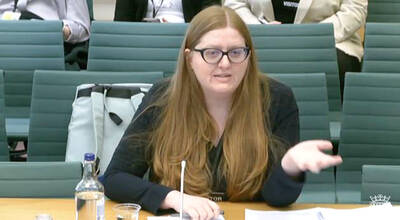
CONDITIONAL: The PRC imposes secret requirements that the funding it provides cannot be spent in states with diplomatic relations with Taiwan, Emma Reilly said China has been bribing UN officials to obtain “special benefits” and to block funding from countries that have diplomatic ties with Taiwan, a former UN employee told the British House of Commons on Tuesday. At a House of Commons Foreign Affairs Committee hearing into “international relations within the multilateral system,” former Office of the UN High Commissioner for Human Rights (OHCHR) employee Emma Reilly said in a written statement that “Beijing paid bribes to the two successive Presidents of the [UN] General Assembly” during the two-year negotiation of the Sustainable Development Goals. Another way China exercises influence within the UN Secretariat is

Taiwan’s first drag queen to compete on the internationally acclaimed RuPaul’s Drag Race, Nymphia Wind (妮妃雅), was on Friday crowned the “Next Drag Superstar.” Dressed in a sparkling banana dress, Nymphia Wind swept onto the stage for the final, and stole the show. “Taiwan this is for you,” she said right after show host RuPaul announced her as the winner. “To those who feel like they don’t belong, just remember to live fearlessly and to live their truth,” she said on stage. One of the frontrunners for the past 15 episodes, the 28-year-old breezed through to the final after weeks of showcasing her unique


 RSS
RSS