


Japanese carmakers are once more proving that small sells big.
After first pioneering the gas-sipping compact, then subcompact, the country's auto companies are scoring again with another downsizing -- the so-called "minicar."
Tiny, cheap and fuel-efficient, these minicars are essentially motorcycle-sized engines on four wheels. But demand for these runty runabouts is anything but petite. Last year, minicars racked record sales in Japan and now account for more than a third of all new cars sold annually here. The automakers have no immediate plans for mass export of the minicars, but some analysts predict they may eventually catch on in developing economies like India and China.
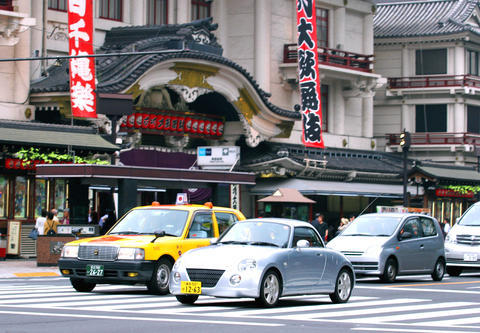
PHOTO: AP
At a time of soaring oil prices, it's little surprise Japanese drivers are turning to more wallet-friendly rides, just as Americans are abandoning their lunky sport utility vehicles. But perhaps only in a country famed for its "small-is-beautiful" culture of pocket electronics and bonsai trees could the trade-ins be so diminutive.
Known as kei or light, cars in Japanese, minis are limited to an engine size of up to 660ccs -- less than half the size of a Honda Civic -- and restricted by law to being no bigger than 3.4m long and 1.5m wide.
The first mini dates back to poverty-stricken post World War II Japan as a rattletrap people's car for those who couldn't afford "real wheels." They never really went away, but only recently became popular again, largely due to improvements in technology, styling and looser size restrictions on cars. Today's generation stretches the limits of engineering and styling, with models sporting four-wheel drive, satellite navigation, antilock brakes and even turbocharging.
"They used to be sold as cheap cars," said Kurt Sanger, an auto analyst for Macquarie Research in Tokyo. "Now they are actually decent cars that just happen to have a wimpy engine in them."
DISMAL MARKET
Japan's minicar boom is the silver lining of an otherwise dismal domestic market. While Japanese automakers have marched from one success to another overseas, sales at home have slumped for three-straight years -- hurt by the country's shrinking population and a trend of increased urbanization.
Minicar sales, however, have been climbing since 2004 and jumped 5.2 percent to a record 2.02 million vehicles last year. And surprisingly, it's not the big names like Toyota or Nissan riding the tide, but second-tier players once dismissed as also-rans, like Suzuki, Daihatsu and Mitsubishi, that locked up the niche market.
ADVANTAGES
Price is a big factor. Minicars cost around just US$10,000 and get tax breaks from the Japanese government. Then there's the savings from fuel efficiency that hits 47mpg (19.8kpl) -- a boon in a country where gasoline sells at about US$4.75 a gallon (US$1.25 per liter).
They are popular in crowded cities because they are easy to park, and a hit in less affluent rural areas where public transportation is limited.
Minis also pay cheaper registration fees and taxes than regular cars, noted Masa Ogawa, a managing director for JD Power Asia Pacific, an automotive consulting company. The basic flat tax on a minicar can run around US$96 a year, compared with more than US$830 for high-end performance cars.
Yet the class got its biggest boost in 1998, when government loosened restrictions on minicar sizes, expanding the overall dimensions to 3.4m by 1.5m, from 3.3m by1.4m.
The added dimensions allowed for roomier cabins, more bells and whistles and sturdier frames. The latter was crucial in helping allay consumer concerns that the whole car could end up a crumple-zone in a crash.
Suzuki's Wagon R has not only been Japan's best-selling minicar for the past three years, it has been the country's best-selling car, period -- even outselling Toyota's universally adored Corolla.
Typical of modern minicar styling, the Wagon R looks like a shrunken-down four-door minivan balanced on pie tin wheels, and is disproportionately tall for its length. The maxed-out passenger compartment nearly overwhelms the chassis, and the hood is compressed into a pug-nose to further save space.
Indeed, gone is the 1980s heyday of Japan's booming bubble economy, when looks mattered more than utility and customers were prepared to shell out big time for a little highway cachet, particularly if it involved a German import.
"Japanese thinking about driving cars has changed a lot," said Kentaro Nakata, spokesman for the Japan Automobile Dealers Association. "It's no longer a big status symbol. It's more about getting from place to place."
Some analysts predict that minicars may eventually catch on in developing economies like India and China, or even be manufactured there. Suzuki is already making slightly larger cars in India based on its minicar technology. It experimented with limited exports to Britain of an open-topped sportster called the Cappuccino in the 1990s, a venture that mostly flopped.
OVERSEAS
"We have no plans to sell the minicar overseas as it is," Suzuki spokesman Yoichi Kojima said.
Japanese minicars are sold mostly in Japan. Partly because profit margins are so low, it's not cost-effective to ship them abroad.
Germany's DaimlerChrysler AG is hoping to sell its own minicar, the tiny two-seat Smart car, in the US next year. But some observers doubt whether US drivers -- used to big, open highways -- are ready for such a radical revolution in size and horsepower.
"The minicar is one or two sizes below the compact," JD Power's Ogawa said. "American consumers would probably perceive the minicar as a kind of toy."

ROLLER-COASTER RIDE: More than five earthquakes ranging from magnitude 4.4 to 5.5 on the Richter scale shook eastern Taiwan in rapid succession yesterday afternoon Back-to-back weather fronts are forecast to hit Taiwan this week, resulting in rain across the nation in the coming days, the Central Weather Administration said yesterday, as it also warned residents in mountainous regions to be wary of landslides and rockfalls. As the first front approached, sporadic rainfall began in central and northern parts of Taiwan yesterday, the agency said, adding that rain is forecast to intensify in those regions today, while brief showers would also affect other parts of the nation. A second weather system is forecast to arrive on Thursday, bringing additional rain to the whole nation until Sunday, it
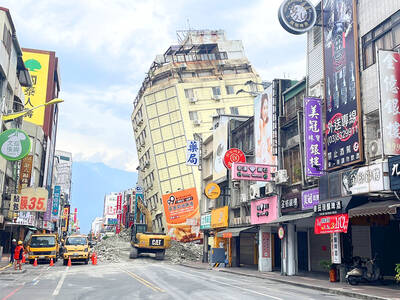
LANDSLIDES POSSIBLE: The agency advised the public to avoid visiting mountainous regions due to more expected aftershocks and rainfall from a series of weather fronts A series of earthquakes over the past few days were likely aftershocks of the April 3 earthquake in Hualien County, with further aftershocks to be expected for up to a year, the Central Weather Administration (CWA) said yesterday. Based on the nation’s experience after the quake on Sept. 21, 1999, more aftershocks are possible over the next six months to a year, the agency said. A total of 103 earthquakes of magnitude 4 on the local magnitude scale or higher hit Hualien County from 5:08pm on Monday to 10:27am yesterday, with 27 of them exceeding magnitude 5. They included two, of magnitude

CONDITIONAL: The PRC imposes secret requirements that the funding it provides cannot be spent in states with diplomatic relations with Taiwan, Emma Reilly said China has been bribing UN officials to obtain “special benefits” and to block funding from countries that have diplomatic ties with Taiwan, a former UN employee told the British House of Commons on Tuesday. At a House of Commons Foreign Affairs Committee hearing into “international relations within the multilateral system,” former Office of the UN High Commissioner for Human Rights (OHCHR) employee Emma Reilly said in a written statement that “Beijing paid bribes to the two successive Presidents of the [UN] General Assembly” during the two-year negotiation of the Sustainable Development Goals. Another way China exercises influence within the UN Secretariat is
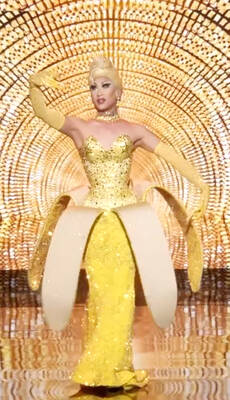
Taiwan’s first drag queen to compete on the internationally acclaimed RuPaul’s Drag Race, Nymphia Wind (妮妃雅), was on Friday crowned the “Next Drag Superstar.” Dressed in a sparkling banana dress, Nymphia Wind swept onto the stage for the final, and stole the show. “Taiwan this is for you,” she said right after show host RuPaul announced her as the winner. “To those who feel like they don’t belong, just remember to live fearlessly and to live their truth,” she said on stage. One of the frontrunners for the past 15 episodes, the 28-year-old breezed through to the final after weeks of showcasing her unique


 RSS
RSS