


Why does Japan insist on whaling?
The Japanese suffered a major embarrassment recently when they had to cut short their annual whale-hunting season in the Antarctic after a fire crippled their main ship and killed a crewmember. The 1.3 million liters of fuel in the vessel threatened to leak out into the pristine waters, a potential public relations nightmare.
A few weeks earlier, more than half the members of the International Whaling Commission, led by anti-whaling nations like the US, Britain and Australia, boycotted a conference that Japan had called in Tokyo to discuss the resumption of commercial whaling.
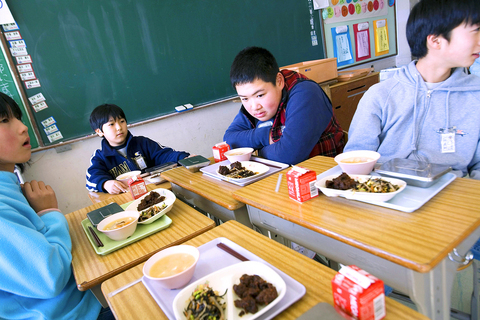
PHOTO: NY TIMES
Why does Japan go through the annual clashes with anti-whaling ships from Western environmental groups? Why does it subject itself to the opprobrium its so-called scientific whaling elicits in the very same countries with which Tokyo proclaims to have shared values? Out of all possible issues, why defy the US on this one?
After all, current demand for whale meat in Japan is abysmally low. Even in a town like Ayukawa -- a small northern community at the tip of a peninsula that juts into the Pacific Ocean, home to a century-old whaling tradition -- officials are struggling to preserve the tradition of eating whale meat by serving it in classroom lunches. Whale nuggets stewed in ketchup was on the menu on a recent Friday.
"I believe this is our traditional culture," said Natsumi Saito, 15, a junior in high school. "It's whaling that made this town famous."
For Japan as a whole, whaling is a far more complex issue. It is intricately tied to Japan's relations with the West, especially the US.
It comes as little surprise that foreign opposition to whaling has fueled nationalist sentiments in Japan. What is far less known is how the US instigated, at least partly, Japan's nationalist obsession with whaling by first encouraging the Japanese in the postwar years to hunt and eat whale meat, and then urging them to stop.
Tokyo is leading a worldwide campaign, arguing that it has the right to manage natural resources and that whale meat is part of its traditional culture.
The clash over the practice emerged with the US-led environmental movement, which emphasized the belief that endangered animals should be protected and that certain highly evolved ones, like whales, should not be killed at all. Under a 1986 ban on commercial whaling by the International Whaling Commission, Japan was allowed to engage in limited, scientific whaling of certain species -- for things like gauging populations and tracking movements -- and to sell the meat for consumption.
Japan has maintained ever since that human beings should be allowed to consume any animal as long as the fishing or hunting is sustainable. To establish this point, Japan sends whalers all the way to the Antarctic's international waters, said Tetsu Sato, a professor of environmental science at Nagano University. In a world of diminishing marine resources, establishing this principle is critical to Japan's long-term food security and managing natural resources, he said.
"Precisely because whaling attracts so much worldwide attention, Japan can't afford to lose," said Sato, who supports whaling.
Last year, Japan killed 1,073 minke whales, which ended up in restaurants, supermarkets, school cafeterias or unsold. Most biologists agree that certain species of whales, including the minke, have not only recovered but are now thriving. Disagreement remains, however, about whether they can be harvested in a sustainable way.
But arguments about resource management do not resonate as much as those about culture.
"I was afraid that our food culture was going to die, so that's why we began serving whale meat in school cafeterias," said Shigehiko Azumi, 80, who served as mayor here when the ban went into effect.
Few deny that whaling is part of Ayukawa's culture. But opinions divide over whether it is part of the culture of Japan.
To maintain the tradition, Ayukawa has tried to make strong-smelling whale meat more palatable to youthful tastes by stewing it in ketchup or serving it sweet-and-sour style.
Yoichi Nishimura, 55, a city agricultural official who grew up eating whale meat, said ketchup and other nontraditional ways of preparing whale meat were just facts of modern life.
"But it definitely is a little strange," he said.

A signaling system malfunction disrupted high-speed rail (HSR) services beginning at 8am today, with trains temporarily reduced to three northbound and three southbound trains per hour as authorities conduct inspections. The malfunction occurred on a section of track in Miaoli County during pre-operation checks early this morning, forcing northbound and southbound trains to use a single track, the HSR operator said. The regular schedule has been replaced with three hourly trains offering only nonreserved seating in each direction, stopping at every station, it said, adding that business class cars would still have reserved seating. Departures from terminal stations are scheduled at the top

Taiwan is still in the process of assessing the possibility of recruiting workers from Eswatini, the Ministry of Foreign Affairs said yesterday, adding that its goal is to help Eswatini upgrade its vocational training centers. If there are plans to recruit workers from Eswatini, safeguarding national security, protecting public health and ensuring the employment rights of Taiwanese would be prerequisites, Department of West Asian and African Affairs Director-General Yen Chia-liang (顏嘉良) told a news conference. Key considerations would also include filling labor shortages in specific industries, and fostering bilateral professional and technical exchanges, he said. Yen was asked about the progress of labor

A US uncrewed surface vessel (USV) encountered multiple Chinese warships during an autonomous transit of the Taiwan Strait, US defense company Seasats said in a statement on Wednesday. Seasats announced that a Lightfish USV had completed the first autonomous transit of the Taiwan Strait. Over five days, the USV traversed the entire length of the Strait while constantly monitoring surface vessel traffic, the company said. The Lightfish encountered multiple Chinese warships, one of which was a Chinese People’s Liberation Army Navy (PLAN) Type 056 corvette, it said. The Chinese vessels were operating “well within Taiwan’s exclusive economic zone without transmitting their identity via the
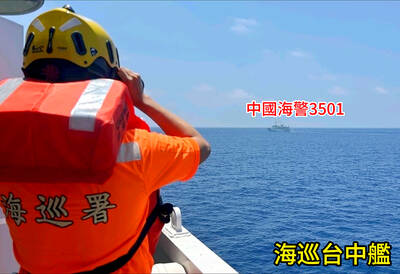
VERBOSE VESSELS: A CGA cutter and a China Coast Guard exchanged verbal barbs for more than a day in Taiwanese-controlled waters before the Chinese vessel left The Taiwanese and Chinese coast guards had a standoff near the strategically located Pratas Islands (Dongsha Islands, 東沙群島) in the north of the South China Sea, the Coast Guard Administration (CGA) said yesterday. The two sides engaged in intense radio exchanges over sovereignty claims during the 33-hour standoff. China Coast Guard vessel 3501 eventually left the restricted waters, 26.6 nautical miles (49.2km) west of the Pratas Islands, at 5pm yesterday, the CGA said. Lying approximately between southern Taiwan and Hong Kong, the Taiwan-controlled Pratas are seen by some security experts as vulnerable to Chinese attack due to their distance — more than


 RSS
RSS