


On New Year's Eve last year, tens of thousands of revelers flooding the streets of Taipei Xinyi District were all excited to usher in the arrival of the new year.
When the clock ticked at 12am, the 128-second fireworks burst from the top floors of Taipei 101. People were not only enchanted by the fireworks, but also by a sentence projected on the world's tallest freestanding building.
The phrase "2006 Bravia by Sony" had caught everyone's attention, at the same time arousing curiosity among those who were not in the know.
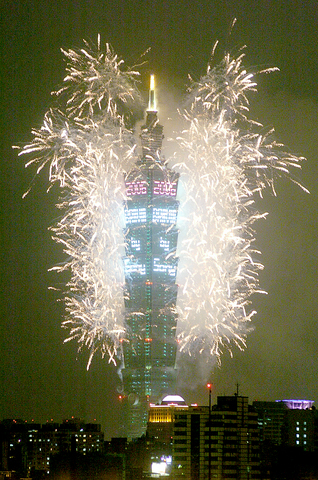
TAIPEI TIMES FILE PHOTO
Chao Yi-chien (
The 22-year-old part-time tutor did not know the meaning of Bravia until she read news reports the following day.
Indeed, Japanese electronics giant Sony Corp managed to send its message across to potential clientele from all walks of life, and they are not limited to those in Taiwan.
The image of the world's tallest countdown was simultaneously broadcast by global media, such as the US' CNN, Japan's NHK and China Central Television.
The price reportedly paid to sponsor the fireworks was NT$20 million (US$60,661).
Taipei Financial Center Corp (TFCC, 台北金融大樓公司) operators have decided this year to push the price tag up to NT$30 million and prolong the fireworks display to 188 seconds.
"We want to break last year's record by showing a longer display of fireworks this time," TFCC assistant vice president Michael Liu (
"The firework countdown attracts international media attention and it is the biggest moment of the year for us," he said.
Already 10 companies have approached TFCC this year for possible firework sponsorship.
The list includes local and foreign big names in the computers, communications and consumer electronics industries. Even an automobile firm made contacts, he said.
Sony is definitely not missing out on the exposure this year.
Hiroyuki Oda, division president of Sony Taiwan Ltd, was all smiles last Wednesday when asked by media about the effect of last year's firework sponsorship.
"The impact was so much greater than we expected," he said.
All that the company initially wanted people to realize was that Bravia is the brandname of Sony's liquid-crystal-display (LCD) TV sets, he said.
Sony brought in its first LCD TVs to local stores in September last year, already throwing a bomb into the market with competitive pricing for the 32-inch model.
The price war caused a shortage for its TVs until October and sales shot to the No. 1 position the following month.
After the 101 sponsorship, Sony maintained its leadership in terms of sales amount for the next nine months until September this year, according to the company's latest statistics.
This translates to an impressive victory in the competitive market, as local makers such as Kolin Inc (歌林), Sampo Corp (聲寶), BenQ Corp (明基) and Tatung Co (大同) are fighting for a share with foreign big names -- Samsung Electronics Co and Matsushita Electric Industrial Co, which owns the Panasonic brand.
While the company is now gearing up for this year's firework bidding, Oda said Sony is still evaluating the campaign format.
"We are looking forward to any form of partnership with 101, but we haven't reached any conclusion yet," he said.
However, some locals were wondering if foreign brands should not have given way to local players to pronounce their branding powers to the world.
"Some people were complaining that 101 had given the advertising chance to a foreign brand last year," Government Information Office (GIO) Minister Cheng Wen-tsang (
The office has decided to play the role of mediator this year by communicating with TFCC, hoping the latter will favor local firms.
The GIO has reportedly asked local big names, such as Acer Inc, Asustek Computer Inc (華碩電腦), BenQ and Giant Inc (巨大機械), one of the world's leading bicycle brands, to form a joint bid.
It hopes each of their brands will be projected on the four sides of the skyscraper.
But Liu said it might be an uphill task to please everyone as views from four directions of the building have a different "value." The tentative plan is to leave all attention to only a single brand, he said.
"What we are looking for is a productive and creative proposal. The sponsorship is not to use Taipei 101 as an outdoor media, but rather co-branding for both the sponsor and the building," he said.
Sony outbid others last year as its sponsorship did not end with the short-lived fireworks.
The deal also included the use of Taipei 101 images in Sony's corporate calendars and brochures, as well as further collaboration on the Sony Fair held in April at the Taipei 101 concourse, he said.

‘NO SECURITY RISK’: The Railway Bureau reassured the public that the technicians’ activities were limited to technical guidance and did not involve sensitive systems The Railway Bureau yesterday said it had invited eight Chinese technicians to assist with an airport MRT construction project. The bureau issued the confirmation after an Internet user said Chinese nationals had entered the construction zone of Taiwan Taoyuan International Airport’s Terminal 3 project. They asked why “individuals from an enemy state” were allowed access to such a major national infrastructure project, which raised serious concerns over Taiwan’s industrial safety, sensitive systems and information security. The bureau’s Northern Region Engineering Branch Office said subcontractor Taiwan Handle Industrial Co (台灣手把工業) of the Taoyuan airport MRT’s “Contract No. CU05 Project A14 Station Civil, MEP &

The National Chungshan Institute of Science and Technology yesterday showcased its locally developed variants of the Vision 60 robotic patrol dog, which it plans to deploy on the nation’s outlying territories in the South China Sea. The variants were produced under the Joint Lab project — created by the institute and domestic companies — and assembled with domestically produced motors, lenses and artificial intelligence (AI) systems alongside licensed tech from the US, Missile and Rocket Systems Research Division deputy director Jen Kuo-kang (任國光) told the media event at a military base in Taipei’s Dazhi (大直) area. Taiwan has built up its strengths

NOT IMMEDIATE: Taiwan has a chance to appeal the proposed 10 percent tariff before it starts, while other countries face a 12.5 percent tariff from the trade office Taiwan is among 60 economies determined by the US to have failed to impose or enforce a ban on the importation of goods produced with forced labor, according to a notice released on Tuesday by the Office of the US Trade Representative (USTR), which proposed imposing an additional 10 percent or more tariff on them. The USTR in a statement said that following an investigation, it had determined under Section 301 of the Trade Act of 1974 that the failure of the 60 economies to impose and effectively enforce a prohibition on the importation of goods produced with forced labor is

TIT-FOR-TAT: The US allegedly revoked the visa of a Chinese national working at Xinhua News Agency in the US in response to Beijing’s expulsion of Vivian Wang The Presidential Office yesterday condemned China for expelling a New York Times correspondent from Beijing following the newspaper’s interview with President William Lai (賴清德), saying the move highlighted Beijing’s suppression of press freedom and its threat to international news media. Taiwan has noted a series of recent incidents in which Beijing used similar tactics to “threaten and pressure international media outlets and journalists,” Presidential Office spokeswoman Karen Kuo (郭雅慧) said in a statement. “This concerns not only press freedom and freedom of expression, but also the safety of journalists, and Taiwan and relevant partners are paying close attention to the situation,” she


 RSS
RSS