


Nothing spooks the markets like the oil price. The fear of running out, the threat of terrorism, panic over US house prices, all of these are built into that most volatile of sums: the price of a barrel. Now, after years of fretting over rising prices, traders and economists are finding reasons to shiver over its fall, and what it tells us about the global economy.
So last week, instead of worrying about confrontation between the US and Iran -- concern that helped drive oil to a US$78 August peak -- the fears were of a nasty US slowdown, thanks in part to a crumpling housing market, that will undercut demand for crude. The price fell to US$60, a six-month low.
Is that fall here to stay, and is it really a harbinger of economic doom? It depends whether what has happened in recent weeks is driven more by real changes or by the feverish speculation of traders.
Recent economic data offer some support for the fears. In the first quarter, US GDP grew by 5 percent year on year, falling to 3 percent in the next. In August US house prices fell for the first time in a decade. Morgan Stanley sees a 23 percent chance of a recession next year.
"There are plenty of traders in the market who believe that the US will grow by only 1.5 percent next year," said Paul Horsnell, oil analyst at Barclays Capital.
In a note last week he went further, saying that this is the "modal expectation" across the market, as is a hard landing in China, whose voracious economy has supported commodity prices in recent years.
Short positions have multiplied, indicating that the market expects short-term falls. But are the bears right?
Horsnell thinks not. He points to his own bank's forecasts for US growth next year of some 3 percent (the IMF has 2.9 percent, down from 3.4 percent this year), and global economic growth of 4.7 percent -- admittedly down from this year's 5.1 percent, but not, he said, "a path that could be described as a hard landing."
Economists elsewhere point out that the oil price will have its own effect on the US economy in particular.
Kevin Gaynor of RBS says that with oil making up 8 percent to 10 percent of consumption, a fall in the price of 15 percent would add up to 1.5 percent on consumption. He believes that US growth will be about 3 percent next year, and consequently said he is "not bearish" about the oil price.
Concerns about economic demand, however, are not the only cause of the recent price fall.
"The reason it has come down is not market fundamentals, it is the easing of geopolitical tensions in Iran, Lebanon and elsewhere," said Fatih Birol, chief economist at the International Energy Agency in Paris.
Here, analysts are not convinced that there will be a lasting effect.
"This is a key reason why people have expected high prices in the past. But there is no reason to think there has been substantial change. The media go from one day to another looking at Lebanon and Iran; they also look at Venezuela and Russia, where some companies have been having problems with Sakhalin. I do not think there has been a major change in the geopolitical situation, and I would be surprised if prices this year or next go much below US$50 a barrel," Birol said.
But they could if there were a dramatic change in the balance of supply and demand. The key players here are the OPEC nations, chiefly Saudi Arabia. While non-OPEC countries produce some 62 percent of the world's oil, investment in regions such as the Gulf of Mexico and Siberia is only maintaining production at current levels.
OPEC, however, at an estimated 29.9 million barrels a day, is pumping out 400,000 barrels fewer than at this time last year.
At its last meeting in Vienna it said that increased production over the past few years had led to growing stockpiles and, although it would not announce a cut in production to support the price, it did not rule one out later this year.
As with the oil market in general, however, nothing with OPEC is simple. The difference between what it does and can produce should be accounted for by the quota system which limits individual countries' production. Few pay attention to this -- the official limit should be 28 million barrels per day.
Leo Drollas at the Center for Global Energy Studies (CGES) in London believes that Saudi Arabia will determine whatever OPEC does.
The kingdom has taken a hands-off approach in the past year by allowing its production to drift down by some 300,000 barrels rather than orchestrating any cuts. It manages this by not selling its crude -- which is "sour" and medium-weight, a grade that costs more to refine than the lighter and "sweeter" US grades -- at a discount.
Drollas says that if OPEC production continues at present levels, prices could fall below US$50 a barrel.
"If you want to keep prices at US$60, OPEC production has to fall to 29.4 million barrels per day [a 500,000 cut] in the last quarter of this year and to 29 million barrels per day in the first quarter of next. The big question is: who is going to do it?" he said.
Outside Saudi Arabia, there are few candidates. Venezuela is producing at well below quota; it will not want to cut because it needs to maximize revenue. The same is true of Indonesia, Iran and Nigeria and the north African countries.

National Taiwan University (NTU) yesterday said it disqualified a person from an entrance examination for using AI smart glasses to cheat, along with two others for making untruthful statements in their curriculum vitae. The three applicants were given null scores, Taiwan’s highest-ranked university said, calling on prospective students to be honest in the admissions process. NTU registrar Lee Hung-sen (李宏森) said that the cheating applicant wore a hat and thick-rimmed glasses to the second written exam for medical school, claiming that they felt cold. Suspicions were aroused when the applicant stared oddly at the test for long stretches while steadily bringing the paper
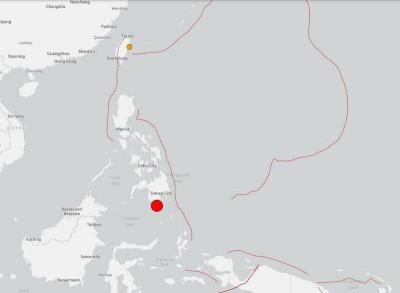
A magnitude 7.8 earthquake struck off the southern coast of Mindanao in the Philippines at 7:38am today, prompting the US Tsunami Warning System to issue an alert for neighboring countries, including Taiwan. The system issued a purple alert indicating a "tsunami threat." The potential threat zone includes Taiwan, the Philippines, Papua New Guinea, Yap and Palau. Philippine authorities were assessing the damage from the quake, with the office of civil defense seeking to verifying initial reports that 15 people had been killed and 129 injured in the region, mostly from falling debris. Arlene Hollero, disaster chief of Maasim town in the Philippines' Sarangani Province,

‘GRAY ZONE’ PRESSURE: Beijing’s activities are intended to create the deceitful impression that China has jurisdiction over the area around Taiwan, the CGA said Taiwan’s rights over its territorial waters and exclusive economic zone must not be violated by any country, the Mainland Affairs Council said yesterday, adding that it will not accept any unprovoked actions. The council issued the remarks in response to the China Coast Guard conducting maritime enforcement drills near eastern Taiwan and claiming to fully exercise China’s maritime administrative law enforcement authority. The Coast Guard Administration (CGA) has been closely monitoring the situation and is taking concrete steps to defend the nation’s sovereignty and secure its waters, the council said. China has no sovereign rights over the waters off eastern
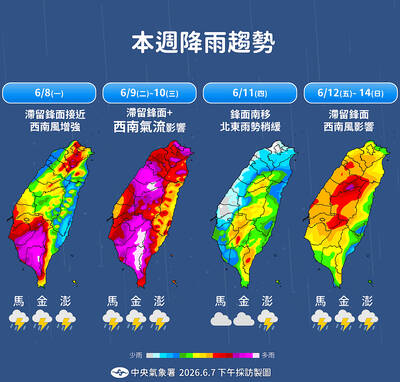
Heavy rain is expected to affect parts of Taiwan this week, the Central Weather Administration (CWA) said yesterday as a meteorologist said the active part of the annual plum rain season has started. A stationary plum rain front and southwesterly winds would bring unstable weather and abundant moisture to Taiwan from today for about a week, with the heaviest rainfall forecast for tomorrow and Wednesday, the CWA said. The agency said western and northeastern Taiwan, and mountainous areas in the east and southeast, could expect showers or thunderstorms on those two days, with localized heavy rain possible. Other parts of


 RSS
RSS