


Last week, in an effort to solve the Israeli-Palestinian crisis, I withdrew settlements in the Gaza Strip. But then a suicide bomber struck in Jerusalem, the Palestine Liberation Organization (PLO) leader called my actions "condescending," and the Israeli Knesset demanded a stern response. Desperate to retain control, I launched a missile strike against Hamas militants.
I was playing Peacemaker, a video game in which players assume the role of either the Israeli prime minister or the Palestinian president. Will you pull down the containment wall? Will you beg the US to pressure your enemy? You make the calls and live with the results the computer generates. Just as in real life, actions that please one side tend to anger the other, making a resolution fiendishly tricky. You can play it over again and again until you get it right, or until the entire region explodes in violence.
"When they hear about Peacemaker, people sometimes go, `What? A computer game about the Middle East?'" admits Asi Burak, the Israeli-born graduate student who developed it with a team at Carnegie Mellon University in Pittsburgh. "But people get very engaged. They really try very hard to get a solution. Even after one hour or two hours, they'd come to me and say, you know, I know more about the conflict than when I've read newspapers for 10 years."
Video games have long entertained users by immersing them in fantasy worlds full of dragons or spaceships. But Peacemaker is part of a new generation: games that immerse people in the real world, full of real-time political crises. And the games' designers aren't just selling a voyeuristic thrill. Games, they argue, can be more than just mindless fun, they can be a medium for change.
The proposition may strike some as dubious, but the "serious games" movement has some serious brain power behind it. It is a partnership between advocates and nonprofit groups that are searching for new ways to reach young people, and tech-savvy academics keen to explore video games' educational potential.
Together they have found some seriously high-powered backers. Last year the MacArthur Foundation began issuing grants to develop persuasive games, including a US$1.5 million joint gift to James Paul Gee, a professor of educational psychology at the University of Wisconsin, and GameLab, a New York firm that designs games.
Supplying a War zone
Meanwhile the UN has released Food Force, a game that helps people understand the difficulties of dispensing aid to war zones. Ivan Marovic, co-founder of Otpor (Resistance) -- the Serbian youth movement widely credited with helping to oust Slobodan Milosevic -- helped produce A Force More Powerful, a game that teaches the principles of nonviolent strategy. And the third annual Games for Change conference in New York, held earlier this month, attracted academics and nonprofit executives, including several from the World Bank and the UN.
"What everyone's realizing is that games are really good at illustrating complex situations," said Suzanne Seggerman, one of the organizers of the conference. "And we have so many world conflicts that are at a standstill. Why not try something new? Especially where it concerns young people, you have to reach them on their own turf. You think you'll get their attention reading a newspaper or watching a newscast? No way."
Henry Jenkins, an MIT professor who studies games and learning, said the medium has matured along with the young people who were raised on it.
"The generation that grew up with Super Mario is entering the workplace, entering politics, so they see games as just another good tool to use to communicate," he added. "If games are going to be a mature medium, they're going to serve a variety of functions. It's like with film. We think first of using it for entertainment, but then also for education and advertising and politics and all that stuff."
Better than `Grand Theft Auto?'
Given away free, they have found astonishingly large audiences. The UN game, Food Force, has been downloaded by 4 million players, a number to rival chart-busting commercial hits like Halo or Grand Theft Auto. In May, MTV's college channel released an online game called Darfur is Dying in which players escape the Janjaweed while foraging for water to support their village: Despite its cartoonish graphics, it is a strangely powerful experience. In the first month alone 700,000 people played it. Of those, tens of thousands entered an "action" area of the game -- political action, that is -- where they can send e-mail messages to politicians and demand action on Darfur.
A Force More Powerful is considerably more complex. Players must make dozens of decisions as they try to foment democratic uprisings, but each action brings unexpected consequences. A huge demonstration may get your leaders arrested by the police, a boycott is safer but less effective, and so on.
"The beauty of the game is that players can teach themselves by trying things out," Marovic said.
This is the central conceit behind all these efforts: that games are uniquely good at teaching people how complex systems work.
"You could have some big theory about society, but these days it's like, sorry, people aren't going to read your white paper on it," said Ian Bogost, an assistant professor at the George Institute of Technology, whose book on serious games will be published next spring by MIT Press. "Put it in a game, and they'll discover what you're talking about themselves."
Video games, serious-games advocates say, also possess a persuasive element that is missing from books or movies: They let the player become a different person (at least for an hour or two), and see the world from a new perspective.
When Burak first showed Peacemaker to Israelis and Palestinians, he found that they were most interested in playing as their own "side." But when he pushed them to switch positions they developed a more nuanced sense of why the other side acted as it did.
In Qatar several people told him that "they kind of understood more the pressures the Israeli prime minister has."
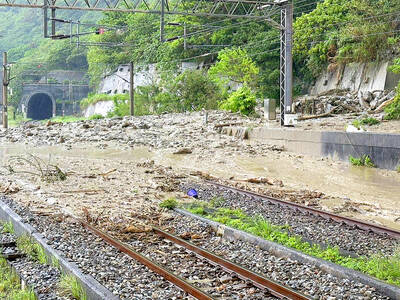
ROLLER-COASTER RIDE: More than five earthquakes ranging from magnitude 4.4 to 5.5 on the Richter scale shook eastern Taiwan in rapid succession yesterday afternoon Back-to-back weather fronts are forecast to hit Taiwan this week, resulting in rain across the nation in the coming days, the Central Weather Administration said yesterday, as it also warned residents in mountainous regions to be wary of landslides and rockfalls. As the first front approached, sporadic rainfall began in central and northern parts of Taiwan yesterday, the agency said, adding that rain is forecast to intensify in those regions today, while brief showers would also affect other parts of the nation. A second weather system is forecast to arrive on Thursday, bringing additional rain to the whole nation until Sunday, it

LANDSLIDES POSSIBLE: The agency advised the public to avoid visiting mountainous regions due to more expected aftershocks and rainfall from a series of weather fronts A series of earthquakes over the past few days were likely aftershocks of the April 3 earthquake in Hualien County, with further aftershocks to be expected for up to a year, the Central Weather Administration (CWA) said yesterday. Based on the nation’s experience after the quake on Sept. 21, 1999, more aftershocks are possible over the next six months to a year, the agency said. A total of 103 earthquakes of magnitude 4 on the local magnitude scale or higher hit Hualien County from 5:08pm on Monday to 10:27am yesterday, with 27 of them exceeding magnitude 5. They included two, of magnitude

CONDITIONAL: The PRC imposes secret requirements that the funding it provides cannot be spent in states with diplomatic relations with Taiwan, Emma Reilly said China has been bribing UN officials to obtain “special benefits” and to block funding from countries that have diplomatic ties with Taiwan, a former UN employee told the British House of Commons on Tuesday. At a House of Commons Foreign Affairs Committee hearing into “international relations within the multilateral system,” former Office of the UN High Commissioner for Human Rights (OHCHR) employee Emma Reilly said in a written statement that “Beijing paid bribes to the two successive Presidents of the [UN] General Assembly” during the two-year negotiation of the Sustainable Development Goals. Another way China exercises influence within the UN Secretariat is

Taiwan’s first drag queen to compete on the internationally acclaimed RuPaul’s Drag Race, Nymphia Wind (妮妃雅), was on Friday crowned the “Next Drag Superstar.” Dressed in a sparkling banana dress, Nymphia Wind swept onto the stage for the final, and stole the show. “Taiwan this is for you,” she said right after show host RuPaul announced her as the winner. “To those who feel like they don’t belong, just remember to live fearlessly and to live their truth,” she said on stage. One of the frontrunners for the past 15 episodes, the 28-year-old breezed through to the final after weeks of showcasing her unique


 RSS
RSS