


Diamonds are forever, but mobile phones are not designed to last quite so long. Unless you are a lucky recipient of a jewel-encrusted mobile this Christmas, that is. Vertu, a subsidiary of Nokia, is producing 200 mobile phones decorated with diamonds. The most expensive of the range are believed to be the first mobile handsets to cost in the region of ?50,000 (US$88,450).
The company, which sells the mobiles through expensive jewellers and department stores such as Harrods in London, plans to ship the first of the diamond handsets next week. The phones are handmade at the company's headquarters near Hook in southern England, and are already pre-sold. But don't worry if a Vertu phone is on your Christmas wish list. The company produces a range of "cheaper" handsets, which start at around ?3,000, and these are still available.
So what do you get for your ?50,000? Down the side of the phone is something called a pave, jewellers' parlance for a "carpet" of tiny diamonds. The keypads of the most expensive handsets are made up of eight carats' worth of diamonds. The keypad itself is housed in a body of white gold (or platinum), underpinned with ruby bearings and furnished with the same ceramic material that was initially manufactured for the space shuttle.
Objects of desire
"Luxury isn't about need, it is about want," explains Chris Harris, the company's UK sales director. "We all have our areas where we spend beyond reason because we get a buzz from it. Owners of Vertu know they are buying an object that only a few people can own." Indeed, consumer technology has long had a luxury market that, at its peak, is often indistinguishable from jewelry. The humble timepiece can cost ?10, but it can also cost ?10,000 and do its job little better. But to the owner, that's not the point. You only have to look at the Persian wealth currently on show at the British Museum to see that everyday objects have long been status symbols.
Surprisingly, the ?50,000 phone comes with just a single year's warranty, doesn't have a camera and there are no promises to retrofit the handsets if the current GSM technology, which it relies on, is ever replaced.
Even a ?50,000 phone has a finite lifespan as a working model. But then again, it is easy to be snotty about such success. What Vertu is doing, after all, is establishing a luxury brand that is becoming synonymous with hi-tech phones -- just as Switzerland is with high-end watches. And you can admire a Vertu almost like a Faberge egg. The engineering is technically excellent and the aforementioned ruby bearings are designed to perform millions of actuations over the handset's life cycle, for example. The phones are far more durable than regular brands and are expected to last up to 20 years if looked after properly.
future antiques?
It is tempting to think of such glittering objects as future antiques, bought as an investment, and Vertu says that a number of its phones are bought by collectors, especially in the far east. So could we expect to see a Vertu handset pop up on antiques TV shows in 50 years' time?
"That's just silly," says a spokeswoman with the auction house Christie's. "The jewels will have an inherent value," she says, "but it is impossible to know what they will sell for in the future. What gives an antique its value is a combination of rarity, quality and provenance. Just because a rich person owns it doesn't give it value."
But if a famous person owns it, then it is a different story. David Beckham, Gwyneth Paltrow and Brad Pitt all own Vertu phones, as do members of the Saudi royal family. And Vertu is not the only firm making phones that go bling, bling.
Motorola is rumored to be producing a limited edition, solid gold version of its superslim clamshell, the V3. Last month, Samsung, one of the biggest "non-luxury" phones manufacturers, announced a partnership with Bang & Olufsen, the Danish makers of sleekly futuristic audio equipment. The resulting lovechild is the Serene, a very odd mobile handset. It features a "dial" keypad, doesn't play music and is expected to cost around ?700 when it goes on sale in the UK next month.
highest quality
"The intention is to provide an alternative for those customers who demand the highest quality," reads a statement from the company, "for whom simplicity and quality are important factors, and for whom less can be more. It is a phone you want to keep. It is timeless in use, in design, and in technology, freed from unnecessary functions and instructions."
The phone is, therefore, the polar opposite of the Vertu handset. But then again, when have the rich ever agreed on what makes style?
A girl's best friend: But blinging up your phone is no longer the preserve of the super-rich. Jewelry makers such as Boodle already supply a range of accessories to glam up the most mundane of mobiles, and Swarovski, the makers of high-quality crystal products, manufacture special cases and holders for mobile phones that sell for several hundred pounds each.
But with mobile phone theft rife, you can't help but wonder about the wisdom of such purchases.
"If you can afford to buy one, you can afford to lose one," says the cabbie on the way to the Vertu factory.

‘NO SECURITY RISK’: The Railway Bureau reassured the public that the technicians’ activities were limited to technical guidance and did not involve sensitive systems The Railway Bureau yesterday said it had invited eight Chinese technicians to assist with an airport MRT construction project. The bureau issued the confirmation after an Internet user said Chinese nationals had entered the construction zone of Taiwan Taoyuan International Airport’s Terminal 3 project. They asked why “individuals from an enemy state” were allowed access to such a major national infrastructure project, which raised serious concerns over Taiwan’s industrial safety, sensitive systems and information security. The bureau’s Northern Region Engineering Branch Office said subcontractor Taiwan Handle Industrial Co (台灣手把工業) of the Taoyuan airport MRT’s “Contract No. CU05 Project A14 Station Civil, MEP &

A US uncrewed surface vessel (USV) encountered multiple Chinese warships during an autonomous transit of the Taiwan Strait, US defense company Seasats said in a statement on Wednesday. Seasats announced that a Lightfish USV had completed the first autonomous transit of the Taiwan Strait. Over five days, the USV traversed the entire length of the Strait while constantly monitoring surface vessel traffic, the company said. The Lightfish encountered multiple Chinese warships, one of which was a Chinese People’s Liberation Army Navy (PLAN) Type 056 corvette, it said. The Chinese vessels were operating “well within Taiwan’s exclusive economic zone without transmitting their identity via the
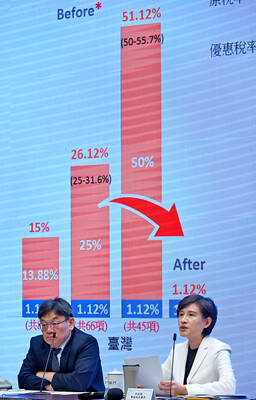
GREATER REACH? Auto parts and wood products would face tariffs of up to 15%, matching those targeting the EU, Japan and South Korea, Vice Premier said The US has announced that preferential tariff treatment for Taiwan’s non-semiconductor Section 232 goods would take effect retroactively from May 1, the Executive Yuan said yesterday. The US government yesterday posted a notice on the Federal Register’s public inspection Web site previewing tariff concessions for Taiwan under a memorandum of understanding (MOU) on Taiwan-US investment after two months of negotiations. The MOU signed on Jan. 15 stipulated three major preferential tariff arrangements: a 15 percent “reciprocal” tariff rate for Taiwan without stacking most-favored nation (MFN) rates; preferential Section 232 treatment for semiconductors and related products; and preferential Section 232 treatment for non-semiconductor

TIT-FOR-TAT: The US allegedly revoked the visa of a Chinese national working at Xinhua News Agency in the US in response to Beijing’s expulsion of Vivian Wang The Presidential Office yesterday condemned China for expelling a New York Times correspondent from Beijing following the newspaper’s interview with President William Lai (賴清德), saying the move highlighted Beijing’s suppression of press freedom and its threat to international news media. Taiwan has noted a series of recent incidents in which Beijing used similar tactics to “threaten and pressure international media outlets and journalists,” Presidential Office spokeswoman Karen Kuo (郭雅慧) said in a statement. “This concerns not only press freedom and freedom of expression, but also the safety of journalists, and Taiwan and relevant partners are paying close attention to the situation,” she


 RSS
RSS