


After laboring 15 years on a tea farm, Zong Qinghou returned to the city and a job riding his bicycle around town selling flavored ice pops. It was an early experiment in private enterprise at the elementary school where his mother worked, and he and his two employees hoped to grow it into a successful company.
Twenty years later, his humble enterprise is China's largest beverage company, Wahaha, with a nationally known brand name and revenues of US$1.3 billion last year. Zong has become one of the most influential entrepreneurs in China and his company's Future Cola has just been shipped to the US.
"Don't worry," he said in an interview at his company's headquarters. "We're not going to bring down Coke and Pepsi."
Not in the US market at least. Not yet.
Zong's hands are full battling cola wars on his own turf. While striving to improve Future Cola's third-place position in the competitive domestic market, he's looking beyond the carbonated beverage market, which he believes is "past its peak" in China and the world. Cola has been in China for nearly a century -- Coca-Cola established its brand in the 1930s and 1940s, then re-entered the market in 1979 as the communist regime liberalized trade.
Today, juices and health drinks are an emerging and fast-growing trend.
"Chinese people are even more fashionable than Westerners," he said. "We love the new and loathe the old."
`Egg striking a rock'
When Wahaha, a Chinese word used to mimic the sound of a laughing child, launched Future Cola six years ago, analysts didn't give it much hope. Several domestic companies had tried selling cola and failed. Coke and Pepsi have cachet because they are American brands.
"Our intention of competing with Coke and Pepsi was regarded as an egg striking a rock," Zong admitted.
Wahaha spent a year developing its own cola, producing a beverage that tastes closer to Pepsi than Coke, Zong said. They named it fei chang cola, which means extraordinary or unusual. (Its sound is similar to "future.") Packaged in red, with a font very similar to that of Coke's, its appeal is a patriotic one.
But in the prosperous big cities, the idea of a "national cola" has not been a winning one. Coke had 24 percent of the soda market last year while Future Cola has less than half that, according to Chinese media reports. Coke sells 2.2 million tonnes per year, Pepsi 1.3 million tonnes and Future Cola 662,000 tonnes, according to the Economic Daily.
"The motivation of buying Chinese cola because of patriotism is rather limiting," said Qu Yongxiang, an analyst with Guotai Jun'an Securities. "If Coke and Pepsi were Japanese, this appeal might work better."
Hometown loyalty doesn't get it very far either. Wahaha is the second-largest taxpayer in Zhejiang Province, after a tobacco company, but the main concession stand at the airport in Hangzhou, the provincial capital, carries not a single Wahaha product. That contract was won by Coke.
"Coke has a better reputation," explains a sales girl. "And it tastes better."
When a customer points out that Future Cola is made in Hangzhou, the sales girl replies: "But Coke is made in Hangzhou, too!"
Future Cola dominates in places where a few pennies can make a difference -- that is, in small cities, the poor interior and China's vast countryside. Rural consumers care more about price than brand.
"To people in central and western China, because Future Cola is the first in the market, it is perceived as an authentic cola product," said a report in the Economic Observer. "On average, the cost of a bottle of Future Cola is 0.5 yuan (US$0.06) lower than the two other colas, giving it great market advantage."
Growing competition
But the competition is about to stiffen as Coke expands into rural markets and Future Cola goes after urban ones. Wahaha has stepped up advertising in big cities while Coke has distributed refrigerators with its logo and promoted a bottle refund program in rural areas.
Coca-Cola did not respond to several requests for comment.
Zong said he does not intend to advertise in the US or actively promote Future Cola. He will leave that to its distributor, tiny Manpolo International Trading Co, a small import/export firm based in New York's Chinatown. More than 14,000 cases of Future Cola will initially be sold in New York and Los Angeles and, using the patriotic appeal, target the overseas Chinese population.
Like many of China's large enterprises, Wahaha's ownership structure is murky. The company calls itself a "mixed ownership" company, part joint venture, part joint-stock, part state-owned. In 1996, French food giant Danone invested in five joint-ventures with Wahaha, injecting more than US$70 million into the company. Wahaha was able to upgrade its equipment and expand production.
Now 59, Zong's official title is general manager and chairman of the board, but everyone knows he's the only boss who counts. He tastes every new product and works 16-hour days.
In the face of ever fiercer competition, Wahaha is undertaking its first restructuring in 17 years to re-tool its employee incentive system.
Qu said the Chinese cola market is not yet saturated, but there is not much more room for it to grow. He described cola as being at a stage of "stable development" rather than "explosive development." Fruit drinks and dairy drinks will grow much faster, at a rate of about 30 percent annually, he said.
"Fruit and dairy drinks are comprising a larger and larger portion in the overall food structure in daily life," he said. "That's the trend in big and developed cities."
Fruit king
Coke has a juice drink called "Coo," but so far, no nationwide brand of fruit drink has emerged. Qu said it's possible for Wahaha, already the No. 2 seller of bottled water in China, to take that role.
Zong, who has only a junior high school education, admires Bill Gates, a Harvard dropout, and Li Ka-shing (
"Experts have done analysis and found that highly educated people aren't fit to be entrepreneurs," he said. "If you know too much, you might hesitate and not take a chance.
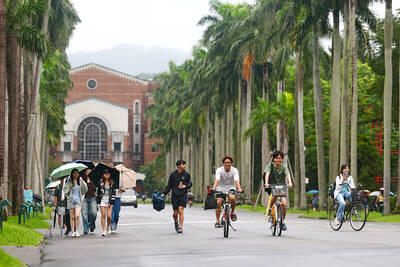
National Taiwan University (NTU) yesterday said it disqualified a person from an entrance examination for using AI smart glasses to cheat, along with two others for making untruthful statements in their curriculum vitae. The three applicants were given null scores, Taiwan’s highest-ranked university said, calling on prospective students to be honest in the admissions process. NTU registrar Lee Hung-sen (李宏森) said that the cheating applicant wore a hat and thick-rimmed glasses to the second written exam for medical school, claiming that they felt cold. Suspicions were aroused when the applicant stared oddly at the test for long stretches while steadily bringing the paper
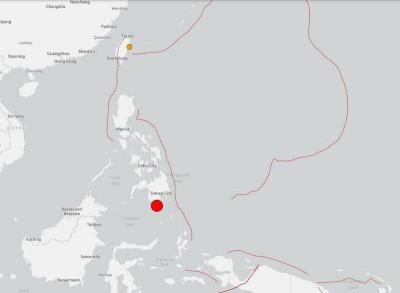
A magnitude 7.8 earthquake struck off the southern coast of Mindanao in the Philippines at 7:38am today, prompting the US Tsunami Warning System to issue an alert for neighboring countries, including Taiwan. The system issued a purple alert indicating a "tsunami threat." The potential threat zone includes Taiwan, the Philippines, Papua New Guinea, Yap and Palau. Philippine authorities were assessing the damage from the quake, with the office of civil defense seeking to verifying initial reports that 15 people had been killed and 129 injured in the region, mostly from falling debris. Arlene Hollero, disaster chief of Maasim town in the Philippines' Sarangani Province,
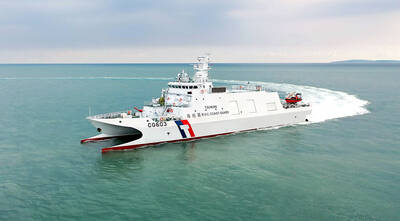
‘GRAY ZONE’ PRESSURE: Beijing’s activities are intended to create the deceitful impression that China has jurisdiction over the area around Taiwan, the CGA said Taiwan’s rights over its territorial waters and exclusive economic zone must not be violated by any country, the Mainland Affairs Council said yesterday, adding that it will not accept any unprovoked actions. The council issued the remarks in response to the China Coast Guard conducting maritime enforcement drills near eastern Taiwan and claiming to fully exercise China’s maritime administrative law enforcement authority. The Coast Guard Administration (CGA) has been closely monitoring the situation and is taking concrete steps to defend the nation’s sovereignty and secure its waters, the council said. China has no sovereign rights over the waters off eastern
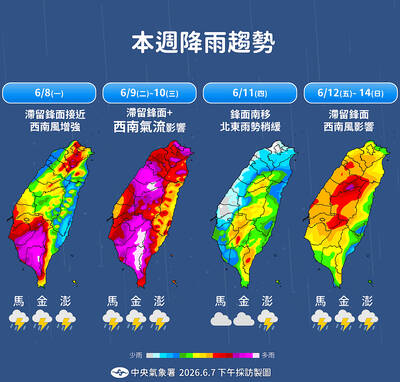
Heavy rain is expected to affect parts of Taiwan this week, the Central Weather Administration (CWA) said yesterday as a meteorologist said the active part of the annual plum rain season has started. A stationary plum rain front and southwesterly winds would bring unstable weather and abundant moisture to Taiwan from today for about a week, with the heaviest rainfall forecast for tomorrow and Wednesday, the CWA said. The agency said western and northeastern Taiwan, and mountainous areas in the east and southeast, could expect showers or thunderstorms on those two days, with localized heavy rain possible. Other parts of


 RSS
RSS