


The new supermarket west of Tokyo has all the trademark Wal-Mart touches -- roomy aisles, price rollbacks and big shiny signs, but shoppers have almost no idea this outlet is run by the US retail giant.
Yuki Kitamura, a housewife who swears by the store's vegetable selection and shops there three times a week, didn't know and didn't care that Wal-Mart Stores Inc, the world's largest retailer, has a 37.7 percent stake in the supermarket chain Seiyu, the operator of this store and 400 others nationwide.
"The store got a liberating feeling, and it got roomier," she said. "It's fun."
Despite the ?700 million (US$6.4 million) remodeling of the flagship store, the Wal-Mart name is nowhere to be seen. Moreover, there isn't a single Super Center in Japan, and Wal-Mart officials say they may never open one here.
Wal-Mart has arrived in Japan, but it's making its entrance cautiously and stealthily.
The retailer, based in Bentonville, Arkansas, studied Japan for several years and concluded it was a complex market best penetrated under an alliance with a local partner that understood Japanese shoppers. So it took a stake in Seiyu last year.
"For Japanese customers, the name Wal-Mart doesn't mean a lot. The Seiyu name means a lot. For the near future, we'll go with the Seiyu brand," said Billie Cole, spokeswoman for Wal-Mart International Holdings.
Wal-Mart, which operates in 10 nations besides the US, has adapted its approach to different markets, making itself more visible with Wal-Mart stores in places like China, while taking a lower profile in Mexico and Britain, where it has chosen partners as it has in Japan.
But nowhere else is the total invisibility of Wal-Mart quite as clear as in Japan, the world's second-largest economy, where foreign brands are sometimes embraced -- among them, Coca-Cola, Louis Vuitton, Walt Disney, the Gap -- but often face failure verging on total rejection.
"If Wal-Mart brings in a bunch of products in bulk, such as candy Japanese can't stand, it's doomed," said Yasuyuki Sasaki, an analyst with Credit Suisse First Boston in Tokyo who believes it will take two or three more years to see the impact of Wal-Mart management on Seiyu.
Many Seiyu stores have yet to get a makeover. The flagship store has introduced Wal-Mart's price rollbacks, discounts that run for an extended time, but it has yet to carry out Wal-Mart's most basic concept, everyday low prices. That idea does away with the necessity for constant advertising and weekly discounts to woo buyers.
Everyday low prices rely on the advantage of cost cuts that come from global suppliers and from Wal-Mart's sheer buying power, with about 4,700 worldwide stores. Achieving those savings takes time.
"We really are focused on making the internal changes that are needed to bring our cost down and to do a better job for the customer," said William Wertz, director of international corporate affairs at Wal-Mart Stores. "There's nothing magic that we can do. There's nothing quick that we can come in and fix overnight. It's just getting in and working with the Seiyu people and gaining a good understanding of the Japanese customer."
What's more obvious is the response from major Japanese retailer Aeon Co, which is hurriedly reshaping its strategy and opening stores with the growing threat from Wal-Mart in mind.
The new Aeon store in a Tokyo suburb is a sprawling shopping mall with a distinctly American look. Escalators crisscross to popular foreign brand stores, The Body Shop, Tower Records, The Sports Authority, Talbots -- all visible from the other floors like an atrium.
"The walls are coming down in Japanese retail to foreign giants," Aeon spokesman Kenichi Arai said. "We need to be reborn as a retailer that meets global standards."
To one-up Wal-Mart, Aeon has been forging alliances with overseas retailers, signing up suppliers that can produce cheap electronics goods and adding fashionable boutiques. But Arai is quick to acknowledge that Aeon, despite its recent growth, remains dwarfed by Wal-Mart, which posted US$244 billion in worldwide sales last year. Aeon's annual sales total about ?3 trillion (US$27.5 billion).
And Wal-Mart is bringing its technological know-how to Japan, introducing a computerized system track inventory and purchases to boost efficiency and trim costs at Seiyu. Within two years, all the stores will have the electronic system; the technology has already enabled Seiyu stores to reducing the number of their full-time workers and replacing them with part-time employees.
Meanwhile, Some Wal-Mart brand products have been brought into Seiyu stores, such as clothing sold in the US, although they have been adapted to smaller Japanese sizes.
Store manager Kazuo Funakoshi walks up and down the aisles, showing off to a visitor his store's new look -- the remodeled elevator that takes shopping carts straight to the parking lot and a neat stack of displayed wares that can be moved simply by setting a forklift under it. So far, it seems the stealth Wal-Mart strategy is working.
"Our business is way up," Funakoshi said.
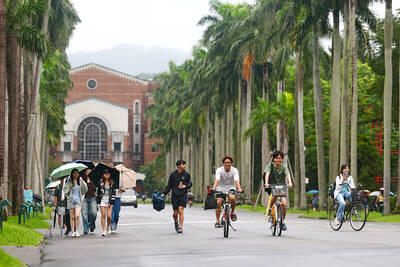
National Taiwan University (NTU) yesterday said it disqualified a person from an entrance examination for using AI smart glasses to cheat, along with two others for making untruthful statements in their curriculum vitae. The three applicants were given null scores, Taiwan’s highest-ranked university said, calling on prospective students to be honest in the admissions process. NTU registrar Lee Hung-sen (李宏森) said that the cheating applicant wore a hat and thick-rimmed glasses to the second written exam for medical school, claiming that they felt cold. Suspicions were aroused when the applicant stared oddly at the test for long stretches while steadily bringing the paper
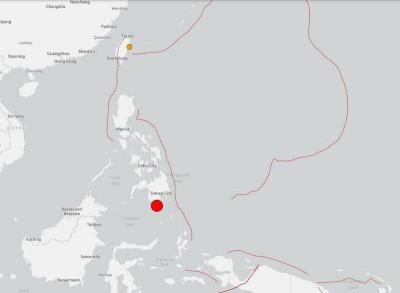
A magnitude 7.8 earthquake struck off the southern coast of Mindanao in the Philippines at 7:38am today, prompting the US Tsunami Warning System to issue an alert for neighboring countries, including Taiwan. The system issued a purple alert indicating a "tsunami threat." The potential threat zone includes Taiwan, the Philippines, Papua New Guinea, Yap and Palau. Philippine authorities were assessing the damage from the quake, with the office of civil defense seeking to verifying initial reports that 15 people had been killed and 129 injured in the region, mostly from falling debris. Arlene Hollero, disaster chief of Maasim town in the Philippines' Sarangani Province,

‘GRAY ZONE’ PRESSURE: Beijing’s activities are intended to create the deceitful impression that China has jurisdiction over the area around Taiwan, the CGA said Taiwan’s rights over its territorial waters and exclusive economic zone must not be violated by any country, the Mainland Affairs Council said yesterday, adding that it will not accept any unprovoked actions. The council issued the remarks in response to the China Coast Guard conducting maritime enforcement drills near eastern Taiwan and claiming to fully exercise China’s maritime administrative law enforcement authority. The Coast Guard Administration (CGA) has been closely monitoring the situation and is taking concrete steps to defend the nation’s sovereignty and secure its waters, the council said. China has no sovereign rights over the waters off eastern
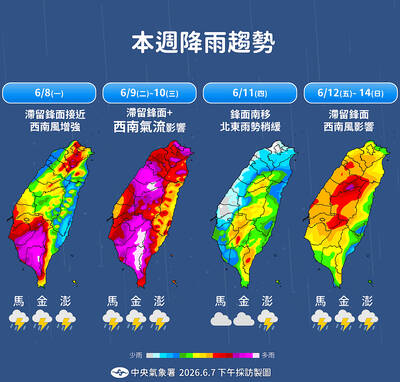
Heavy rain is expected to affect parts of Taiwan this week, the Central Weather Administration (CWA) said yesterday as a meteorologist said the active part of the annual plum rain season has started. A stationary plum rain front and southwesterly winds would bring unstable weather and abundant moisture to Taiwan from today for about a week, with the heaviest rainfall forecast for tomorrow and Wednesday, the CWA said. The agency said western and northeastern Taiwan, and mountainous areas in the east and southeast, could expect showers or thunderstorms on those two days, with localized heavy rain possible. Other parts of


 RSS
RSS