


Americans aren't referred to as Homo consumens for nothing. There is very little they don't understand about the almighty dollar except, perhaps, how to hold onto one.
Even so, as the US Treasury Department prepares to introduce a redesigned US$20 bill on Oct. 9, it isn't taking any chances that confusion over the bill's new look will interfere with commerce. And it is not relying on the standard government approach of public service booklets and brochures to get out the word.
The US Bureau of Engraving and Printing will spend US$33 million on advertising, marketing and education programs to promote the new bill, and it has hired a public relations firm and, in a first, a product placement firm and one of Hollywood's top talent agencies to put the US$20 bill on the publicity circuit. By the time the new bill joins the currency flow next month, it will have appeared virtually everywhere but on the ballot for California's recall election.
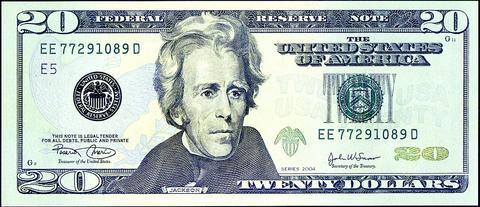
PHOTO: NY TIMES
"We knew we couldn't rely on public service announcements and the news media alone to get the depth of information out about the bill's new design and security features," said Thomas A. Ferguson, the bureau's director.
"We needed to look at different avenues. And we knew from our research that people get a lot of their information from entertainment and television," he said.
The new US$20 bill, which is shaded with peach and blue, is the first US bill since 1905 to come in colors other than green and black. Although the additional color is subtle, it makes the bills more complex and harder to counterfeit, according to the US Secret Service, whose original mission when it was set up in 1865 was to fight counterfeiting.
Former US president Andrew Jackson still graces the front of the US$20 bill with his tousled hair and cape, although he appears to have had some work done around his eyes and chin. His portrait is larger than it is on the current bills, and the oval that has surrounded him for decades has been removed. In addition to the new subtle colors, which prompted comedian David Letterman to crack that the bill had been made over by the guys from Queer Eye for the Straight Guy, the bill also has a large eagle to Jackson's right and a smaller eagle to his left. For enhanced security, there is a plastic security thread embedded in the paper, ink that changes colors when it is tilted in the light (from copper to green instead of the old green to black) and more microprinting, the tiny letters that are difficult to reproduce.
That may sound like a lot of changes, but in many ways the new bill still looks like the traditional bill, which apparently is how Americans prefer it. When the bureau tested bills with more intense colors, like purple and magenta, focus groups thought they looked fake.
"Intuitively, we thought that people would have liked the brighter colors," said Richard I. Mintz, chairman of the public affairs practice of Burson-Marsteller, who is in charge of the campaign for the new currency. "We were wrong. What they wanted was a more subtle change."
Even that may require an adjustment. "People may need a little bit of a heads-up about the new bill because of the color change," said David Robertson, publisher of the Nilson Report, a trade journal for people who work with consumer payment systems. "But I think the public will readily accept the bill, and it will quickly go from ooh-ah to ho-hum."
It's the ooh-ah stage that the US Treasury Department and its Hollywood agents are looking to exploit by lobbying the pop culture world for as much free exposure as possible.
The bill has already made appearances on the game shows Wheel of Fortune and Pepsi Play for a Billion, where its new look and security features were talked up. Jay Leno, David Letterman and other late-night talk-show hosts have been poking fun at it -- which is exactly what the William Morris Agency was hoping for when it discussed the new bill months ago with the shows' writers.
During the introduction week, the bill is likely to be featured on many news and entertainment programs just because it's newsworthy. But it will also have a starring role on Who Wants to Be a Millionaire, with hundreds of new US$20 bills doled out to audience members, and Meredith Vieira, the host, explaining the bills and waving them in front of the camera. The bill will get a category of questions on Jeopardy and will pop up on America's Funniest Home Videos. In one of several joint marketing efforts between the US Treasury Department and consumer goods companies, the bill's design will grace bags of Pepperidge Farm's Goldfish crackers, and the crackers themselves will be colored to match the new bills. Images of the new note will pop up on thousands of ATMs, and the bill will even be superimposed electronically on the field during college football games on ESPN and Monday Night Football on ABC.
For the US$12 million the government is spending on print and television advertising for the bill, it shopped around among America's largest media companies, including Viacom, Walt Disney and Time Warner, to see which would give the bill the most exposure on their entertainment shows in return for the advertising dollars. Disney, which owns ABC and ESPN among other cable networks, made the best offer, Mintz said.
The goal of all this is relatively simple. "We want to build awareness -- then we can begin to change behavior," he said. The behavior that he wants to change includes stuffing the US$20 bill, the most frequently counterfeited in the US, into a pocket or cash register before checking its authenticity by, say, holding it up to a light or feeling for the security thread.
The entertainment and advertising blitz is part of a five-year campaign meant to introduce the world to the US$20 bill, and later to color versions of the US$50 and US$100 bills. Campaigns for those bills will be less elaborate and focus more on foreign countries, where those bills are the most popular. (Foreigners need to be reassured, for example, that their old bills have not been devalued.)
In the US, a half-million businesses and organizations have received elaborate information and training kits that will be used to bring employees up to speed. The US Treasury Department has also sent information to schools and retail outlets.
"This is a product that everyone uses every day," said James Lake, client managing partner for Burson-Marsteller. "When you change it and you don't explain it, the lessons you learn are pretty clear."
The US Treasury Department itself learned some of those lessons in 1996, the last time it changed the look of the currency. Tens of thousands of vending machines in post offices and train and subway stations hadn't been set up to accept the revised version, Lake said, and cashiers and other money handlers didn't always know what to make of the new money. Overseas, some consumers panicked, thinking that their old dollars would be worthless. Such confusion not only hurts sales for retailers, but can also give counterfeiters a wider berth to exploit the chaos.
Only one in every 10,000 bills of all denominations is a fake, according to the US Secret Service. But the criminals are gaining. "The old traditional methods required a high degree of skill," said Jean Mitchell, a spokeswoman for the US Secret Service. "We see that diminishing."
As technology becomes more sophisticated, counterfeiters now have easy access to fast and inexpensive digital printers and scanners. In 1995, digitally produced bills accounted for only 1 percent of counterfeit bills; last year, that share was nearly 40 percent, including some dashed off with printers in college dorms to pay pizza delivery men.
To stay ahead of counterfeiters, the US Treasury Department plans to make changes to the currency every seven to 10 years. That may seem like a lot of effort to guard something that most Americans use less and less each year.
Last year, Americans used cash for just 19 percent of their US$5.4 trillion in purchases, versus 25 percent in 1990, according to the Nilson Report. By 2020, as little as 10 percent of payments will be in cash, Robertson said.
There is still plenty of cash around, of course: US$2,178 for every man, woman and child, according to the Federal Reserve. And the number could get a little bump once the new colorful money appears. The Fed says it will print millions of new bills for the holiday season, in anticipation of a peach-and-blue Christmas.

ROLLER-COASTER RIDE: More than five earthquakes ranging from magnitude 4.4 to 5.5 on the Richter scale shook eastern Taiwan in rapid succession yesterday afternoon Back-to-back weather fronts are forecast to hit Taiwan this week, resulting in rain across the nation in the coming days, the Central Weather Administration said yesterday, as it also warned residents in mountainous regions to be wary of landslides and rockfalls. As the first front approached, sporadic rainfall began in central and northern parts of Taiwan yesterday, the agency said, adding that rain is forecast to intensify in those regions today, while brief showers would also affect other parts of the nation. A second weather system is forecast to arrive on Thursday, bringing additional rain to the whole nation until Sunday, it
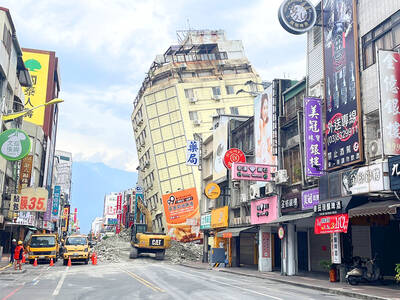
LANDSLIDES POSSIBLE: The agency advised the public to avoid visiting mountainous regions due to more expected aftershocks and rainfall from a series of weather fronts A series of earthquakes over the past few days were likely aftershocks of the April 3 earthquake in Hualien County, with further aftershocks to be expected for up to a year, the Central Weather Administration (CWA) said yesterday. Based on the nation’s experience after the quake on Sept. 21, 1999, more aftershocks are possible over the next six months to a year, the agency said. A total of 103 earthquakes of magnitude 4 on the local magnitude scale or higher hit Hualien County from 5:08pm on Monday to 10:27am yesterday, with 27 of them exceeding magnitude 5. They included two, of magnitude
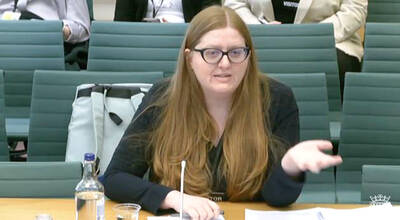
CONDITIONAL: The PRC imposes secret requirements that the funding it provides cannot be spent in states with diplomatic relations with Taiwan, Emma Reilly said China has been bribing UN officials to obtain “special benefits” and to block funding from countries that have diplomatic ties with Taiwan, a former UN employee told the British House of Commons on Tuesday. At a House of Commons Foreign Affairs Committee hearing into “international relations within the multilateral system,” former Office of the UN High Commissioner for Human Rights (OHCHR) employee Emma Reilly said in a written statement that “Beijing paid bribes to the two successive Presidents of the [UN] General Assembly” during the two-year negotiation of the Sustainable Development Goals. Another way China exercises influence within the UN Secretariat is
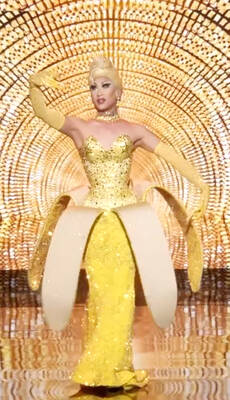
Taiwan’s first drag queen to compete on the internationally acclaimed RuPaul’s Drag Race, Nymphia Wind (妮妃雅), was on Friday crowned the “Next Drag Superstar.” Dressed in a sparkling banana dress, Nymphia Wind swept onto the stage for the final, and stole the show. “Taiwan this is for you,” she said right after show host RuPaul announced her as the winner. “To those who feel like they don’t belong, just remember to live fearlessly and to live their truth,” she said on stage. One of the frontrunners for the past 15 episodes, the 28-year-old breezed through to the final after weeks of showcasing her unique


 RSS
RSS