


Roy Neuberger, 99, paid US$800 in 1950 for a canvas a struggling artist had splattered with paint. The artist was Jackson Pollock. The painting is now worth US$50 million, art experts say.
Neuberger, founder of money managers Neuberger Berman Inc, has bought and sold millions of dollars worth of stock for 73 years. He sold his shares in the company when it went public in 1999, though he says he'll never sell his Pollock. Or any of the other 1,000 paintings he bought since the 1930s, which have established him as a major figure in American art.
"It would be a criminal act for me to sell," Neuberger said in an interview. "Stocks fluctuate and I have no difficulty buying or selling. In art I buy because I love the work." Neuberger became a collector in an era when patrons like financier Joseph Hirshhorn and oil magnate John Paul Getty, among others, vied to buy important works of art. Today, the Hirshhorn Museum is part of the Smithsonian Institution in Washington and the J. Paul Getty Museum is a Los Angeles tourist attraction.
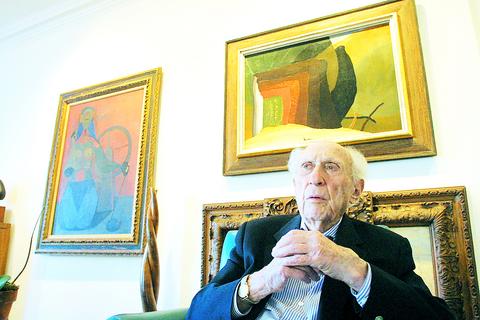
The 180cm-by-100cm Pollock, Number 8, 1949, now hangs in the Neuberger Museum in Purchase, New York, and may fetch as much as US$50 million, said Matthew Carey-Williams, vice president of auctioneers Sotheby's Holdings Inc's contemporary department.
"His collection was actually very risky," said Barbara Haskell, curator of early 20th Century American art at New York's Whitney Museum of American Art, to which Neuberger has donated 32 works. "He purchased work that was not well recognized by the establishment or even among members of the art world. Now, they're assured masters in the canon of American art." In his new book The Passionate Collector: Eighty Years in the World of Art, (John Wiley & Sons, 2003), Neuberger traces his interest to when he was 18 and studied art.
"I discovered that I would never be a first-rate painter," he writes. "But I discovered that I loved art and had a good eye for it." Instead, he started buying art, and helped create two generations of serious art collectors by virtue of his example, said Bruce Ferguson, dean of Columbia University's School of the Arts.
"He's one of the great collectors of a generation that believed art was critical to human development," Ferguson said.
"Then he led the way in making certain that other business people believed it as well." Orphaned at 12, Neuberger was a New York University dropout working in a department store when he decided, in 1924, to take some of his US$30,000 inheritance and go to Paris. He stayed five years, worked for a decorating firm and visited the Louvre three times a week.
Then he read a biography of Vincent Van Gogh that changed his life, relating how few works the painter sold in his own lifetime.
"That aroused my youthful passion," Neuberger said. "I resolved to go back to America, to make a fortune and to buy the work of unknown living artists." Neuberger made it his mission to support artists so their work was viewed while they were alive, he said.
In 1929, he returned and began work on Wall Street -- two months before the stock market crash. He survived, partly through short sales of borrowed stock that he later replaced with shares bought at a lower price.
He founded Neuberger Berman in 1939. Sixty years later, the firm went public with a market value of US$1.65 billion when it sold 7.25 million shares -- 14 percent of the company's stock -- at US$32 for US$232 million.
At the time, Neuberger held 192,000 shares, said Andrea Trachtenberg, a company spokeswoman. Neuberger said he sold his own shares and retained those earmarked for his three children.
Though no longer an employee, Neuberger still went to the office most days to manage his own funds. After back surgery in August, he now trades almost daily from home.
The company reported income of US$119.13 million on revenue of US$603.36 million for last year. The stock rose 44 cents yesterday to US$28.54 on the New York Stock Exchange.
Neuberger's first art purchases, in 1938, were two paintings by Peter Hurd, stepbrother of artist Andrew Wyeth. He frequented New York galleries every Saturday, buying something almost every week from the 1940s to the 1960s, said Lucinda Gedeon, director of the Neuberger Museum.
"He was always looking," she said. "He went to all the major openings. He was very much a part of the scene, and very well acquainted with the dealers." Neuberger, an early champion of Milton Avery, became the American painter's largest single collector. "I looked at the work of Henri Matisse, and I believed that Milton Avery was comparable," said Neuberger.
He owns at least 200 works by Avery. Two hang side-by-side in his seven-room apartment in the Pierre Hotel, as do other works by Alexander Calder and Adolph Gottlieb. His larger collection of American artists includes Georgia O'Keeffe, Edward Hopper and Willem de Kooning.
Neuberger provided 14 paintings by Jacob Lawrence that were the centerpiece of a retrospective of the African-American artist's work at the Whitney in New York last year.
In a way, his life on Wall Street was almost "a second career," Neuberger said. He bought art to hang in his company's offices, helping pioneer what became a common practice.
"It was known that there was art in the offices, before the days of widespread corporate collections," said Avis Berman, an art historian and specialist in American art. In 1990, Neuberger Berman used company funds to establish its own collection of work by emerging American artists.
Instead of selling art, Neuberger donated hundreds of works to museums such as the Metropolitan Museum of Art and Museum of Modern Art in New York, as well as the Whitney.
The bulk of his collection -- about 800 pieces -- is owned by the Neuberger Museum on the campus of the State University of New York at Purchase. He has promised the museum another 200 works, Gedeon said.
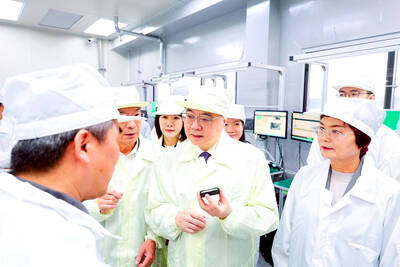
KEY INDUSTRY: The vice premier discussed a plan to create a non-red drone supply chain by next year, which has been allocated a budget of more than NT$7.2 billion The government has budgeted NT$44.2 billion (US$1.38 billion) to cultivate Taiwan’s uncrewed aerial vehicle (UAV) industry over the next five years, which would make the nation a major player in the industry’s democratic supply chain in the Asia-Pacific region, Premier Cho Jung-tai (卓榮泰) said yesterday. Cho made the remarks during a visit to the facilities of Cub Elecparts Inc (為升電裝). Democratic Progressive Party (DPP) Legislator Chen Su-yueh (陳素月) and Chinese Nationalist Party (KMT) Legislator Hsieh Yi-fong (謝依鳳) also participated in the trip. Cub Elecparts has transitioned from the automotive industry to the defense industry, which is the top priority among the nation’s
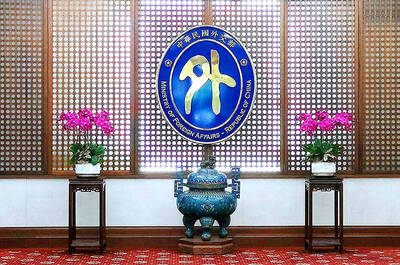
SOUTH KOREA DISPUTE: If Seoul continues to ignore its request, Taiwan would change South Korea’s designation on its arrival cards, the foreign ministry said If South Korea does not reply appropriately to a request to correct Taiwan’s name on its e-Arrival card system before March 31, the government would take corresponding measures to change how South Korea is labeled on the online Taiwan Arrival Card system, the Ministry of Foreign Affairs said yesterday. South Korea’s e-Arrival card system lists Taiwan as “China (Taiwan)” in the “point of departure” and “next destination” fields. Taipei has asked Seoul to change the wording. Since March 1, South Koreans who hold government-issued Alien Resident Certificates (ARC) have been identified as from “South Korea” rather than the “Republic of Korea,” the
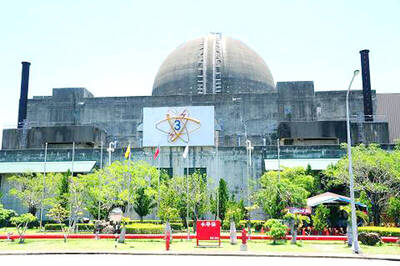
SUFFICIENT: The president said Taiwan has enough oil for next month, with reserves covering more than 100 days and natural gas enough for 12 to 14 days A restart plan for the Guosheng Nuclear Power Plant in New Taipei City’s Wanli District (萬里) and the Ma-anshan Nuclear Power Plant in Pingtung County’s Hengchun Township (恆春) would be submitted to the Nuclear Safety Commission by the end of the month, President William Lai (賴清德) said yesterday, reversing the government’s policy to abolish nuclear energy. On May 17 last year, Taiwan shut down its last nuclear reactor and became the first non-nuclear nation in East Asia, fulfilling the Democratic Progressive Party (DPP) government’s pledge of a “nuclear-free homeland.” Even without nuclear power, Taiwan can maintain a stable electricity supply until 2032,
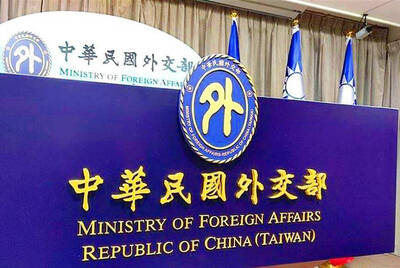
DEROGATORY: WTO host Cameroon’s designation of Taiwan as a ‘province of China’ seriously undermines the nation’s status and rights as a WTO member, MOFA said The Ministry of Foreign Affairs (MOFA) yesterday condemned Cameroon for listing Taiwan as “Taiwan, Province of China” in visa documents for an upcoming WTO ministerial conference, a move that led to Taiwan’s withdrawal from the event. The designation “seriously undermined” Taiwan’s status and rights as a WTO member, the ministry said in a statement. It is the first time since 2001 that Taiwan has declined to attend a WTO Ministerial Conference. The conference is scheduled to take place from Thursday to Sunday next week in Yaounde, the capital of Cameroon. Taiwan had planned to send a delegation led by Minister Without Portfolio


 RSS
RSS