


If Alan Greenspan is on the same weekly distribution lists that I am (his e-mail address is probably top secret, not to be dispensed randomly to the hoi polloi), he was probably struck by two graphs in Wall Street's economic research.
Based on the one-picture-worth-a-thousand-words doctrine, Salomon Smith Barney's "Comments on Credit" produced a graph of real retail sales and manufacturing production, which is a real measure computed and reported by the Federal Reserve every month.
The two series rarely stray far from one another. In the last two years, however, the gap between the two lines has become wide enough to steer the USS Nimitz through with the captain three sheets to the wind. Real retail sales have increased by 8 percent while manufacturing output has fallen 5 percent.
"Given the degree of the shortfall in output, we've tried to tell people we don't need strong demand to get strong growth," says Salomon economist Bob DiClemente.
That's the counter-argument to the one being promulgated by Fed Chairman Alan Greenspan. Greenspan's been telling anyone who would listen that the impetus to the growth from inventories -- from aggressive inventory de-stocking to a slower pace of drawdown or even accumulation -- will be short-lived unless final demand sees a sustained increase.
DiClemente says nonsense. US manufacturers have a long way to go just to meet consumer demand. Output has to exceed demand if producers want to replenish inventories so as not to risk losing sales to foreign companies.
As it happens, final demand, or final domestic demand, which is the only thing the Fed can influence, isn't doing too shabbily.
Real final sales to domestic purchasers rose 3.7 percent in the first quarter following the fourth quarter's 3.9 percent rise.
Together, the two quarters represent the strongest back-to-back increases since the first half of 2000.
DiClemente suspects Greenspan has seen his graph of retail sales and manufacturing output; at least he's seen the concept of the gaping divide between the two.
"I think Greenspan's more optimistic than he lets on publicly," DiClemente says. "If there's any kind of problem in the economy with 1 to 2 percent interest rates, the Fed is faced with all kinds of unconventional policy choices. Better to cushion the economy monetarily for the moment."
The companion graph to the Solly snapshot of retail sales and manufacturing output is one of capacity growth, published by Henry Willmore, senior US economist at Barclays Capital Group. The growth of industrial capacity has slowed to crawl speed -- 1 percent -- in the last year from a 5-plus percent rate in 1995 to 1998, Willmore says.
"The deceleration is partly due to the decline in business fixed investment that began in the first quarter of 2001," he says. "However, the growth rate started to slow in late 1998."
The slowdown in investment is only half the story. The other part is the accelerating rate of depreciation of the capital stock. Willmore says the rate of depreciation, or how quickly the capital stock wears out or becomes obsolete, accelerated by 30 percent since 1990. Which means that "investment must now be over 30 percent higher to maintain a given capital stock than was the case in 1990," he says.
Yesterday's heavy industrial equipment had a much longer life than today's personal computer, as determined by the Bureau of Economic Analysis. Twenty years ago, the capital stock depreciated 3.6 percent a year; today it's 4.4 percent, according to Willmore.
For equipment and software, those rates are 14 percent and 17 percent, respectively.
With the capital stock depreciating so rapidly and investment declining, the rate of investment "is barely adequate to prevent an outright decline in capacity," Willmore says. Add to that the pick-up in industrial output, which is up an annualized 5.5 percent in the first four months of the year, and all the pieces, not to mention both graphs, start to fit together.
If industrial production maintains its rate of growth for the entire year, which DiClemente's chart suggests is likely, and capacity growth remains sluggish, the capacity utilization rate will rise 4 percentage points, "bringing it back to a level close to historical averages by early next year," Willmore says.
If excess capacity is a problem, there's more than one way to skin that cat.

National Taiwan University (NTU) yesterday said it disqualified a person from an entrance examination for using AI smart glasses to cheat, along with two others for making untruthful statements in their curriculum vitae. The three applicants were given null scores, Taiwan’s highest-ranked university said, calling on prospective students to be honest in the admissions process. NTU registrar Lee Hung-sen (李宏森) said that the cheating applicant wore a hat and thick-rimmed glasses to the second written exam for medical school, claiming that they felt cold. Suspicions were aroused when the applicant stared oddly at the test for long stretches while steadily bringing the paper
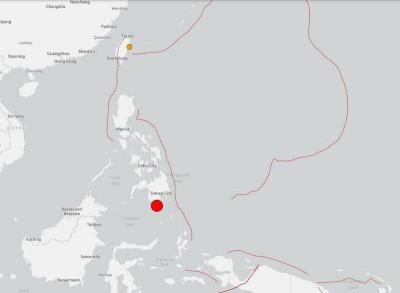
A magnitude 7.8 earthquake struck off the southern coast of Mindanao in the Philippines at 7:38am today, prompting the US Tsunami Warning System to issue an alert for neighboring countries, including Taiwan. The system issued a purple alert indicating a "tsunami threat." The potential threat zone includes Taiwan, the Philippines, Papua New Guinea, Yap and Palau. Philippine authorities were assessing the damage from the quake, with the office of civil defense seeking to verifying initial reports that 15 people had been killed and 129 injured in the region, mostly from falling debris. Arlene Hollero, disaster chief of Maasim town in the Philippines' Sarangani Province,

‘GRAY ZONE’ PRESSURE: Beijing’s activities are intended to create the deceitful impression that China has jurisdiction over the area around Taiwan, the CGA said Taiwan’s rights over its territorial waters and exclusive economic zone must not be violated by any country, the Mainland Affairs Council said yesterday, adding that it will not accept any unprovoked actions. The council issued the remarks in response to the China Coast Guard conducting maritime enforcement drills near eastern Taiwan and claiming to fully exercise China’s maritime administrative law enforcement authority. The Coast Guard Administration (CGA) has been closely monitoring the situation and is taking concrete steps to defend the nation’s sovereignty and secure its waters, the council said. China has no sovereign rights over the waters off eastern
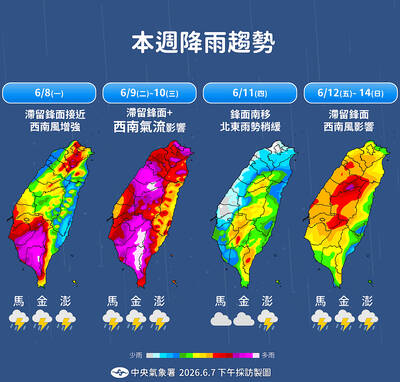
Heavy rain is expected to affect parts of Taiwan this week, the Central Weather Administration (CWA) said yesterday as a meteorologist said the active part of the annual plum rain season has started. A stationary plum rain front and southwesterly winds would bring unstable weather and abundant moisture to Taiwan from today for about a week, with the heaviest rainfall forecast for tomorrow and Wednesday, the CWA said. The agency said western and northeastern Taiwan, and mountainous areas in the east and southeast, could expect showers or thunderstorms on those two days, with localized heavy rain possible. Other parts of


 RSS
RSS