


Financial experts are expressing grave worries about the solvency of China's banking system, which may have a bad-loan problem several times as bad as Japan's.
The head of China's central bank said recently that 25 to 30 percent of all bank loans were not being repaid. On Thursday, the credit-rating agency Standard & Poor's estimated that the situation may be twice that bad, with half of all loans classifiable as nonperforming. And the agency found signs that the banks were busily making matters worse.
PHOTO: NY TIMES
Without a robust banking system, it will be increasingly difficult for China to sustain rapid growth, attract foreign investment and develop the modern economy it needs to provide jobs and maintain social stability at a time of widespread disillusionment with the Communist ideology that united the country for 50 years.
Standard & Poor's warned on Thursday that Chinese banks appeared to be trying to prop themselves up by issuing new loans at a furious pace, in many cases financing vaguely described projects with little discernible effect on China's overall economic output. This approach could yield even more bad loans, and may be creating a financial bubble of wasteful and mismanaged overspending of the kind that led to crises in many other East Asian nations in the late 1990s, according to Terry E.H. Chan, the ratings agency's director for Chinese and Southeast Asian financial institutions.
"Is the bubble building?" Chan asked at a news conference here on Thursday. "We are concerned. Where is the money going?"
Though a few privately owned and foreign banks have gained small footholds, China's banking system is dominated by four giant commercial banks, all state-owned. Questions have arisen periodically for a decade about the banks' viability, mainly because of the evident pressures on them to make uneconomic loans for various political reasons.
Beginning in 1999, the Chinese government sought to resolve these concerns by relieving the four big banks of US$170 billion worth of bad loans -- 12 percent of loans outstanding -- and then writing off the loans or reselling them, following the same general approach that worked for the US after the savings and loan crisis.
But those efforts do not appear to have succeeded, Chinese and Western officials now say. Dai Xianglung, the central bank governor, said in a recent speech that even under the most generous accounting rules, one-quarter of the loans left on the books of the country's banks were nonperforming. New, more stringent rules being introduced will push the figure above 30 percent, other Chinese regulators have said.
The banks are gradually earning profits to offset the bad loans, Dai said in his speech. He called on the banks to get the bad-loan number down to 15 percent within five years.
By comparison, the highest estimates of the bad-loan situation in Japan, where banks have been in desperate straits for a decade and are very slow to write loans off, put the size of the problem at 15 percent or less of outstanding loans.
In the US, banks are much more aggressive about writing off loans on which they are not receiving interest payments. At banks with assets of more than US$1 billion, just 1.5 percent of loans were more than 90 days overdue on Dec. 31, according to data from the Federal Deposit Insurance Corp.
Standard & Poor's is far from alone in its assessment of China's problems. Wei Yen, vice president for Chinese banking at Moody's Investors Service, also say that the bailout has failed. But he was less pessimistic than Standard & Poor's about the potential for Chinese banks to grow their way out of their problems by finding creditworthy new borrowers.
Yen said the four main commercial banks had made considerable progress in centralizing control over lending and in imposing strict risk controls. The goal of these measures is to insulate local branch managers against pressure from local politicians and factory bosses to make ill-considered loans.
"We don't dispute that the Chinese banking system has terrible problems, but if you take a long-term perspective and look at what they have done in the last five or six years, it's tremendous," Yen said, adding that Moody's would soon release its own report.
In the Mao Zedong era, Chinese banks were not businesses in the Western sense. They were conduits for distribution of state subsidies to local enterprises, and for collection of taxes and other contributions to national revenue from those enterprises. How much borrowers received had little to do with how much they repaid.
Beijing tried to put the banks on a commercial footing in 1994 by setting up three new institutions to take over the job of financing big state-owned enterprises, the ones that employed so many people that for the sake of social and political stability they could not be allowed to fail. The commercial banks were supposed to stick to making loans strictly on the financial merits from then on. But they do not appear to have done so.
China plans to open up its banking sector to international competition over the next five years as part of its entry to the WTO, which will put more pressure on domestic banks. Foreign banks now have less than 2 percent of all deposits and loans in China.
The four big domestic commercial banks -- the Bank of China, the China Construction Bank, the Industrial and Commercial Bank of China and the Agricultural Bank of China -- are in various stages of preparing to sell minority stakes to public shareholders, in the hope of raising money to offset their bad loans.
The Bank of China is furthest along, and it had been expected to issue stock this year in China, Hong Kong and possibly New York. But its plans have been set back by several scandals in the last five months involving allegations of fraudulent loans to friends of bank managers.
Chan of Standard & Poor's predicted that the level of bad loans at Chinese banks would discourage international investors from buying any of their shares.
Moody's and Standard & Poor's usually agree on most credit ratings, but they have sharply divergent assessments of the four big banks. Moody's puts all four at Baa-1, three grades above the minimum to qualify as investment grade. But Standard & Poor's does not rate the Agricultural Bank at all, and rates the other three at BB+, a speculative rating four notches below Moody's.

National Taiwan University (NTU) yesterday said it disqualified a person from an entrance examination for using AI smart glasses to cheat, along with two others for making untruthful statements in their curriculum vitae. The three applicants were given null scores, Taiwan’s highest-ranked university said, calling on prospective students to be honest in the admissions process. NTU registrar Lee Hung-sen (李宏森) said that the cheating applicant wore a hat and thick-rimmed glasses to the second written exam for medical school, claiming that they felt cold. Suspicions were aroused when the applicant stared oddly at the test for long stretches while steadily bringing the paper
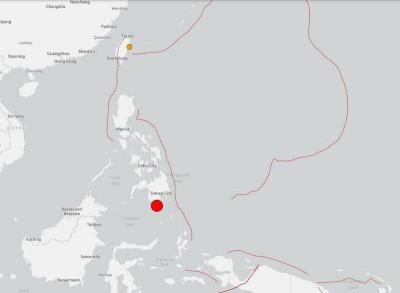
A magnitude 7.8 earthquake struck off the southern coast of Mindanao in the Philippines at 7:38am today, prompting the US Tsunami Warning System to issue an alert for neighboring countries, including Taiwan. The system issued a purple alert indicating a "tsunami threat." The potential threat zone includes Taiwan, the Philippines, Papua New Guinea, Yap and Palau. Philippine authorities were assessing the damage from the quake, with the office of civil defense seeking to verifying initial reports that 15 people had been killed and 129 injured in the region, mostly from falling debris. Arlene Hollero, disaster chief of Maasim town in the Philippines' Sarangani Province,

‘GRAY ZONE’ PRESSURE: Beijing’s activities are intended to create the deceitful impression that China has jurisdiction over the area around Taiwan, the CGA said Taiwan’s rights over its territorial waters and exclusive economic zone must not be violated by any country, the Mainland Affairs Council said yesterday, adding that it will not accept any unprovoked actions. The council issued the remarks in response to the China Coast Guard conducting maritime enforcement drills near eastern Taiwan and claiming to fully exercise China’s maritime administrative law enforcement authority. The Coast Guard Administration (CGA) has been closely monitoring the situation and is taking concrete steps to defend the nation’s sovereignty and secure its waters, the council said. China has no sovereign rights over the waters off eastern
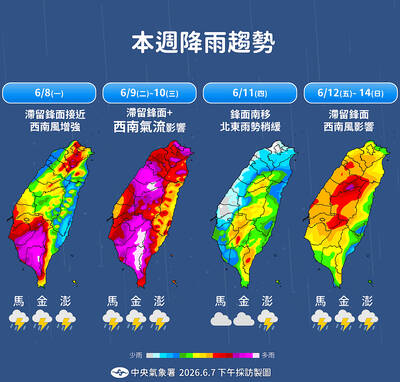
Heavy rain is expected to affect parts of Taiwan this week, the Central Weather Administration (CWA) said yesterday as a meteorologist said the active part of the annual plum rain season has started. A stationary plum rain front and southwesterly winds would bring unstable weather and abundant moisture to Taiwan from today for about a week, with the heaviest rainfall forecast for tomorrow and Wednesday, the CWA said. The agency said western and northeastern Taiwan, and mountainous areas in the east and southeast, could expect showers or thunderstorms on those two days, with localized heavy rain possible. Other parts of


 RSS
RSS