


The fact that Tadashi Okamura wasn't involved in making Toshiba Corp the world's biggest memory-chip maker a decade ago may explain why he was brave enough to scrap the business last year as it slid deeper into losses.
Investors say Okamura's 40 years of experience marketing factory-automation equipment may not help much in his next big challenge -- finding new sources of revenue.

PHOTO: AFP
Toshiba needs to regain its competitive edge in the semiconductor industry with new chips, become a leading brand in digital consumer electronics and reverse a decline in finances that's seen its credit rating slip, they say.
"Not knowing about chips made Okamura a messiah -- he's really trying to reform," said Hiroyoshi Nakagawa, chief investment officer at SG Yamaichi Asset Management Co, which holds US$21 billion in assets including Toshiba shares. His bigger challenge, he adds, "is to show investors how Toshiba can come up with strong products."
Toshiba said Thursday its group loss was a lower-than-expected Japanese yen 46 billion (US$355 million) in the three months ended March 31, compared with Japanese yen 31 billion net income a year earlier. Toshiba's memory-chip unit probably had a US$1 billion loss in the fiscal year.
Okamura, an ex-rugby player who likes to read books on how Samurais managed their lands in the 16th century, has spent most of his first two years as president cleaning up Toshiba's house.
Toshiba, which employed 188,000 workers as of March 2001, spent Japanese yen 190 billion last fiscal year to pare its workforce, contributing to an annual loss of Japanese yen 254 billion. The cuts are part of an effort to reduce Toshiba's staff 10 percent by March 2004 and shutter unprofitable factories.
Leaving the memory-chip business would have been a harder decision for executives that experienced the company's glory days.
Toshiba was the biggest producer in the industry between 1989 and 1991, helping Toshiba to post a record profit of Japanese yen 132 billion in the year ended March 1990 and its share price to soar to a record high of Japanese yen 1,470 in June 1989.
The plunge in Toshiba's stock to Wednesday's close of Japanese yen 575 came partly as South Korean and Taiwanese companies piled into the business, producing more chips than the market needed.
The spot price of 128-megabit dynamic random-access memory (DRAM) chips, the main memory in personal computers, plummeted 80 percent to US$1 in November from the beginning of last year. The price has since tripled from the trough to US$3.63.
"It doesn't make sense to keep a business whose earnings are so volatile," Okamura, 63, told Bloomberg News two weeks after announcing the company would sell its US memory-chip unit. "I'm so relieved to terminate the business."
While Okamura announced the sale of Toshiba's US DRAM plant to Micron Technology on Dec. 18, it will still make memory chips for Sony Corp's Playstation 2 game consoles, with the price set at a fixed percentage premium over production costs to guarantee profits.
"Having an exclusive contract with a strong customer like Sony Corp is good," said Sadaji Shibata, general manager at Daiwa Asset Management Co, which manages Japanese equities including Toshiba shares.
"There is no price competition there," he said.
Toshiba's shares jumped 25 percent since the DRAM business sale, outperforming the 13 percent rise of the Topix Electric Appliances Index. Domestic rival Hitachi Ltd's shares rose just 1 percent.
For the stock to rise further, investors say, Okamura needs to push out new products that can gain a top-three market share.
Finding focus will be hard, investors say, since Toshiba makes everything from notebook computers, semiconductors, elevators, vacuum cleaners and electric power plant equipment, to liquid-crystal displays.
"Toshiba doesn't have a core business," said Fumiaki Sato, an analyst at Deutsche Securities Ltd, who rates Toshiba's shares "underperform." "It's not clear what Toshiba wants to strengthen."
Okamura has already started sifting through the product range. Toshiba stopped producing CD-ROM disk drives at its Philippines plant in December last year. He shifted production of cathode-ray tube monitors for PCs and televisions from Japan to Thailand and China. The company may build a large-scale factory in China that would make Dynabook laptop PCs and digital consumer electronics.
Okamura also decided to merge Toshiba's LCD business with that of Matsushita Electric Industrial Co to cut development and production costs and compete with South Korean rivals such as Samsung Electronics Ltd.
He's expanding other areas. Toshiba, Sony and International Business Machines Corp said they will together develop processor chips for digital consumer electronics such as DVD players.
Toshiba already makes processor chips for PlayStation 2, dubbed emotion engines, with Sony.
"Okamura's on the right track, but he has to do more," Daiwa's Shibata said.
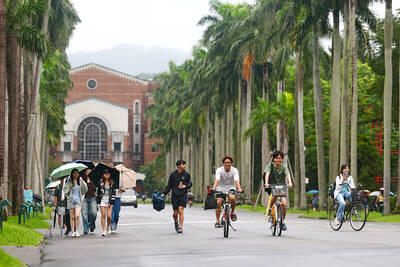
National Taiwan University (NTU) yesterday said it disqualified a person from an entrance examination for using AI smart glasses to cheat, along with two others for making untruthful statements in their curriculum vitae. The three applicants were given null scores, Taiwan’s highest-ranked university said, calling on prospective students to be honest in the admissions process. NTU registrar Lee Hung-sen (李宏森) said that the cheating applicant wore a hat and thick-rimmed glasses to the second written exam for medical school, claiming that they felt cold. Suspicions were aroused when the applicant stared oddly at the test for long stretches while steadily bringing the paper
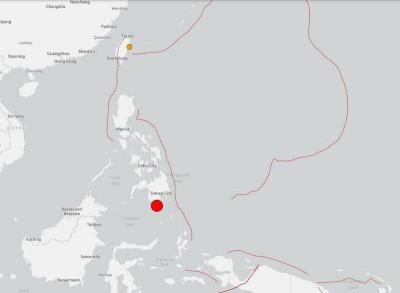
A magnitude 7.8 earthquake struck off the southern coast of Mindanao in the Philippines at 7:38am today, prompting the US Tsunami Warning System to issue an alert for neighboring countries, including Taiwan. The system issued a purple alert indicating a "tsunami threat." The potential threat zone includes Taiwan, the Philippines, Papua New Guinea, Yap and Palau. Philippine authorities were assessing the damage from the quake, with the office of civil defense seeking to verifying initial reports that 15 people had been killed and 129 injured in the region, mostly from falling debris. Arlene Hollero, disaster chief of Maasim town in the Philippines' Sarangani Province,
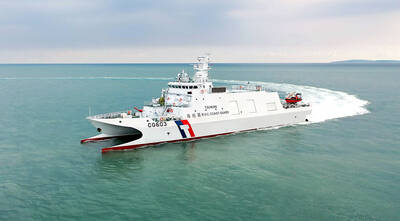
‘GRAY ZONE’ PRESSURE: Beijing’s activities are intended to create the deceitful impression that China has jurisdiction over the area around Taiwan, the CGA said Taiwan’s rights over its territorial waters and exclusive economic zone must not be violated by any country, the Mainland Affairs Council said yesterday, adding that it will not accept any unprovoked actions. The council issued the remarks in response to the China Coast Guard conducting maritime enforcement drills near eastern Taiwan and claiming to fully exercise China’s maritime administrative law enforcement authority. The Coast Guard Administration (CGA) has been closely monitoring the situation and is taking concrete steps to defend the nation’s sovereignty and secure its waters, the council said. China has no sovereign rights over the waters off eastern
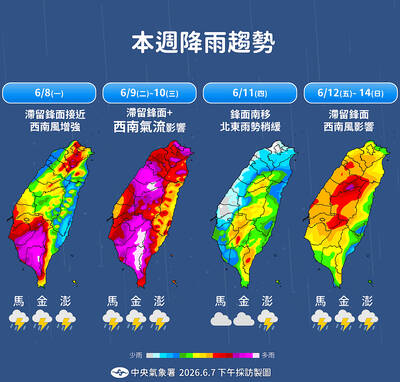
Heavy rain is expected to affect parts of Taiwan this week, the Central Weather Administration (CWA) said yesterday as a meteorologist said the active part of the annual plum rain season has started. A stationary plum rain front and southwesterly winds would bring unstable weather and abundant moisture to Taiwan from today for about a week, with the heaviest rainfall forecast for tomorrow and Wednesday, the CWA said. The agency said western and northeastern Taiwan, and mountainous areas in the east and southeast, could expect showers or thunderstorms on those two days, with localized heavy rain possible. Other parts of


 RSS
RSS